

XBRL Applicability: Criteria & Filing Requirements | Chhota CFO
When is XBRL filing mandatory for Indian companies? Discover the applicability criteria, exemptions, and continuing filing requirements under Rule 3(2).

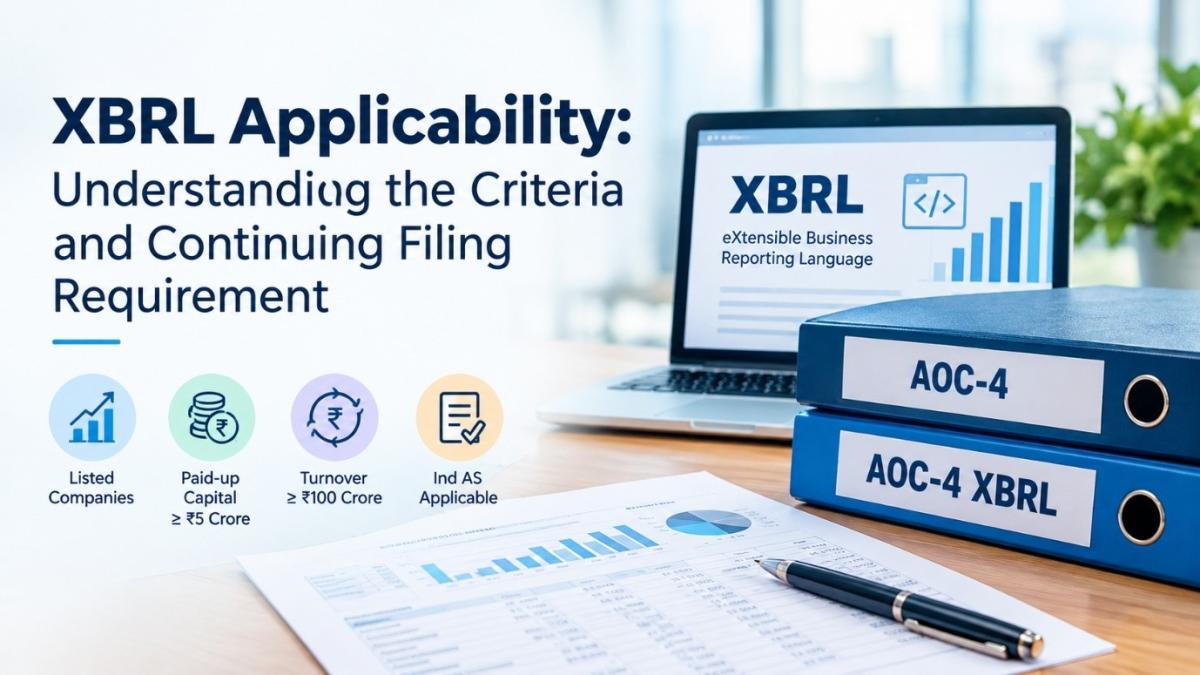
XBRL (eXtensible Business Reporting Language) is a standardised electronic reporting format used for filing financial information with the Ministry of Corporate Affairs (MCA). It enables financial information to be presented in a structured and machine-readable format, facilitating its analysis and comparison.
For companies covered by the applicable provisions, financial statements and prescribed documents are required to be filed with the Registrar of Companies in XBRL format.
Businesses should understand their XBRL filing obligations and continuing compliance requirements to ensure accurate and timely financial reporting. Learn more about our services and expertise at Chhota CFO
Need Help Determining XBRL Applicability?
Unsure whether your company needs to file financial statements in XBRL format? Chhota CFO can help you understand the applicable criteria and identify the compliance requirements relevant to your business.
Contact Chhota CFO for XBRL Compliance Support
Which companies are required to file in XBRL?
The Companies (Filing of Documents and Forms in Extensible Business Reporting Language) Rules, 2015 prescribe the classes of companies required to file financial statements and other documents in XBRL.
Broadly, the applicability includes:
- Companies listed on stock exchanges in India and their Indian subsidiaries;
- Companies having paid-up capital of ₹5 crore or more;
- Companies having turnover of ₹100 crore or more; and
- Companies required to prepare their financial statements in accordance with Ind AS.
Accordingly, XBRL applicability should not be determined solely on the basis of turnover. Meeting any one of the applicable criteria may bring a company within the XBRL requirement, subject to the exclusions prescribed under the Rules.
Certain classes of companies, including specified banking, insurance, NBFC and housing finance companies, are excluded from the applicability of the XBRL provisions, subject to the conditions prescribed under the Rules.
Does XBRL applicability have to be checked every year?
Yes, the company’s position should be reviewed for each financial year. However, there is an important continuing requirement under Rule 3(2).
Where a company has filed its financial statements and other documents under the XBRL provisions, the company is required to continue filing its financial statements and other documents in XBRL in subsequent years, even if it subsequently falls outside the class of companies specified under Rule 3(1).
This is an important distinction.
For example, if a company becomes subject to XBRL because its turnover exceeds ₹100 crore and files its financial statements in XBRL, a subsequent reduction in turnover below ₹100 crore does not, by itself, permit the company to revert to filing its financial statements in the normal AOC-4 format.
Illustration
|
Financial Year |
Turnover |
XBRL Position |
|
FY 2025-26 |
₹120 crore |
XBRL applicable |
|
FY 2026-27 |
₹80 crore |
Continuing XBRL requirement |
|
FY 2027-28 |
₹75 crore |
Continuing XBRL requirement |
The reduction in turnover does not, by itself, discontinue the XBRL requirement where Rule 3(2) applies.
Already Filed in XBRL? Check Your Continuing Compliance Requirements
A reduction in turnover or paid-up capital does not automatically mean your company can stop filing in XBRL. Review your previous filing history and applicable requirements before preparing your annual financial statements.
Get Expert Guidance from Chhota CFO
What should companies check before filing?
Before preparing AOC-4 or AOC-4 XBRL, the company should review:
- Current year applicability under Rule 3(1);
- Whether the company falls under any prescribed exclusion;
- Whether the company has filed financial statements in XBRL in an earlier year; and
- Whether the continuing requirement under Rule 3(2) applies.
This is particularly relevant where there has been a change in turnover, paid-up capital, listing status, Ind AS applicability, or the nature of the company’s business.
Reviewing financial records and compliance procedures can help companies identify reporting gaps before completing their annual filings. Learn more about internal audit and its role in reviewing internal controls.
A common compliance misconception
A company may assume that XBRL is applicable only when turnover crosses ₹100 crore. That is not the complete position.
Similarly, a company that has previously filed in XBRL should not automatically move back to normal AOC-4 merely because its current-year figures fall below one of the applicable thresholds.
XBRL applicability is therefore not merely a current-year threshold test. The company’s previous filing history also needs to be considered.
Why Choose Chhota CFO for XBRL Compliance?
Choosing the correct filing format is an important part of corporate compliance. Chhota CFO can help businesses understand their XBRL filing obligations and approach annual financial reporting with greater clarity.
- XBRL Applicability Guidance: Understand the criteria relevant to your company, including paid-up capital, turnover, listing status, and Ind AS applicability.
- Continuing Compliance Support: Review previous XBRL filing history and understand the continuing requirement under Rule 3(2).
- Filing Requirement Review: Identify applicable requirements and prescribed exclusions before preparing annual financial statement filings.
- Practical Compliance Assistance: Get guidance on determining whether AOC-4 or AOC-4 XBRL is appropriate for your company’s circumstances.
Conclusion
The decision between AOC-4 and AOC-4 XBRL should be made after reviewing both the company’s current applicability and its previous XBRL filing history.
For companies that have already entered the XBRL regime, the continuing requirement under Rule 3(2) is particularly important.
Simplify Your Company’s XBRL Compliance with Chhota CFO
Understanding XBRL applicability involves more than checking current-year turnover. Your company’s paid-up capital, listing status, Ind AS applicability, prescribed exclusions, and previous XBRL filings may also need to be considered.
Connect with Chhota CFO for professional guidance on XBRL applicability and annual filing requirements.










Comments (0)