

Registration of Underwriters with SEBI in India: Regulatory Framework, Eligibility and Compliance
Understand registration of underwriters with SEBI in India, eligibility, regulatory requirements, documentation, fees and compliance obligations.


When a company plans to raise capital through a public issue, it cannot always assume that investors will subscribe to the entire number of securities offered. Market conditions, investor sentiment and the financial position of the company can affect subscription levels. This creates a funding risk for the issuing company.
Underwriting helps address this risk. An underwriter agrees to subscribe to, or arrange subscriptions for, securities that remain unsubscribed after an issue. This commitment provides an additional layer of assurance to the issuer while helping manage the risks associated with raising capital.
In India, underwriting is regulated by the Securities and Exchange Board of India (SEBI). However, the regulatory framework has changed significantly since 2021. Businesses planning to enter this activity must understand the current registration requirements rather than rely on older provisions relating to standalone underwriter registration.
This article explains the registration of underwriters with SEBI in India, including the applicable regulatory framework, eligibility requirements, registration process, documentation, financial requirements and continuing compliance obligations.
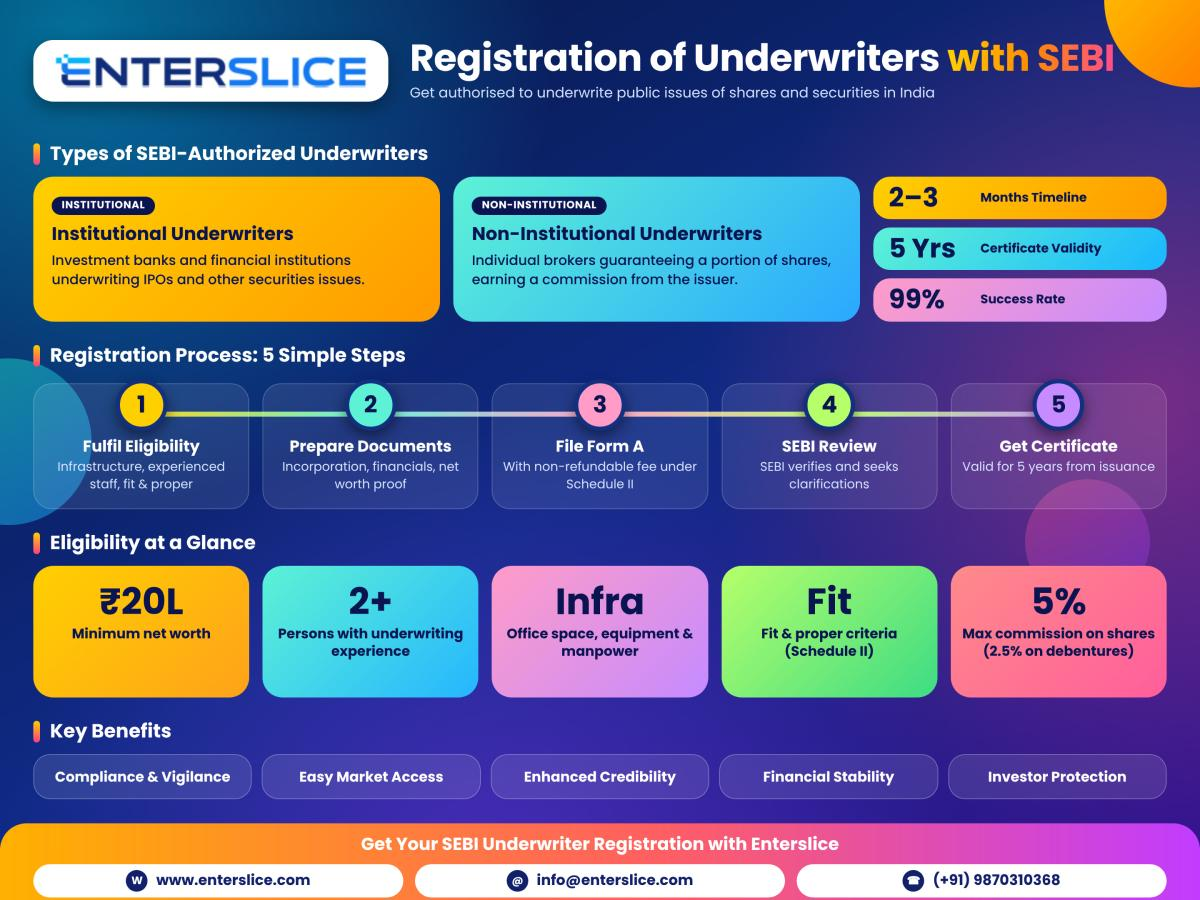
What Is Underwriting in the Indian Securities Market?
Underwriting is an arrangement under which an intermediary agrees to subscribe to or procure subscriptions for securities that remain unsubscribed in an issue.
For example, suppose a company offers 10 lakh equity shares to the public. Investors subscribe to only 8 lakh shares before the issue closes. If the remaining 2 lakh shares fall within an underwriting commitment, the underwriter may be required to subscribe to those shares or arrange their subscription according to the agreement.
The underwriter receives an agreed commission or brokerage for accepting this responsibility.
Underwriting is relevant to several capital-raising transactions, including public issues and other securities offerings where underwriting arrangements are permitted under the applicable SEBI regulations.
An important distinction is that an underwriter does not simply provide investment advice. It assumes a contractual obligation that may result in a financial commitment if the issue is undersubscribed.
Regulatory Framework for Underwriters in India
The Securities and Exchange Board of India Act, 1992 provides the statutory foundation for regulating securities market intermediaries.
Historically, underwriting activities were governed separately under the SEBI (Underwriters) Regulations, 1993. These regulations provided a dedicated registration mechanism for persons intending to operate as underwriters.
However, SEBI introduced a major regulatory change on March 30, 2021.
Through the SEBI (Underwriters) (Repeal) Regulations, 2021, the separate 1993 regulations were repealed. The relevant provisions governing underwriting activities were incorporated into two existing regulatory frameworks:
-
SEBI (Merchant Bankers) Regulations, 1992.
-
SEBI (Stock Brokers) Regulations, 1992.
Consequently, businesses should not treat the old standalone underwriter registration procedure as the current application route.
The appropriate registration depends on the intermediary's proposed business structure and activities. A merchant banker or eligible stockbroker may undertake underwriting activities subject to the applicable regulatory conditions.
The SEBI (Merchant Bankers) (Amendment) Regulations, 2025, effective January 3, 2026, introduced further changes to the merchant banking framework, including revised capital requirements and underwriting exposure limits.
Who Can Undertake Underwriting Activities in India?
An organisation intending to undertake underwriting activities must first identify the applicable SEBI registration category.
1. SEBI-Registered Merchant Bankers
Merchant bankers are important participants in capital market transactions. Their activities include issue management, corporate advisory services and underwriting.
Under the revised Merchant Bankers Regulations, there are two registration categories:
Category I Merchant Banker
A Category I merchant banker can undertake all permitted merchant banking activities, including issue management and underwriting, subject to the applicable regulatory conditions.
Category II Merchant Banker
A Category II merchant banker can undertake permitted merchant banking activities, including underwriting, but cannot manage public issues of equity shares proposed to be listed on the main board of a recognised stock exchange.
The appropriate category should be selected after considering the proposed business activities and financial capacity.
2. SEBI-Registered Stock Brokers
Stockbrokers can also undertake underwriting activities under the amended SEBI Stock Brokers Regulations, 1992.
However, the stockbroker must comply with the applicable registration conditions, stock exchange requirements, capital adequacy standards and other regulatory obligations.
For an existing stockbroker, the proposed underwriting activity should be assessed against its current registration conditions and the relevant exchange framework.
Eligibility Criteria for SEBI Merchant Banker Registration
For an organisation planning to undertake underwriting through the merchant banking route, obtaining merchant banker registration is an important first step.
The revised eligibility framework includes the following requirements.
Legal Structure
The applicant must generally be a body corporate, including a company incorporated under the Companies Act, 2013 or an applicable previous company law, or a limited liability partnership.
The amended regulations provide specific exclusions, including One Person Companies and non-banking financial companies, as well as certain foreign-incorporated entities.
Minimum Net Worth
The revised merchant banker framework prescribes the following minimum net worth requirements:
|
Registration category |
Minimum net worth |
|
Category I |
₹50 crore |
|
Category II |
₹10 crore |
The applicant must also satisfy the prescribed liquid net worth requirements.
Liquid Net Worth
The minimum liquid net worth requirements are:
-
Category I: ₹12.50 crore.
-
Category II: ₹2.50 crore.
These financial requirements are relevant to new applicants from January 3, 2026. Existing merchant bankers have been provided a phased implementation framework by SEBI.
Professional Personnel
The applicant must maintain the required professional workforce with suitable qualifications and experience.
The amended framework requires at least two professionally qualified employees in relevant disciplines, such as finance, law, accountancy or business management, subject to the prescribed conditions.
Principal Officer
The merchant banker must designate a principal officer who has at least five years of experience working in financial markets and is responsible for decisions relating to merchant banking activities and operations.
Fit and Proper Criteria
SEBI examines whether the applicant and relevant persons associated with its management satisfy the applicable fit and proper requirements.
Regulatory history, integrity, financial soundness and other relevant considerations may form part of this assessment.
Registration Procedure for Undertaking Underwriting Activities
The registration process depends on whether the applicant intends to enter the activity through merchant banking or stockbroking.
For a new business choosing the merchant banking route, the process generally involves the following stages.
Step 1: Determine the Appropriate Registration Category
The applicant should evaluate whether Category I or Category II merchant banker registration is appropriate.
This decision should reflect the proposed services, issue management plans, financial resources and intended underwriting activities.
Step 2: Establish the Eligible Business Structure
The applicant must ensure that its legal constitution meets the requirements under the Merchant Bankers Regulations.
The company's constitutional documents and proposed business activities should be reviewed before proceeding with the application.
Step 3: Arrange Capital and Financial Resources
The applicant must demonstrate compliance with the applicable net worth and liquid net worth requirements.
Financial statements, capital structure details and supporting financial records should be prepared to establish the applicant's financial position.
Step 4: Appoint Qualified Personnel
The applicant should appoint the required professional employees and designate a suitable principal officer.
The experience and qualifications of the proposed personnel should be supported by relevant documentary evidence.
Step 5: Prepare the SEBI Application
An application for merchant banker registration must be submitted in Form A under Regulation 3 of the Merchant Bankers Regulations.
The application should include the prescribed information, declarations and supporting documents. The applicable non-refundable application fee must also be paid.
Step 6: Respond to SEBI Queries
SEBI may seek additional information, documents or explanations during the application review.
The applicant should respond accurately and within the specified timelines. Any discrepancy in financial information, business activities or personnel details should be addressed appropriately.
Step 7: Obtain the Registration Certificate
After examining the application and determining that the eligibility requirements have been fulfilled, SEBI may grant the certificate of registration.
The applicant should commence regulated activities only after obtaining the relevant registration and satisfying applicable conditions.
An existing registered intermediary should separately assess whether its proposed underwriting activity is covered by its registration and applicable regulatory permissions.
Documents Required for SEBI Registration
Documentation depends on the intermediary category and the nature of the application. For a merchant banker registration application, the following documents may be relevant:
-
Certificate of incorporation and constitutional documents.
-
Memorandum and Articles of Association, where applicable.
-
LLP incorporation and constitutional documents, where applicable.
-
PAN and registered office details.
-
Details of directors, partners and key managerial personnel.
-
Details of the principal officer and professional employees.
-
Educational qualification certificates and experience records.
-
Audited financial statements.
-
Net worth certificate issued by a practising Chartered Accountant.
-
Details supporting liquid net worth requirements.
-
Organisational structure and proposed business activities.
-
Details of existing regulatory registrations, if any.
-
Fit and proper declarations and relevant disclosures.
-
Internal compliance arrangements and other information required by SEBI.
This list is indicative. The actual application must follow the current Form A, applicable regulations and SEBI's instructions.
Registration Fees and Other Costs
One common source of confusion is the registration fee mentioned in older articles on underwriting.
The former SEBI (Underwriters) Regulations, 1993 contained a separate fee structure. Those provisions should not be presented as the current fee structure for fresh underwriting registration.
Under the present framework, there is no separate standalone underwriter registration fee under the repealed 1993 regulations.
Instead, an applicant must pay the applicable registration and application fees under the relevant intermediary framework.
For merchant banker registration, Regulation 3 and Schedule II of the Merchant Bankers Regulations govern the prescribed application and registration fees. The applicable amounts should be checked against the latest amended schedule and SEBI instructions before filing.
Other costs may include:
-
Professional and legal advisory charges.
-
Company incorporation and documentation expenses.
-
Chartered Accountant certification and financial assessment.
-
Recruitment and remuneration of qualified personnel.
-
Office infrastructure and technology expenses.
-
Internal compliance and audit costs.
The overall expenditure depends on the applicant's existing infrastructure, registration category and readiness to meet SEBI requirements.
Compliance Obligations After Registration
Obtaining registration is only the beginning. An intermediary undertaking underwriting must maintain adequate financial resources and comply with the applicable regulatory framework.
Underwriting Agreements
An underwriter must enter into a written agreement with the issuer. The agreement should clearly specify the underwriting commitment, responsibilities of the parties, agreement period, commission or brokerage and arrangements for fulfilling the obligation.
Underwriting Exposure Limit
Under Regulation 22B of the Merchant Bankers Regulations, as amended, the total underwriting obligations of a merchant banker must not exceed 20 times its liquid net worth.
SEBI's January 2, 2026 circular provides a phased compliance period for existing merchant bankers, with the requirement applicable to them by January 2, 2028.
Merchant bankers are also required to submit a Chartered Accountant's certificate covering their total underwriting obligations as part of the prescribed half-yearly reporting.
Timely Fulfilment of Obligations
Where an underwriter is called upon to subscribe to securities under an underwriting agreement, it must fulfil the commitment in accordance with the applicable regulations and contractual terms.
Books and Records
Proper books of account, transaction records, agreements and supporting documents must be maintained.
The intermediary should ensure that records are accurate, complete and available for regulatory inspection.
Compliance Officer and Regulatory Reporting
The intermediary must maintain the required compliance arrangements, appoint the appropriate compliance personnel and submit applicable periodic reports and disclosures.
It must also follow the relevant code of conduct and cooperate with SEBI inspections or information requests.
Why Professional Guidance Matters
Underwriting involves more than completing a regulatory application. An applicant must assess its financial capacity, legal structure, professional workforce and ability to meet potential subscription commitments.
For example, a financial services company that already provides corporate advisory services may wish to expand into underwriting. Before doing so, it should determine whether its existing SEBI registration permits the proposed activity or whether an additional or different registration is required.
Similarly, an organisation planning to establish a merchant banking business must assess the revised capital and liquid net worth requirements before committing resources to the registration process.
An incorrect assessment at this stage can result in unnecessary expenditure, application delays or regulatory complications.
How Enterslice Can Assist
Businesses planning to enter India's securities market need to understand the regulatory route before starting their operations. The registration category, capital requirements, documentation and ongoing obligations should be evaluated together.
Enterslice assists businesses with regulatory advisory, SEBI registration-related documentation, eligibility assessment and compliance support. Organisations exploring merchant banking or underwriting activities can seek professional assistance to understand the applicable framework and prepare their registration requirements.
Most popular services :



Comments (0)