

Pharmaceutical Chemicals Market Revenue Forecast Points to USD 240.33 Billion by 2034
The global pharmaceutical chemicals market size was valued at USD 134.07 billion in 2025

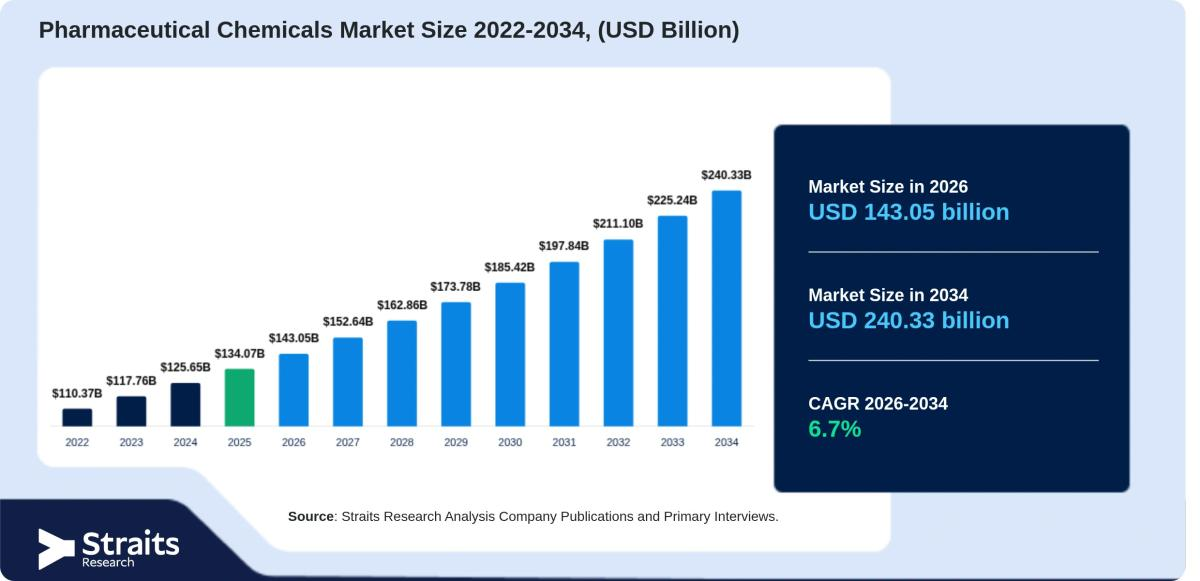
Pharmaceutical Chemicals Market Size, Forecast to 2034
The global pharmaceutical chemicals market size was valued at USD 134.07 billion in 2025 and is projected to grow from USD 143.05 billion in 2026 to USD 240.33 billion by 2034, registering a CAGR of 6.7% during the forecast period from 2026 to 2034. North America dominated the pharmaceutical chemicals market in 2025, accounting for 36.8% of the global market.
Market Drivers
Increasing Demand for Generic Medicines
The rising demand for affordable medicines is encouraging pharmaceutical manufacturers to expand generic drug production, strengthening demand for active pharmaceutical ingredients (APIs), intermediates, and excipients. Patent expirations of branded medicines create opportunities for generic manufacturers to introduce lower-cost alternatives, increasing the need for reliable supplies of pharmaceutical chemicals. Expanding access to essential medicines across emerging economies further contributes to market demand.
Expansion of Biopharmaceutical Research and Development
Advancements in biotechnology are increasing demand for specialized chemicals used in the development and production of biologics, biosimilars, and other complex therapies. Pharmaceutical companies require high-purity ingredients and intermediates to support drug formulation, process development, and manufacturing consistency. Investment in targeted therapies and innovative treatment platforms is also encouraging suppliers to develop chemicals suited to more complex pharmaceutical applications.
Growing Adoption of Sustainable Chemical Manufacturing
Environmental regulations and sustainability objectives are encouraging pharmaceutical manufacturers to adopt greener chemical processes. Technologies that reduce solvent consumption, minimize waste, and improve energy efficiency can help companies manage production costs and environmental impact. This shift is creating opportunities for suppliers that provide sustainable synthesis methods, alternative solvents, and more efficient pharmaceutical chemical solutions.
Market Challenges
Stringent Regulatory and Quality Requirements
Pharmaceutical chemicals must meet strict quality, purity, and consistency requirements because variations can affect the safety and effectiveness of finished medicines. Manufacturers must maintain validated processes, detailed documentation, and robust quality-control systems to meet applicable regulatory standards. Compliance investments and the time required to qualify suppliers can increase operating costs and delay product commercialization.
Volatility in Raw Material Costs
Fluctuations in the prices and availability of chemical feedstocks, solvents, and specialty intermediates can affect production economics. Dependence on geographically concentrated suppliers and international logistics exposes manufacturers to supply disruptions and cost pressures. These factors can complicate procurement planning and reduce margins, particularly for producers operating under fixed-price supply agreements.
Complexity in Manufacturing High-Purity Chemicals
The production of pharmaceutical-grade chemicals requires precise process control, specialized equipment, and rigorous contamination management. Complex molecules and high-potency ingredients may require advanced containment systems and specialized technical expertise. These requirements can increase capital expenditure and make capacity expansion more difficult for smaller manufacturers.
Market Segmentation
The pharmaceutical chemicals market is segmented by:
-
By Product: Active pharmaceutical ingredients (APIs), pharmaceutical excipients, pharmaceutical intermediates
-
By Type: Proprietary, non-proprietary
-
By Application: Pharmaceutical manufacturing, research and development (R&D)
-
By End-User: Pharmaceutical companies, biotech companies, contract manufacturing organizations (CMOs), contract research organizations (CROs), others
-
By Region: North America, Europe, Asia Pacific, Middle East and Africa, Latin America
Regional Insights
North America Pharmaceutical Chemicals Market Analysis
North America held the largest share of the pharmaceutical chemicals market in 2025, supported by an established pharmaceutical industry, advanced research infrastructure, and substantial investment in drug development. Demand for high-purity APIs, specialty intermediates, and formulation ingredients is reinforced by biotechnology innovation and the development of complex therapies. Regulatory compliance and supply-chain reliability remain important considerations for regional manufacturers.
Europe Pharmaceutical Chemicals Market Analysis
Europe's pharmaceutical chemicals market benefits from its established pharmaceutical manufacturing base, chemical engineering expertise, and research capabilities. Demand for APIs, intermediates, and excipients is driven by branded medicine production, generic drug manufacturing, and biotechnology research. Environmental requirements are also encouraging manufacturers to improve production efficiency and adopt cleaner chemical processes.
Asia Pacific Pharmaceutical Chemicals Market Analysis
Asia Pacific is expected to be the fastest-growing regional market, driven by expanding pharmaceutical manufacturing capacity, increasing demand for generic medicines, and competitive production capabilities. China and India are important suppliers of APIs and pharmaceutical intermediates, while Japan and South Korea contribute through advanced pharmaceutical research and specialized chemical production. Investments in domestic manufacturing and supply-chain diversification are further strengthening the region's position.
Middle East and Africa Pharmaceutical Chemicals Market Analysis
The Middle East and Africa market is developing alongside investments in pharmaceutical manufacturing, healthcare infrastructure, and local medicine production. Demand for pharmaceutical chemicals is encouraged by efforts to improve access to medicines and reduce reliance on imported finished products. However, limited specialized manufacturing capacity and dependence on imported raw materials can constrain market expansion in some countries.
Latin America Pharmaceutical Chemicals Market Analysis
Latin America's pharmaceutical chemicals market is shaped by demand for generic medicines, domestic drug manufacturing, and healthcare expansion. Brazil and Mexico offer important opportunities due to their established pharmaceutical sectors and demand for locally manufactured medicines. Reliable sourcing, regulatory compliance, and investment in production capabilities remain central to strengthening the regional supply chain.
Key Players Analysis
The pharmaceutical chemicals market comprises large chemical manufacturers, specialized API suppliers, and companies providing intermediates and pharmaceutical-grade formulation ingredients. Established players compete through product quality, manufacturing scale, regulatory compliance, technical expertise, and long-term supply relationships. Emerging suppliers focus on specialized chemical synthesis, flexible production capabilities, cost efficiency, and sustainable manufacturing processes to serve evolving pharmaceutical requirements.
Key industry participants include BASF SE, Lonza Group AG, Johnson Matthey, Dishman Carbogen Amcis Ltd., and Jubilant Ingrevia Limited.
For Detailed Insights, Visit: https://straitsresearch.com/report/pharmaceutical-chemicals-market
About Us
Straits Research is a research and intelligence organization specializing in research, analytics, and advisory services, providing business insights and market research reports across diverse industries.
Contact Us
Email: [email protected]
Tel: +1 646 905 0080 (U.S.), +44 203 695 0070 (U.K.)











Comments (0)