

Liquid Biopsy Market Future Outlook: Advancing Personalized Cancer Treatment and Monitoring
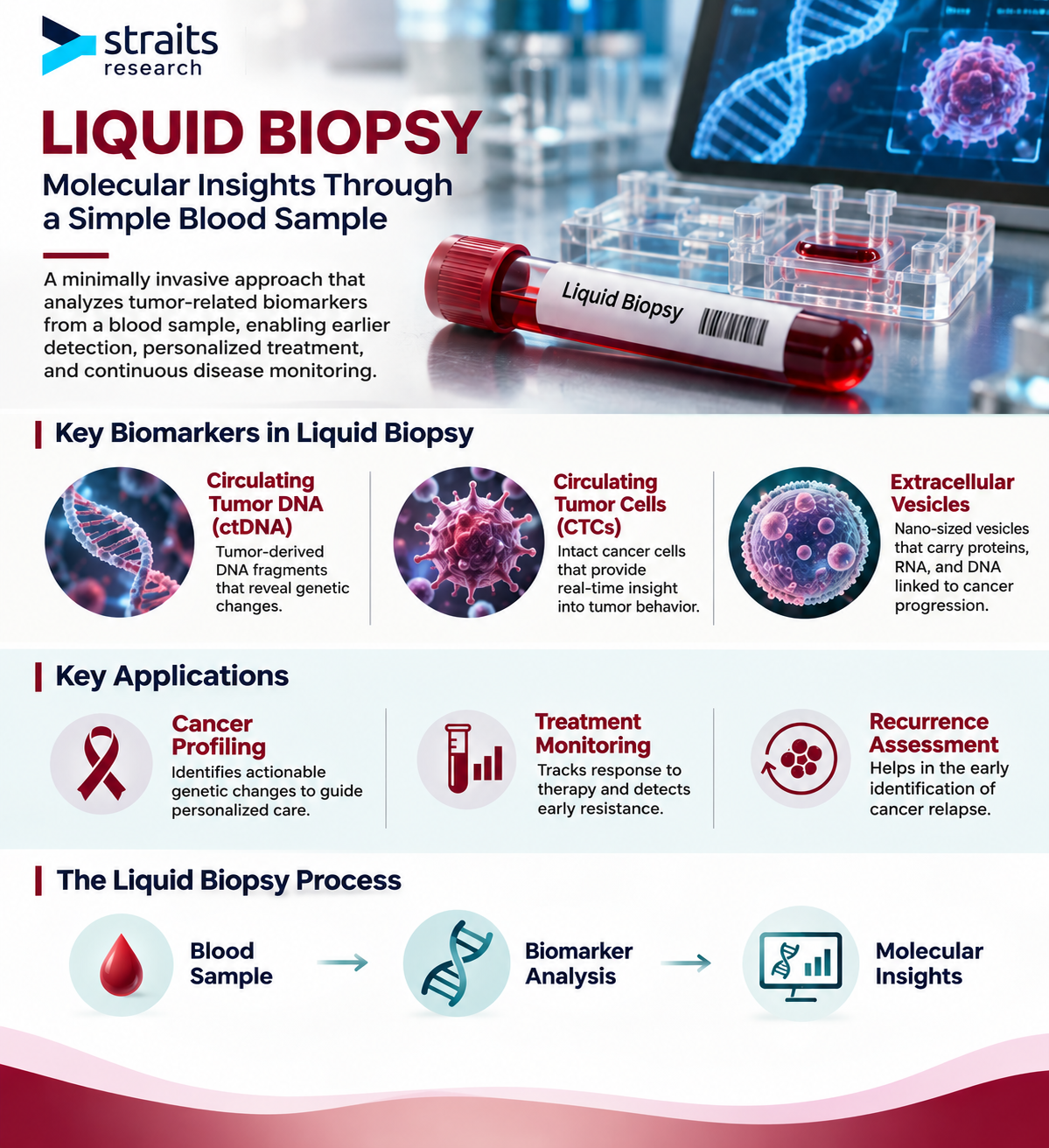
Liquid biopsy is a minimally invasive diagnostic technique that analyzes biomarkers found in biological fluids, primarily blood, to detect and monitor diseases. The technique commonly examines circulating tumor DNA (ctDNA), circulating tumor cells (CTCs), cell-free DNA (cfDNA), RNA, and extracellular vesicles released into the bloodstream.


Liquid biopsy is transforming cancer diagnostics by providing a minimally invasive method for detecting and monitoring cancer-related biomarkers through blood and other biological fluids. Growing interest in precision medicine, molecular profiling, treatment monitoring, and early cancer detection is increasing the adoption of liquid biopsy technologies across healthcare and research settings.
The global liquid biopsy market size was valued at USD 12.23 billion in 2025 and is projected to grow from USD 13.61 billion in 2026 to USD 32.11 billion by 2034, registering a CAGR of 11.32% during the forecast period (2026–2034). North America dominated the liquid biopsy market with a share of 42.15% in 2025. Increasing demand for non-invasive diagnostic procedures, advancements in molecular testing, and expanding applications in oncology are supporting market expansion.
Advancements in Molecular Diagnostics Strengthen Liquid Biopsy Adoption
Traditional tissue biopsies remain an important diagnostic approach, but invasive procedures may present limitations when repeated sampling is required or tumor tissue is difficult to access. Liquid biopsy offers an alternative by examining circulating tumor DNA (ctDNA), circulating tumor cells (CTCs), cell-free DNA, RNA, and extracellular vesicles. These biomarkers can provide valuable information about tumor characteristics, genetic alterations, and disease progression without requiring conventional tissue sampling.
Advancements in next-generation sequencing, polymerase chain reaction technologies, and biomarker detection are improving the accuracy and analytical capabilities of liquid biopsy tests. These developments are expanding the use of molecular diagnostics for identifying mutations, evaluating treatment responses, and monitoring changes in tumor profiles throughout the treatment process.
Precision Oncology and Treatment Monitoring Drive Market Demand
The growing adoption of personalized cancer treatment is creating new opportunities for liquid biopsy technologies. Molecular testing enables healthcare professionals to identify genetic alterations that may help guide targeted therapies, supporting more individualized treatment approaches. Liquid biopsy is also increasingly relevant in cases where tumor tissue is unavailable or repeated testing is necessary to evaluate disease progression.
Treatment monitoring represents another important application. Liquid biopsy can help detect molecular changes associated with treatment resistance, cancer recurrence, and residual disease. The growing emphasis on monitoring patients throughout their treatment journey is encouraging healthcare providers, diagnostic laboratories, and biotechnology companies to invest in advanced liquid biopsy solutions.
Liquid Biopsy Market Segmentation
The liquid biopsy market is segmented by products and services, circulating biomarkers, cancer type, end-user, and region. Kits and reagents accounted for 48.36% of the market in 2025, reflecting their essential role in biomarker detection, sample preparation, and molecular analysis. Among circulating biomarkers, extracellular vesicles are the fastest-growing segment, projected to register a CAGR of 13.87% during 2026–2034.
Lung cancer accounted for 32.64% of the market in 2025, highlighting the growing application of liquid biopsy in cancer diagnosis and monitoring. Hospitals and laboratories represent the fastest-growing end-user segment, with a projected CAGR of 12.94% during the forecast period, supported by increasing adoption of molecular diagnostic procedures and advanced oncology testing.
Regional Outlook for the Liquid Biopsy Market
North America dominated the liquid biopsy market, accounting for 42.15% of the market in 2025. The region's leadership is supported by advanced healthcare infrastructure, strong cancer research capabilities, growing adoption of precision oncology, and the presence of established biotechnology and molecular diagnostic companies. Increasing investment in genomic technologies and blood-based cancer testing is further strengthening regional demand.
Europe is the fastest-growing regional market, projected to expand at a CAGR of 14.62% during 2026–2034. Growing investment in cancer research, expanding molecular diagnostic capabilities, and increasing adoption of personalized medicine are supporting market development. Meanwhile, Asia Pacific is also emerging as an important growth region as healthcare infrastructure, genomic testing capabilities, and access to advanced cancer diagnostics continue to improve.
Competitive Landscape and Future Outlook
The liquid biopsy industry is evolving through advancements in biomarker identification, molecular testing platforms, sequencing technologies, and cancer monitoring applications. Industry participants are focusing on developing more sensitive diagnostic assays, expanding testing capabilities, and improving the integration of liquid biopsy into clinical oncology workflows.
The future of the liquid biopsy market will increasingly depend on clinical validation, technological innovation, broader adoption of precision medicine, and the expansion of applications across cancer detection and monitoring. As molecular diagnostics continue to advance, liquid biopsy is expected to become an increasingly important component of modern cancer care during the forecast period.
For more detailed market insights, segmentation, regional trends, and competitive analysis, explore the Liquid Biopsy Market Report by Straits Research.
About Straits Research
Straits Research is a market intelligence and research organization providing industry insights, market forecasts, competitive analysis, and strategic information across multiple industries. Its research reports help businesses, investors, and industry professionals understand market developments, identify emerging opportunities, and make informed strategic decisions.










Comments (0)