

Fuel Cell Market Outlook: USD 50.92 Billion Valuation by 2034
The global fuel cell market size was valued at USD 8.89 billion in 2025 and is projected to reach USD 10.79 billion in 2026 and USD 50.92 billion by 2034, registering a CAGR of 21.4% during 2026–2034.

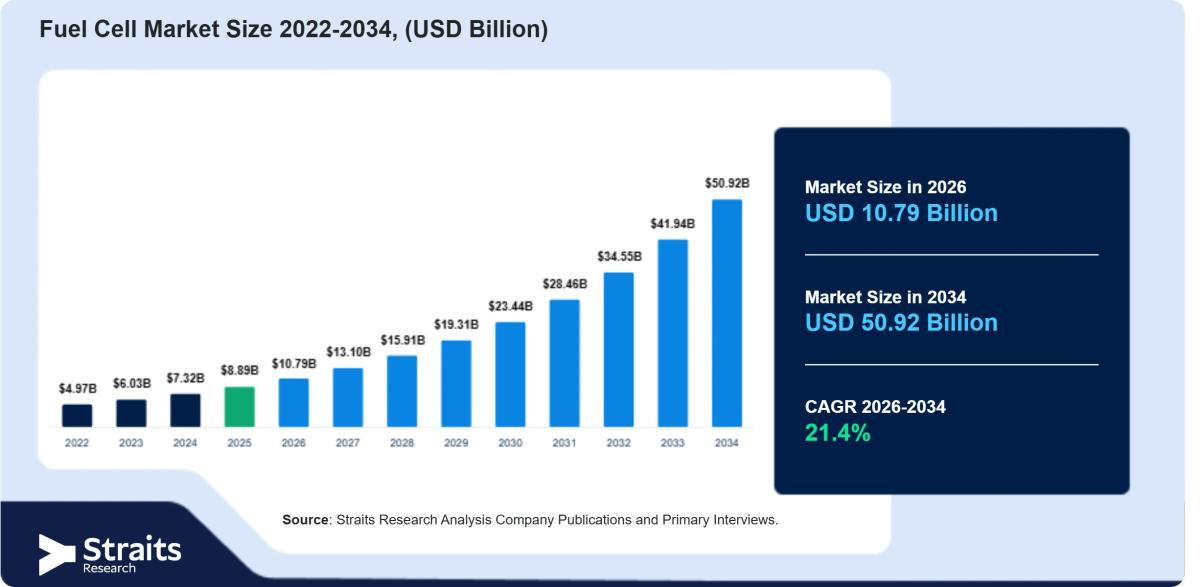
Fuel Cell Market Forecast, 2034
The global fuel cell market is being shaped by the transition toward low-emission power generation, clean transportation, and hydrogen-based energy systems. Fuel cells convert chemical energy into electricity through an electrochemical reaction, offering high efficiency and reliable power generation with water and heat as primary by-products when hydrogen is used as the fuel. Applications across transportation, stationary power, marine systems, aerospace, and distributed energy are creating a broader commercial base for fuel cell technologies.
The global fuel cell market size was valued at USD 8.89 billion in 2025 and is projected to reach USD 10.79 billion in 2026 and USD 50.92 billion by 2034, registering a CAGR of 21.4% during 2026–2034.
Market Drivers
Government Incentives for Hydrogen and Clean Energy
Government incentives, grants, tax benefits, and hydrogen-development programs are reducing financial barriers for fuel cell manufacturers and end users. Policy support for clean transportation, low-carbon electricity, and hydrogen infrastructure is encouraging investment in fuel cell projects across multiple applications.
Expansion of Hydrogen-Powered Transportation
Hydrogen fuel cells are gaining traction in commercial vehicles where long operating ranges, rapid refueling, and high vehicle utilization are important. Bus, truck, fleet, and material-handling applications are creating demand for fuel cell systems that can provide consistent power without direct tailpipe emissions.
Growing Demand for Distributed and Backup Power
Fuel cells provide reliable electricity for distributed generation, backup power, and combined heat and power applications. Their ability to operate continuously with relatively low local emissions is supporting adoption among facilities that require dependable electricity and greater energy resilience.
Increasing Electricity Demand from Data Centers
The expansion of artificial intelligence, cloud computing, and digital infrastructure is creating additional demand for reliable power systems. Fuel cell-based generation can provide continuous electricity while reducing reliance on conventional grid infrastructure, creating opportunities in large-scale data-center power applications.
Market Challenges
Limited Hydrogen Refueling Infrastructure
The uneven availability of hydrogen production, storage, transportation, and refueling infrastructure remains a major barrier to wider fuel cell deployment. Limited station coverage can restrict vehicle utilization and discourage fleet operators from committing to hydrogen-powered transportation.
Specialized Technical Expertise Requirements
Fuel cell systems require specialized knowledge across electrochemistry, hydrogen handling, thermal management, power electronics, and system integration. A limited pool of experienced engineers and technicians can make installation, maintenance, and commercialization more difficult for companies entering new markets.
Complexity of Hydrogen Supply Chains
Fuel cell deployment depends on a dependable supply of suitable hydrogen at commercially viable locations. Differences in hydrogen production methods, transportation infrastructure, storage requirements, and fuel quality can complicate project planning and create uncertainty for end users.
Integration with Existing Energy Infrastructure
Fuel cell systems often require modifications to electrical, hydrogen, thermal, and control infrastructure before commercial deployment. Integration requirements can lengthen project development timelines and create additional engineering and coordination requirements for operators.
Market Segmentation
-
By Type: Proton Exchange Membrane Fuel Cell (PEMFC), Solid Oxide Fuel Cell (SOFC), Molten Carbonate Fuel Cell (MCFC), Direct Methanol Fuel Cell (DMFC), Alkaline Fuel Cell (AFC), Others
-
By Fuel Type: Hydrogen, Methanol, Ammonia, Hydrocarbon, Others
-
By End-User: Aerospace, Energy & Power, Marine, Residential, Transportation, Others
-
By Region: North America, Europe, Asia Pacific, Middle East & Africa, Latin America
Regional Insights
North America Fuel Cell Market Analysis
The North American fuel cell market is supported by strong government incentives for hydrogen technologies, investments in clean-energy infrastructure, and established fuel cell manufacturers. Demand from transportation, stationary power, data centers, and backup-power applications is creating a broad deployment base for fuel cell systems.
Europe Fuel Cell Market Analysis
The European market is reinforced by ambitious decarbonization policies, hydrogen strategies, and investments in low-emission transportation and energy infrastructure. Fuel cell deployment across commercial mobility, industrial applications, and distributed power is supported by the region's focus on reducing fossil-fuel dependence.
Asia Pacific Fuel Cell Market Analysis
The Asia Pacific market benefits from strong government support for hydrogen technologies, established fuel cell manufacturing capabilities, and expanding adoption of fuel cell vehicles. Japan, China, and South Korea are strengthening hydrogen ecosystems through investments in production, mobility, infrastructure, and stationary power applications.
Middle East & Africa Fuel Cell Market Analysis
The Middle East & Africa market is underpinned by investments in green hydrogen production, renewable energy projects, and economic diversification initiatives. Large-scale hydrogen projects are creating opportunities for fuel cell deployment in power generation, transportation, and industrial applications.
Latin America Fuel Cell Market Analysis
The Latin American market is strengthened by renewable-energy resources, emerging hydrogen strategies, and growing interest in industrial decarbonization. Investments in green hydrogen production and clean transportation are creating opportunities for fuel cell systems across mobility and stationary energy applications.
Key Players Analysis
The fuel cell market includes established energy companies, specialized fuel cell manufacturers, automotive technology providers, and industrial power suppliers. Competition is centered on system efficiency, durability, power density, manufacturing cost, hydrogen compatibility, stack performance, and the ability to provide integrated solutions across transportation and stationary applications.
Key players include AISIN CORPORATION, Ballard Power Systems, Bloom Energy, Ceres, and Cummins Inc.
For detailed insights, visit: https://straitsresearch.com/report/fuel-cell-market
About Us
Straits Research is a leading research and intelligence organization specializing in research, analytics, and advisory services, providing comprehensive business insights and market research reports across diverse industries.
Contact Us
Email: [email protected]
Tel: +1 646 905 0080 (U.S.), +44 203 695 0070 (U.K.)













Comments (0)