

What Is Generative Engine Optimization and Why Does It Matter?

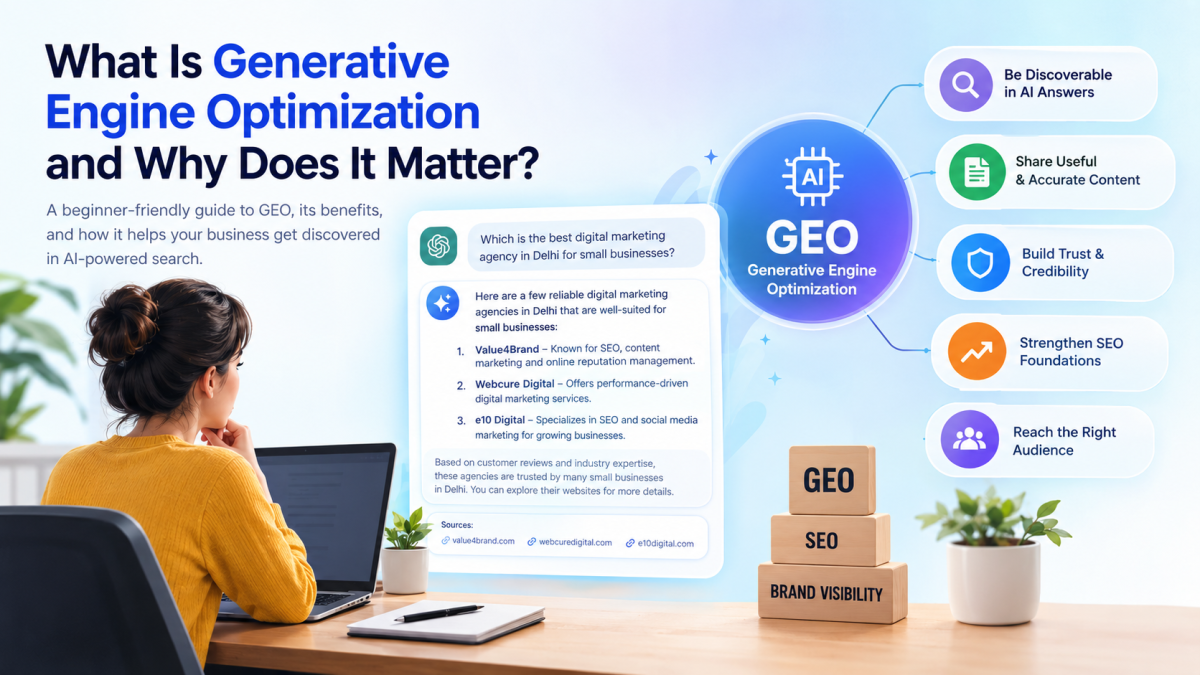
Imagine a customer asking ChatGPT to recommend a reliable digital marketing agency in Delhi. Instead of receiving only a list of website links, the customer may get a direct answer that names a few businesses, explains their services, and provides sources for further research.
Now consider the same question from a business owner's perspective. If your company has relevant experience but does not appear in the answer, potential customers may never discover your brand through that interaction.
This is one reason Generative Engine Optimization (GEO) is receiving attention from marketers.
As people explore AI-powered search tools to research products, compare services, and find solutions, businesses are looking beyond traditional search rankings. They want to understand how their information can become more visible in AI-generated responses.
But GEO is not about finding a secret trick to make AI recommend a brand. It is about building a credible online presence, publishing useful information, and making business content accessible to the systems that retrieve and summarize information.
What Is Generative Engine Optimization (GEO)?
Generative Engine Optimization is the practice of improving a brand's visibility in AI-generated answers and other generative search experiences.
These experiences may include tools such as ChatGPT, Google Gemini, Perplexity, and Google's AI-powered search features. Depending on the platform and the question, users may receive summaries, explanations, product comparisons, business suggestions, or links to supporting sources.
Traditional SEO generally focuses on helping web pages appear in organic search results. GEO places additional attention on whether a brand's information is discovered, referenced, or represented in AI-generated responses.
For example, a company offering online reputation management services may want its website to be discoverable when someone asks an AI platform how businesses can manage negative search results.
To support that goal, the company could publish detailed guides about reputation monitoring, review response strategies, crisis communication, and evaluating ORM providers. It could also maintain accurate service pages and build a trustworthy presence across relevant websites.
These activities help establish a useful information base, although they do not guarantee that an AI platform will mention the company.
Google's guidance also makes an important point: established SEO practices remain relevant to its generative AI search experiences. GEO should therefore be viewed as an extension of a broader search visibility strategy rather than a replacement for SEO.
Why Is Generative Engine Optimization Becoming Important?
The way people discover information is expanding. Some users still prefer browsing traditional search results, while others ask conversational questions and use AI-generated summaries to begin their research.
This creates new opportunities and challenges for businesses.
1. Customers Are Asking More Detailed Questions
A traditional search query might be "best local SEO agency in Delhi." A conversational query could be, "Which local SEO agency should a small business in Delhi consider if it wants more calls and Google Maps visibility?"
The second question gives more context about the customer's needs. An AI system may use that context to produce a more specific response.
Businesses can prepare for these questions by explaining their services clearly, answering common customer concerns, and publishing information that helps people compare available solutions.
For example, a local SEO company could explain the difference between Google Business Profile optimization, local keyword targeting, review management, and location-specific landing pages.
This content serves potential customers while making the company's expertise easier to understand.
2. Brand Discovery Is No Longer Limited to Website Rankings
A business can invest heavily in SEO and still find that its customers discover competitors through other channels, including industry publications, review platforms, social discussions, and AI-generated answers.
GEO encourages marketers to consider a broader question: Is our brand accurately represented wherever potential customers research this category?
This does not mean every business needs to publish on every platform. It means identifying the sources that genuinely matter to its audience and maintaining a consistent, credible presence there.
A healthcare provider, for instance, may benefit from accurate service information and trustworthy professional references. A software company may need detailed product documentation, comparison pages, and independent reviews.
The right approach depends on the industry, the audience, and the questions customers ask.
3. Trust Matters When Customers Compare Businesses
When someone asks an AI tool to compare companies, the answer may include descriptions of their services, areas of expertise, or other relevant details.
If a business has unclear service pages, outdated contact information, or conflicting descriptions across websites, potential customers may find it harder to verify what the company actually offers.
A consistent online presence helps reduce this confusion.
Businesses should keep their website, business profiles, service descriptions, and other important information accurate. They should also publish evidence of their expertise, such as useful resources, genuine case studies, and relevant credentials.
The objective is not to manufacture popularity. It is to make the business easier to understand and evaluate.
4. AI Search Can Create Additional Discovery Opportunities
AI-generated responses sometimes include links to supporting websites. A user may follow one of those links to learn more about a business, read a detailed guide, or evaluate a service.
For companies, this creates another potential route to qualified visitors.
However, AI visibility and website traffic are not the same thing. A brand may be mentioned without receiving a click, and a mention does not necessarily generate a lead.
Businesses should therefore measure AI visibility alongside website visits, enquiries, conversions, and other outcomes relevant to their goals.
How Does GEO Differ From Traditional SEO?
GEO and SEO share many foundations, but they emphasize different visibility outcomes.
| Factor | Traditional SEO | Generative Engine Optimization |
|---|---|---|
| Primary focus | Visibility in organic search results | Visibility or representation in AI-generated responses |
| Content priorities | Relevant pages, search intent, technical health, and credibility | The same foundations, with added attention to clear explanations and source-worthy information |
| Discovery experience | Users browse results and select websites | Users may receive a summarized answer with supporting links |
| Important activities | Keyword research, technical SEO, internal linking, and content development | Helpful content, clear brand information, credible references, and monitoring AI responses |
| Measurement | Rankings, impressions, clicks, traffic, and conversions | Brand mentions, citations, referral visits, accuracy, and business outcomes where measurable |
The distinction is not absolute. AI-powered search systems can use information retrieved from conventional search indexes, and traditional SEO can support GEO efforts.
A website that ranks well for a relevant query is not guaranteed to appear in an AI response. Similarly, appearing in one AI answer does not prove that the brand will be consistently recommended for related questions.
For most businesses, a combined SEO and GEO strategy is more practical than treating the two as competing disciplines.
How Can Businesses Improve Their GEO Visibility?
There is no universal formula for getting a brand mentioned by every AI platform. However, businesses can take practical steps to improve the quality, accessibility, and credibility of their online information.
1. Create Helpful, Original Content
Publishing more articles does not automatically improve AI visibility. Content should provide useful information that readers cannot get simply by reading a few generic paragraphs.
Start by identifying the questions customers ask before choosing a product or service. Then create resources that answer those questions with relevant details, practical guidance, and supporting evidence.
For example, a company providing review management services could publish an article explaining how to respond to an unfair review, when to report a review that violates platform policies, and how to improve the customer experience behind recurring complaints.
This is more useful than publishing several articles that repeat the same broad advice.
2. Answer Specific Questions Clearly
Readers should be able to understand the main point of a page without searching through unnecessary introductions.
Use descriptive headings, clear explanations, and examples that demonstrate how a recommendation works.
A page about AEO services in India, for example, could explain what Answer Engine Optimization involves, how it differs from traditional SEO, what businesses should expect from an engagement, and how performance can be evaluated.
Clear organization helps readers navigate the page and makes its purpose easier to understand.
There is no need to shorten every paragraph or split all content into tiny sections for AI systems. Choose a format that suits the subject and the reader.
3. Maintain Strong Technical SEO Foundations
Useful information must also be accessible to the systems expected to discover it.
Review your website for common technical issues:
-
Ensure important pages are crawlable and eligible for indexing.
-
Use clear page titles and descriptive headings.
-
Maintain logical internal links between related pages.
-
Fix broken links and unnecessary duplicate pages.
-
Check mobile usability and page performance.
-
Use structured data when it accurately describes the page.
Structured data can help search engines interpret information, but it does not guarantee AI citations or recommendations. Similarly, no special technical file or markup is a universal shortcut to appearing in AI-generated answers.
Businesses should prioritize established technical SEO practices before investing time in unverified GEO tactics.
4. Build a Credible Presence Beyond Your Website
Your website is an important source of information, but customers may also research your brand through third-party sources.
Relevant industry publications, genuine customer reviews, professional profiles, and credible business directories can help people learn more about a company.
Focus on sources that make sense for your industry and audience.
For example, a B2B service provider may benefit from useful expert contributions to relevant industry publications. A local business may need accurate business listings and a consistent review management process.
Avoid mass-producing guest posts or arranging artificial brand mentions solely to influence AI responses. Low-quality or misleading references do not establish genuine credibility.
5. Keep Brand Information Accurate and Consistent
A company's services, business name, location, and expertise should be described accurately across its website and relevant public profiles.
Review important business information periodically. Update outdated service pages, correct inaccurate directory entries, and ensure that contact details remain current.
This is especially important for businesses operating in multiple locations or offering several related services.
Consistency helps customers verify information and reduces the risk of confusion when they research a brand across different sources.
6. Demonstrate Genuine Expertise
A generic article can explain the basic definition of a topic, but it may not give readers a strong reason to trust its author.
Add value through practical experience, original observations, relevant examples, and reliable references.
A local SEO agency, for instance, could explain how it approaches a Google Business Profile audit, which issues it checks first, and how it measures improvements in customer enquiries.
Any case study or performance claim should be based on real evidence. Do not invent customer results, testimonials, or statistics to make a brand appear more authoritative.
Google's guidance for generative AI search emphasizes useful, distinctive, people-first content rather than simply repeating information already available elsewhere.
7. Monitor Brand Visibility Across Relevant AI Platforms
GEO should be measured rather than judged by a few isolated searches.
Create a list of realistic questions customers might ask about your services. Test those questions across selected AI platforms and record whether your brand appears, whether the information is accurate, and whether any sources are cited.
Repeat the tests periodically under similar conditions. Responses may vary with the wording, location, context, platform, and time.
Where possible, also review referral traffic and enquiries from AI platforms. These measures can help connect brand visibility with meaningful business outcomes.
Common GEO Mistakes Businesses Should Avoid
As interest in Generative Engine Optimization grows, some businesses may spend time and money on tactics that promise quick results.
Here are several mistakes to avoid:
Replacing SEO entirely with GEO: Traditional search remains important, and many of its core practices support AI-powered discovery.
Publishing content at scale without adding value: Repeating generic information across dozens of pages can waste resources and create a poor user experience.
Stuffing keywords into every section: Natural language and useful explanations are more important than repeating exact phrases unnecessarily.
Creating artificial brand mentions: Inauthentic recommendations and low-quality placements do not build lasting trust.
Assuming structured data guarantees AI visibility: Structured data can support search understanding, but it is not a guarantee of inclusion in AI answers.
Expecting every platform to respond identically: Different AI tools may retrieve different sources and generate different recommendations.
Measuring success only by mentions: Brand visibility matters, but it should be considered alongside relevant visits, enquiries, and conversions.
A sustainable GEO strategy focuses on credible information, helpful content, and continuous improvement rather than shortcuts.
How Can Businesses Choose the Right GEO Agency?
Businesses that lack in-house SEO or content resources may consider professional Generative Engine Optimization services. Before selecting a provider, it is important to understand what the agency will actually do.
Ask potential providers how they assess existing visibility, identify content gaps, improve technical SEO, evaluate third-party references, and report performance.
A reliable GEO agency should explain its process clearly and set realistic expectations. It should not promise guaranteed ChatGPT recommendations, fixed AI rankings, or citations across every platform.
Value4Brand works in areas including SEO, online reputation management, and Generative Engine Optimization. Businesses exploring GEO services in India can evaluate Value4Brand alongside other providers based on their requirements, relevant experience, proposed deliverables, and reporting approach.
The right provider should help connect AI visibility efforts with broader business goals instead of treating every brand mention as a success on its own.
The Future of GEO: Focus on Being Useful and Trustworthy
Generative AI is creating new ways for people to discover and evaluate businesses. However, the basic need behind every search remains the same: people want accurate information that helps them make a decision.
Businesses that invest in useful content, maintain a technically sound website, and communicate their expertise clearly can prepare for this changing environment.
GEO is not about controlling what an AI system says. It is about improving the information available about your business and making that information easier to discover, understand, and verify.
As AI-powered search continues to evolve, the strongest strategy is to combine sound SEO practices with genuine expertise, credible brand information, and consistent measurement.









Comments (0)