

How to Start a Business in Singapore: Structure, Incorporation Checklist and the Company Secretary Role
Learn how to start a business in Singapore: compare structures, prepare your incorporation checklist, and understand what a company secretary does.

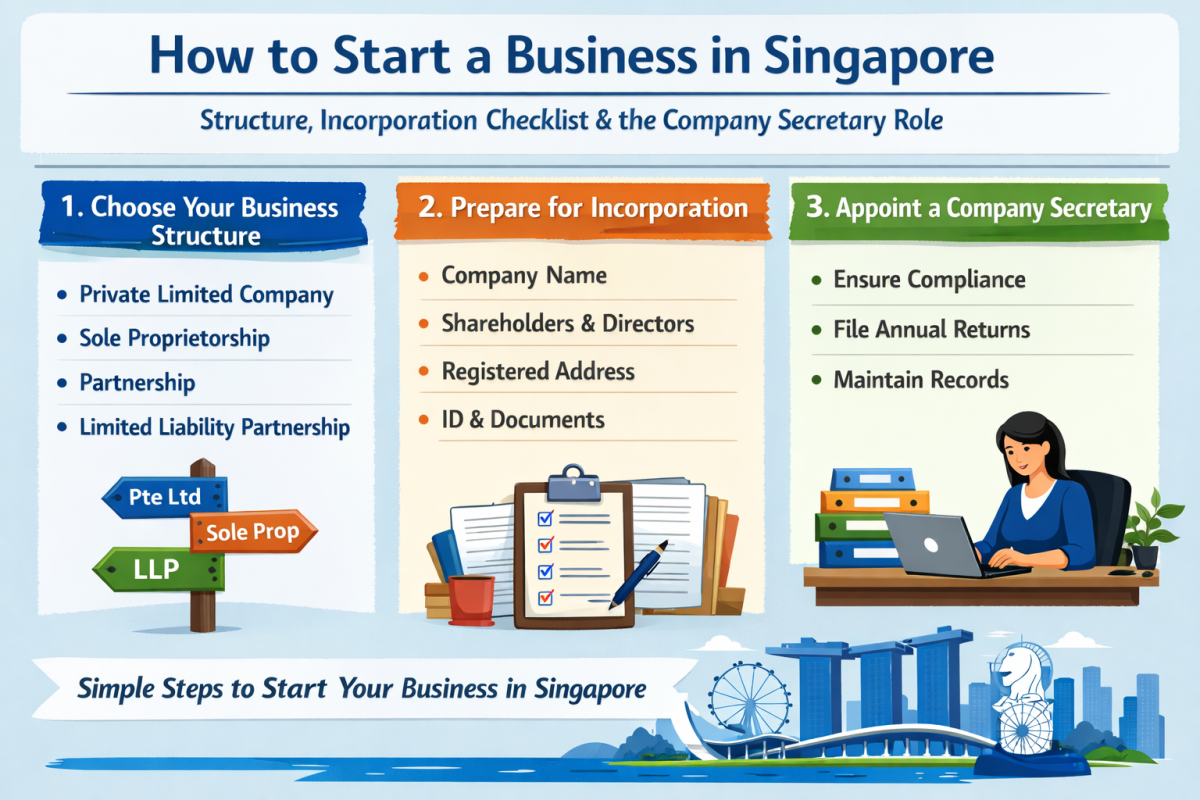
Starting a business in Singapore is easier than many founders expect. The harder part is knowing which decisions matter early. Pick the right structure, gather the right details before you file, and plan who will look after your legal paperwork once the company exists. This article walks through those three steps in plain language.
Step 1: Choose the Right Business Structure
The biggest difference between structures is liability. In plain terms, liability means who pays if the business owes money or loses a case. Here is how the main options compare:
-
Sole proprietorship: One owner. The owner is personally responsible for risks, debts and losses.
-
Partnership: Two to 20 individuals or companies. Partners are personally responsible, and they can also be held responsible for losses caused by other partners.
-
Limited liability partnership: At least two partners. Partners have limited liability, but they remain personally liable for debts and losses that result from their own actions.
-
Limited partnership: At least one general partner and one limited partner. The general partner has unlimited personal liability, while the limited partner is liable up to an agreed amount.
-
Private limited company: A separate legal entity with at least one resident director. Owners have limited liability, and a private company can have up to 50 owners.
Imagine two friends who start a design studio as a general partnership. A client sues, and one partner made a costly mistake. Both friends can be pulled in. Had they used a private limited company, the company would be the main target, and their personal savings would usually be shielded. That is why many sole owners and general partners move to a company once the business grows.
Step 2: Prepare the Details Before You Incorporate
Filing can be quick. Incorporating a company can take as little as 15 minutes, or up to two weeks if the case is more complex. If your business needs approval from other authorities, it may take up to two months. Preparing early prevents delays.
Use this checklist before you file. For a fuller walkthrough, read this quick guide to starting a Singapore business.
-
Company name. Search for it first to check it is unique. Also check whether a matching domain name is available. Be careful with sensitive words such as “bank” or “university”.
-
Business activities. A company can list two principal activities, based on the Singapore Standard Industrial Classification (SSIC).
-
Financial year end (FYE). This is the day and month your financial year closes. Think about whether the date affects your eligibility for tax incentives.
-
Constitution. This legal document sets out how the company is run. It explains the rights, duties and powers of directors, shareholders and the company secretary.
-
Share capital and functional currency. Decide how much capital to issue and which currency matches your main market.
-
Registered office. The address must be a physical Singapore address. A P.O. box does not qualify.
-
Director. You need at least one director with a local residential address. Singapore citizens, permanent residents and Employment Pass holders can qualify.
-
Shareholder. A shareholder can be a person or a company. Fully foreign ownership is allowed. One person can be both director and shareholder.
-
Company secretary. You need at least one local company secretary.
-
Auditor. The company must appoint an auditor within three months of incorporation, unless it qualifies for an exemption under the Companies Act.
A common mistake is treating the financial year end as an afterthought. Once chosen, it drives your accounting, tax and filing calendar for years.
Step 3: Understand the Company Secretary Role
Many founders hear “company secretary” and picture an assistant who takes notes. The role is more formal than that.
Every private limited company needs a company secretary who lives in Singapore and is a natural person. The company must appoint one within six months of incorporation. If the post becomes vacant, it should not stay empty for more than six months. A sole director and the company secretary cannot be the same person, so a one-person company needs a second individual for this role.
The secretary is also an officer of the company. Their name appears in ACRA records, and they carry similar fiduciary duties to directors. That means they must act in the company’s best interests and flag any conflicts.
What a Company Secretary Actually Does
In smaller companies, much of the work revolves around the annual general meeting (AGM) and the annual return. Day to day, the role usually includes:
-
Keeping statutory records, such as the share register, minutes book and registers of controllers and nominee directors
-
Reminding directors of AGM and annual return deadlines
-
Preparing minutes, resolutions and notices
-
Updating ACRA when officers’ details change
-
Applying for an extension of time to hold the AGM when needed
-
Advising on share issues and transfers
Here is a simple example. A director moves house and forgets to tell anyone. Months later, ACRA records still show the old address, and official letters go astray. A secretary who monitors changes, and who prompts the director to update records, helps stop that kind of problem early.
Should You Hire One or Do It Yourself?
Some owners want to keep costs down by handling filings alone. That can work for a very simple company, but it carries risk. Missed deadlines can bring penalties, and sloppy records can cause trouble during audits, bank reviews or investor checks.
If you outsource, ask a few direct questions. Who will be named as the company secretary? How will you receive deadline reminders? Who prepares the AGM paperwork? How quickly do they update ACRA after a change? Clear answers show you what the service actually covers.
Many accounting and advisory firms offer both incorporation help and corporate secretarial support under one roof. That can keep your records and your accounts in step, since the same team sees both sides.
A Short Starter Plan
After you incorporate, note your six-month secretary deadline and three-month auditor deadline in a shared calendar. Firms such as MetroCorp in Singapore support new companies with incorporation, corporate secretarial and accounting services, so founders can handle these steps with one provider if they prefer.
Frequently Asked Questions
1. Can a foreigner start a business in Singapore?
Yes. Foreign ownership of a private limited company can be 100 percent. The company still needs at least one director with a local residential address, a Singapore registered office and a local company secretary.
2. How long does it take to incorporate a company?
Incorporation can take as little as 15 minutes, or up to two weeks for more complex cases. If the business needs approval from another authority, it may take up to two months.
3. Is a company secretary compulsory?
Yes. A private limited company must have at least one company secretary who is a natural person living in Singapore. The appointment must happen within six months of incorporation.
4. Can I be my own company secretary?
Only in some cases. A sole director cannot also act as the company secretary. If the company has more than one director, a director may hold the role, provided the person meets the residency requirement.
5. Should I convert my sole proprietorship into a company?
Many advisers suggest it once the business takes on real risk, because a company is a separate legal entity with limited liability. Compare the extra filing duties and costs, and speak to an adviser before you decide.











Comments (0)