

Tool Steel Market Landscape: Material Innovation and Industrial Applications
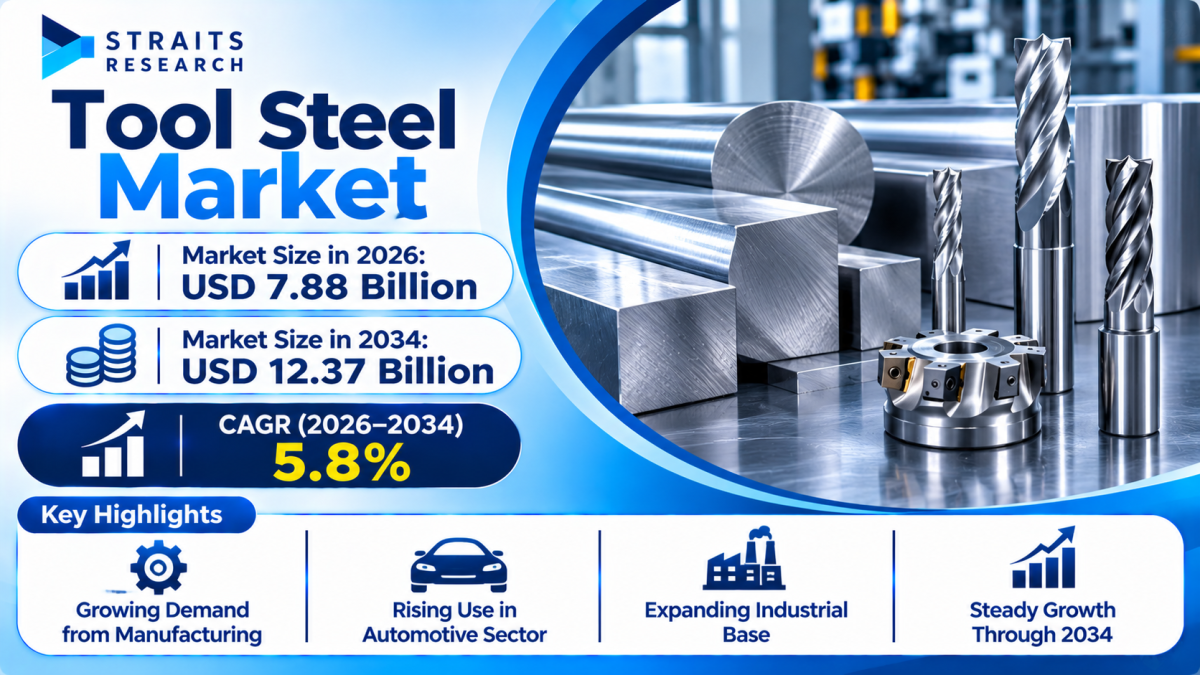
The global tool steel market size was valued at USD 7.45 billion in 2025 and is projected to grow from USD 7.88 billion in 2026 to USD 12.37 billion by 2034, registering a CAGR of 5.8% during the forecast period from 2026 to 2034.

Tool Steel Market Size, Share to 2034
Tool steel is a specialized category of steel designed to manufacture cutting tools, dies, molds, and other components that require high hardness, wear resistance, and durability. Its alloying elements, including tungsten, chromium, vanadium, and molybdenum, improve performance under demanding operating conditions. Tool steel is widely used in automotive manufacturing, metalworking, injection molding, industrial machinery, and precision engineering.
According to StraitsResearch, the global tool steel market size was valued at USD 7.45 billion in 2025 and is projected to grow from USD 7.88 billion in 2026 to USD 12.37 billion by 2034, registering a CAGR of 5.8% during the forecast period from 2026 to 2034.
Market Drivers
Expansion of Manufacturing and Industrial Production
Manufacturing industries rely on tool steel for cutting, forming, stamping, and shaping metal components. Expansion of automotive, electronics, machinery, and industrial equipment production is supporting demand for durable tooling materials that maintain performance under repeated use.
Increasing Demand for Precision Tooling
Modern manufacturing requires accurate components and consistent product quality. Tool steel offers hardness, strength, and wear resistance for dies, molds, and precision tools, supporting its use in applications that require tight tolerances and extended tool life.
Growth in Automotive and Metalworking Applications
Automotive production and metalworking operations use tool steel in stamping dies, cutting tools, molds, and machining equipment. Vehicle component manufacturing and demand for high-performance tooling are contributing to market expansion.
Market Challenges
High Production and Processing Costs
Tool steel requires specialized alloying, heat treatment, and finishing processes to achieve desired mechanical properties. Energy-intensive manufacturing and advanced processing requirements can increase production costs and affect pricing competitiveness.
Fluctuations in Alloying Element Prices
The cost of tool steel is influenced by the availability and pricing of tungsten, chromium, vanadium, and other alloying elements. Supply disruptions and commodity price changes can affect manufacturers' operating costs and procurement strategies.
Competition from Alternative Materials and Tooling Technologies
Advanced ceramics, carbide materials, and other high-performance alloys compete with tool steel in selected applications. Changes in machining technologies and tooling design can influence material selection across manufacturing industries.
Market Segmentation
By Product
- Die work, injection molding, and other product applications represent the major categories.
- Die work dominated the product segment, supported by its extensive use in metal forming, stamping, and industrial tooling.
By Product Type
- Tungsten, chromium, vanadium, and other alloying-based product types represent the major categories.
- Tungsten-based tool steel is projected to register the fastest growth, supported by its hardness, wear resistance, and suitability for cutting and shaping applications.
Regional Insights
Asia Pacific
Asia Pacific dominated the tool steel market with a share of 48.2% in 2025. The region's extensive manufacturing base, automotive production, industrial machinery sector, and metalworking activities support demand for high-performance tooling materials.
Europe
Europe is projected to register the fastest growth during the forecast period. Advanced manufacturing, precision engineering, automotive production, and demand for specialized tooling materials support regional market development.
North America
North America benefits from established automotive, aerospace, machinery, and metal fabrication industries. Demand for durable cutting tools and high-performance molds supports the use of tool steel across manufacturing applications.
Middle East and Africa
Industrial development, infrastructure projects, and investments in manufacturing create opportunities for tool steel suppliers. Demand from metalworking and machinery applications contributes to regional market activity.
Latin America
Manufacturing, automotive component production, and industrial equipment demand support the regional market. Investments in production facilities and metalworking operations create opportunities for tool steel applications.
Key Players Analysis
The tool steel market includes specialty steel producers and high-performance material suppliers. Competition is shaped by alloy composition, heat-treatment capabilities, product consistency, wear resistance, and the ability to supply grades tailored to industrial tooling requirements.
- voestalpine AG (Austria)
- Jacquet Metals (France)
- Sandvik AB (Sweden)
- Fugang Special Steel (China)
- Baosteel Group Corporation (China)
- NACHI-FUJIKOSHI Corp. (Japan)
- Hitachi High-Tech Corporation (Japan)
- Universal Stainless & Alloy Products, Inc. (U.S.)
For Detailed Insights, Visit:
https://straitsresearch.com/report/tool-steel-market
About Us
Straits Research is a research and intelligence organization specializing in research, analytics, and advisory services, providing business insights and market research reports across diverse industries.
Contact Us
Email: [email protected]
U.S.: +1 646 905 0080
U.K.: +44 203 695 0070











Comments (0)