

RG217 Cable Specifications: Size, Impedance & Performance

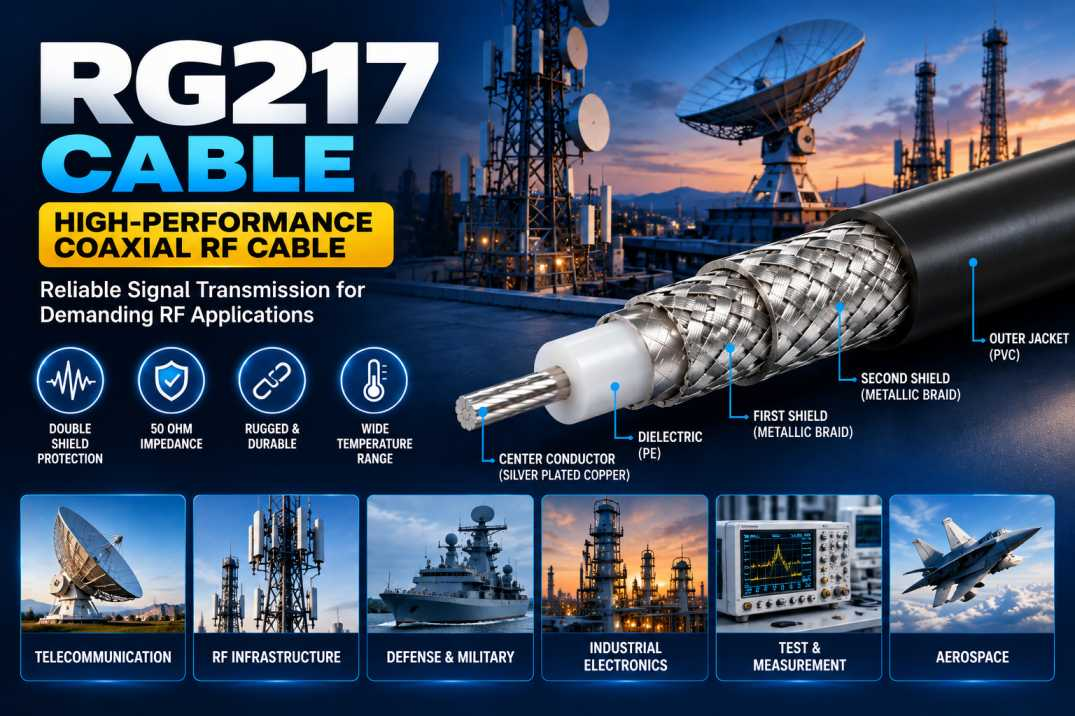
The RG217 Cable is a heavy-duty coaxial cable designed for reliable RF signal transmission in applications where high power handling, mechanical strength, and stable electrical performance are important. Its robust construction makes it suitable for demanding communication, broadcasting, military, industrial, and RF test environments.
Understanding RG217 Cable specifications such as cable size, impedance, conductor construction, dielectric material, shielding, attenuation, and power capability is essential when selecting the right coaxial cable for an RF system. The cable must provide consistent impedance and controlled signal transmission while maintaining mechanical and environmental reliability.
What Is RG217 Cable?
RG217 Cable is a 50-ohm coaxial RF cable generally used for high-power and low-frequency RF applications. Its coaxial construction consists of a center conductor, dielectric insulation, conductive shielding, and an external protective jacket.
The coaxial structure keeps the electromagnetic field contained between the center conductor and shield. This helps reduce unwanted radiation and provides controlled RF transmission between connected equipment.
Compared with smaller flexible coaxial cables, RG217 is physically larger and designed for applications where higher power capability and rugged construction are required.
RG217 Cable Construction
The construction of RG217 Cable plays an important role in its electrical and mechanical performance.
Center Conductor
The center conductor carries the RF signal through the cable. Depending on the manufacturer and cable version, conductor materials and plating can vary. The conductor design affects DC resistance, RF losses, flexibility, and power-handling capability.
Dielectric
The dielectric separates the center conductor from the outer shield while maintaining the required characteristic impedance. The dielectric material and its dimensions influence velocity of propagation, capacitance, attenuation, and overall RF performance.
Shield
The conductive shield surrounds the dielectric and provides the return path for the RF circuit. It also helps protect the transmitted signal from external electromagnetic interference and limits RF leakage.
Outer Jacket
The external jacket protects the internal cable structure from mechanical damage, moisture, abrasion, and environmental exposure. Jacket material and temperature rating depend on the specific RG217 Cable construction.
RG217 Cable Size and Dimensions
One of the most important characteristics of RG217 Cable is its relatively large physical size. The larger construction provides space for a substantial conductor, dielectric, and shielding system.
Cable dimensions can vary between manufacturers and specific constructions, so the manufacturer's datasheet should always be checked before designing an installation.
When evaluating RG217 Cable size, consider:
-
Overall cable diameter
-
Center conductor diameter
-
Dielectric diameter
-
Shield construction
-
Minimum bending radius
-
Cable weight
-
Connector dimensions
-
Installation space
The relatively large diameter means RG217 Cable is generally more suitable for fixed installations and high-power RF systems than compact miniature coaxial cables.
RG217 Cable Impedance
The characteristic impedance of RG217 Cable is 50 ohms, making it suitable for many RF and microwave systems designed around a 50-ohm transmission architecture.
Maintaining impedance throughout the complete RF path is important because impedance discontinuities can produce reflections. These reflections can increase VSWR and reduce effective power transfer.
For best system performance, the cable, connectors, adapters, terminations, and connected equipment should use compatible impedance specifications.
RG217 Cable Performance
The performance of RG217 Cable depends on several electrical and mechanical parameters.
Attenuation
Attenuation represents the amount of RF signal power lost as the signal travels through the cable. Cable length, operating frequency, conductor characteristics, dielectric properties, and construction all affect attenuation.
For longer RF cable runs, attenuation becomes particularly important when determining the available signal level at the receiving equipment.
VSWR and Return Loss
VSWR indicates the degree of impedance mismatch within an RF transmission system. A properly matched RG217 Cable assembly can help maintain efficient power transfer and reduce signal reflections.
Connector quality and assembly accuracy are just as important as the cable itself.
Power Handling
The relatively substantial construction of RG217 Cable makes it suitable for applications requiring higher RF power capability. Actual power handling depends on operating frequency, ambient temperature, cable length, installation conditions, and manufacturer specifications.
Always use the manufacturer's rated power values for final system design.
Frequency Performance
RG217 Cable is commonly associated with RF applications where controlled transmission and power handling are important. Its usable frequency range and attenuation characteristics depend on the exact construction and manufacturer.
For high-frequency applications, designers should verify attenuation, VSWR, insertion loss, and connector performance at the intended operating frequency.
RG217 Cable Applications
RG217 Cable can be used across several demanding RF environments.
RF Communication Systems
The 50-ohm impedance makes RG217 suitable for RF communication equipment and transmission systems requiring reliable signal connectivity.
Broadcasting
RG217 Cable can be used in RF broadcasting infrastructure where robust cable construction and dependable signal transmission are required.
Military and Defense
Its rugged construction makes it suitable for selected defense and communication systems where reliability and RF performance are important.
Test and Measurement
RG217 Cable assemblies can be used to connect RF equipment, test instruments, transmitters, loads, and other laboratory systems.
Industrial RF Systems
Industrial communication and RF equipment may use RG217 where larger coaxial construction and reliable transmission are required.
RG217 Cable Connector Options
The correct connector is essential for achieving reliable performance from an RG217 Cable assembly. Connector selection depends on equipment interface, frequency, power level, installation requirements, and environmental conditions.
Possible connector configurations may include RF connector families such as N-Type, UHF, or other compatible interfaces depending on the cable assembly design.
Professional termination is important because poor connector installation can increase insertion loss, VSWR, and signal reflection.
How to Select the Right RG217 Cable
Before purchasing RG217 Cable, evaluate:
-
Required characteristic impedance
-
Operating frequency
-
Required cable length
-
Maximum RF power
-
Cable attenuation
-
Operating temperature
-
Installation environment
-
Minimum bending radius
-
Required connectors
-
Mechanical and environmental requirements
For critical RF systems, selection should be based on the complete cable assembly rather than cable type alone.
Conclusion
RG217 Cable provides a robust 50-ohm coaxial solution for RF systems requiring dependable transmission, substantial construction, and suitable power-handling capability. Its size, impedance, shielding, dielectric design, attenuation, and connector configuration all contribute to overall system performance.
For reliable results, always evaluate the exact manufacturer's specifications for frequency range, attenuation, power handling, dimensions, temperature rating, and connector compatibility before final installation.
FAQs About RG217 Cable
1. What is RG217 Cable?
RG217 Cable is a 50-ohm coaxial RF cable designed for demanding RF transmission applications where robust construction and reliable performance are required.
2. What is the impedance of RG217 Cable?
RG217 Cable has a nominal characteristic impedance of 50 ohms.
3. Is RG217 Cable suitable for high-power RF applications?
Yes, RG217 Cable is commonly used in applications requiring substantial RF power handling, subject to the manufacturer's frequency and power ratings.
4. Why is RG217 Cable larger than many other coaxial cables?
Its larger construction supports a substantial conductor, dielectric, and shielding arrangement intended for demanding RF applications.
5. What affects RG217 Cable performance?
Frequency, cable length, conductor construction, dielectric properties, shielding, connectors, installation conditions, and temperature can all affect performance.
6. Can RG217 Cable be used for RF communication?
Yes. Its 50-ohm impedance makes RG217 Cable suitable for many RF communication and transmission systems.
7. Is RG217 Cable flexible?
RG217 Cable can have limited flexibility compared with smaller coaxial cables because of its larger physical construction. The manufacturer's minimum bend radius should be followed.
8. Which connectors can be used with RG217 Cable?
Connector selection depends on the specific cable assembly and equipment interface. Compatible RF connector types can be selected according to frequency, power, and mechanical requirements.
9. How should RG217 Cable be selected?
Select it according to impedance, frequency, attenuation, power handling, cable size, temperature, bend radius, environment, length, and connector requirements.
10. Where is RG217 Cable used?
Typical applications include RF communication, broadcasting, defense systems, industrial RF equipment, and test and measurement systems.







Comments (0)