

Can You Have a Miscarriage Without Bleeding? Signs of a Missed Miscarriage
A miscarriage can happen without any bleeding. This guide explains what a missed miscarriage is, why it happens, the subtle symptoms to watch for, how doctors confirm it with a scan and hCG tests, and the safe management options. From Dr. Aravind's IVF Fertility and Pregnancy Centre, the best IVF centre in Salem.

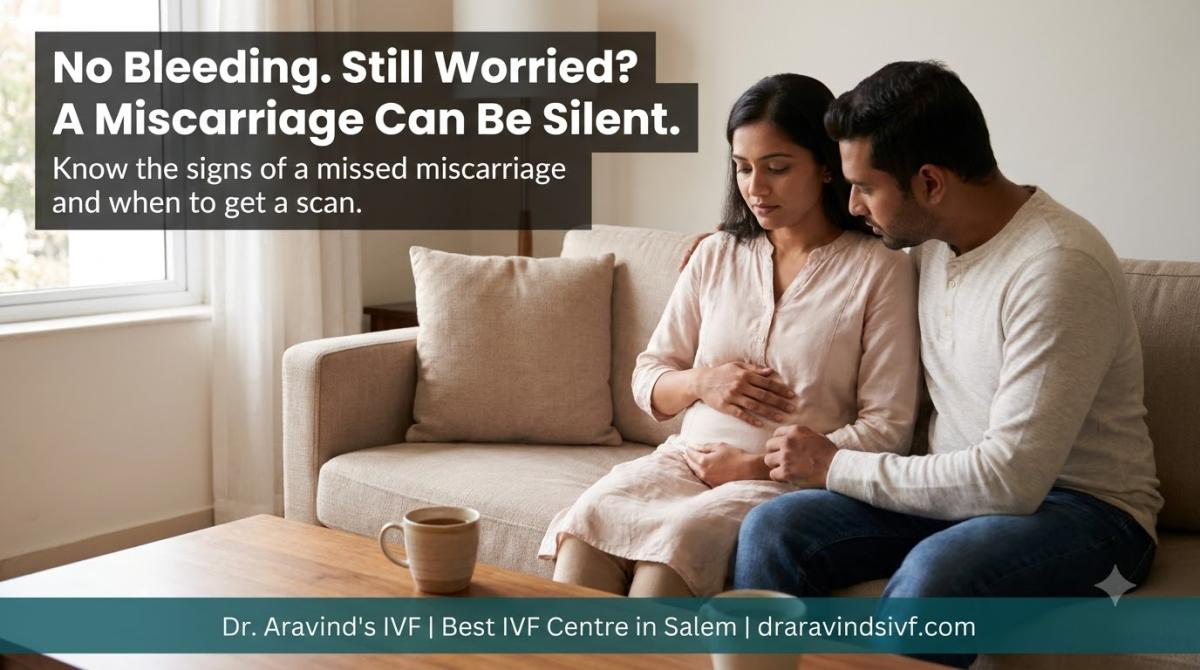
The question usually comes after a quiet moment of doubt. Nausea has faded. The breasts feel less tender. There is no bleeding and no pain, yet something feels different.
Yes, a miscarriage can happen without any bleeding. It is called a missed miscarriage, and many women learn about it only at a routine scan.
At Dr. Aravind’s IVF Fertility and Pregnancy Centre, the best IVF centre in Salem, we explain what a quiet loss looks like so you can recognise it and know what to do next.
What Is a Missed Miscarriage?
In a missed miscarriage, the embryo or foetus stops developing but the body does not expel the pregnancy tissue. Because nothing passes, bleeding and cramping may not begin for days or weeks.
It is also called a silent miscarriage. Doctors use that name because the loss gives no obvious outward signal.
Missed miscarriages account for a meaningful share of first trimester losses. They are usually caused by a chromosomal error at conception, and nothing the mother did.
Miscarriage Without Bleeding: Why It Happens
The body keeps producing pregnancy hormones for a short time after development stops. Hormone levels fall slowly, so the cervix stays closed and the uterus does not begin to contract.
That delay explains why a woman can feel pregnant and look pregnant on a home test while the scan shows no heartbeat.
The main causes include:
- Chromosomal abnormalities in the embryo, the most common reason
- Hormonal factors such as low progesterone or thyroid disease
- Uterine factors such as a septum, fibroids or scar tissue
- Clotting and autoimmune disorders like antiphospholipid syndrome
- Maternal age, because egg quality declines over time
For a broader overview of causes, read our guide on miscarriage without bleeding.
Missed Miscarriage Symptoms: What to Watch For
Many women have no symptoms at all. When symptoms do appear, they are often subtle.
- Fading pregnancy symptoms, such as nausea, breast tenderness or fatigue disappearing suddenly
- Brown or pink spotting that appears late
- Mild cramping or a dull back ache
- A negative or faint home pregnancy test after earlier positives
- A uterus measuring smaller than expected for the weeks of pregnancy
One caution matters here. Pregnancy symptoms naturally ease for some women in the second trimester, and many healthy pregnancies have no symptoms at all. Fading symptoms alone do not confirm a loss.
How Doctors Confirm a Missed Miscarriage
Only a scan and blood tests can answer the question. A confirmed diagnosis usually involves:
- Transvaginal ultrasound showing no heartbeat in an embryo of adequate size
- Serial beta hCG blood tests, taken 48 hours apart, to see whether levels rise or fall
- A repeat scan after 7 to 14 days when the first result is uncertain
Doctors often wait and repeat the scan before confirming a loss. This avoids the rare but real mistake of misjudging a very early pregnancy.
Management Options After a Missed Miscarriage
Once confirmed, there are three safe options. The right choice depends on your health, your preference and how far along you were.
- Expectant management: waiting for the body to pass the tissue naturally
- Medical management: tablets that help the uterus expel the tissue
- Surgical management: a short day procedure to remove the tissue
Each option is safe when supervised. Your doctor will explain the likely bleeding, pain and recovery so you can decide without pressure.
When to Seek Help Immediately
Go to an emergency department if you have:
- Heavy bleeding that soaks a pad every hour for two hours
- Severe one sided abdominal pain or shoulder tip pain
- Fever, chills or foul smelling discharge
- Dizziness or fainting
For any other worry, such as symptoms fading or a faint test, call your doctor the same day. Waiting rarely helps and early reassurance often does.
Care at the Best IVF Centre in Salem
Early scans and clear answers reduce the anxiety of not knowing. At Dr. Aravind’s IVF, care after a suspected loss includes:
- Same week transvaginal ultrasound and hCG tracking
- Support to choose the right management option
- Testing after two or more losses, covering hormones, uterine anatomy, clotting disorders and genetics
- Counselling for both partners, because grief after pregnancy loss is real
If you are searching for an IVF centre in Salem that gives honest answers and plans the next step with you, our team is ready to help.
Book your consultation at Dr. Aravind’s IVF Fertility and Pregnancy Centre, Salem.
Phone: +91 90 2012 2012














Comments (0)