

Battery Pack Manufacturing in India: How a Pack Is Built, Step by Step

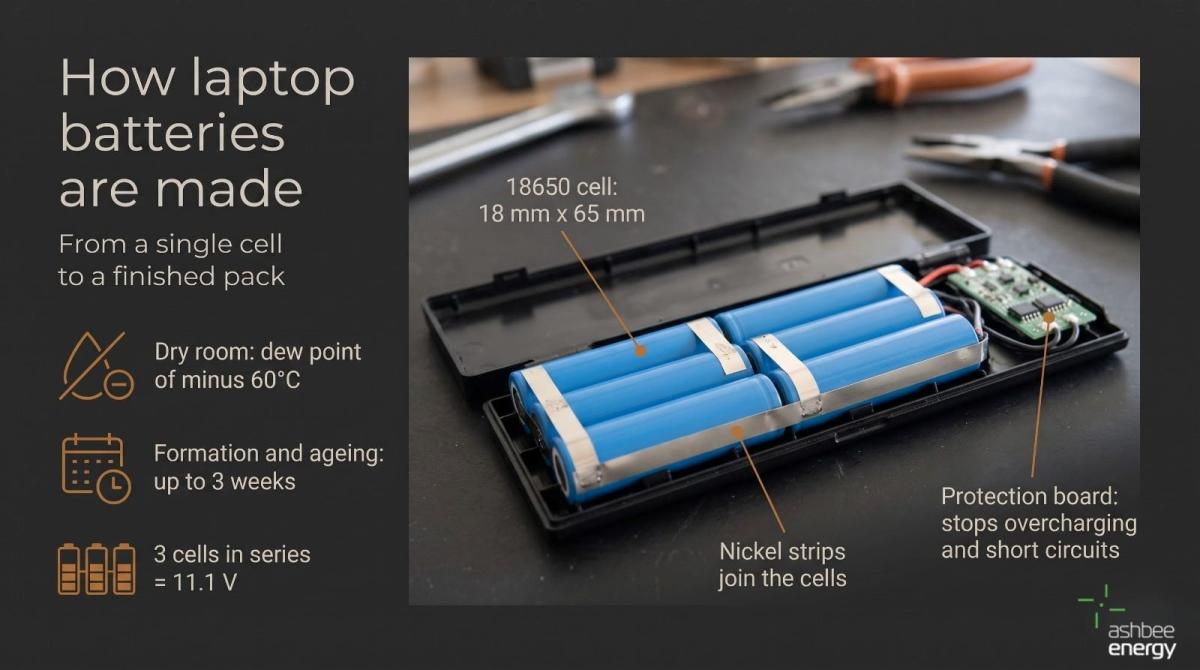
A lithium cell is only a component. The pack built around it decides how the battery behaves on your site. That part rarely comes up in a sales call. No matter how long a catalogue is, one question matters most. Who actually assembles and tests the packs? This guide walks through battery pack manufacturing step by step. Then you can ask better questions.
How battery manufacturing companies in India Works
Cells get sorted by capacity and internal resistance before anything is welded. Skip that and one weak cell hits its cut-off early. Then the whole string follows it down. Lithium battery pack manufacturers who only resell finished units cannot tell you why a batch failed, because they never saw inside it.
A well-run line follows six main steps:
1. Incoming inspection. Each cell is checked for capacity, internal resistance and open-circuit voltage.
2. Sorting and matching. Cells with close values are grouped together so no weak cell sits in a string.
3. Module assembly. The cells are stacked and joined with welded busbars or nickel strips.
4. BMS wiring. Sensing wires connect every cell group to the battery management system. These wires carry voltage and temperature readings.
5. Enclosure and cooling. The modules go into a rack or cabinet with air or liquid cooling.
6. End-of-line testing. The finished pack is charged and discharged to confirm its capacity. Its insulation, alarms and BMS communication are checked before dispatch.
LFP Voltage Maths, from 12 V to 832 V
A LiFePO4 lithium battery runs at about 3.2 V per cell. So four in series give roughly 12.8 V. That is close enough to stand in for a 12 V lead-acid unit in many setups. Sixteen cells in series give 51.2 V. That is why so many 48 V class battery racks use LFP.
The same maths scales up to large storage systems. Take a 261 kWh liquid-cooled cabinet built from 314 Ah LFP cells. Fifty-two cells in series make one 52.25 kWh pack at about 166 V. Five of these packs in series give 261 kWh at 832 V.
Things to Keep Track Of
Get the cell chemistry and BMS details in writing. Ask where testing happens. and ask to see an end-of-line test report. A short call with the engineers tells you more than a thick brochure.
Ashbee Energy's factory in India is built for 2 GWh of battery pack capacity a year. Today it makes laptop batteries. For storage, Ashbee Energy supplies complete systems and commissions them with its own engineers.
FAQs
Q. What are the main steps in battery pack manufacturing?
Ans. There are six main steps. Cells are inspected, then sorted and matched. They are assembled into modules and welded. The BMS is wired in. The modules go into the enclosure with cooling. Finally the pack is tested before dispatch.
Q. Why are LFP pack voltages multiples of 3.2 V?
Ans. Each LFP cell has a nominal voltage of about 3.2 V. So pack voltage is the number of cells in series times 3.2 V. Four cells give 12.8 V and sixteen give 51.2 V.
Q. Is a LiFePO4 lithium battery fine for hot sites?
Ans. Generally yes, though you should still check the maker's temperature limits.
Q. What is an end-of-line test?
Ans. It is the final test of a finished pack before it leaves the factory. The pack is charged and discharged to confirm its capacity. Its insulation, alarms and BMS communication are also checked.












Comments (0)