

Humanoid Robot Market Forecast to Reach USD 48.14 Billion by 2034, Registering a CAGR of 29.5%
The global humanoid robot market size was valued at USD 4.7 billion in 2025 and is projected to reach USD 6.09 billion in 2026 and USD 48.14 billion by 2034, registering a CAGR of 29.5% during 2026–2034.

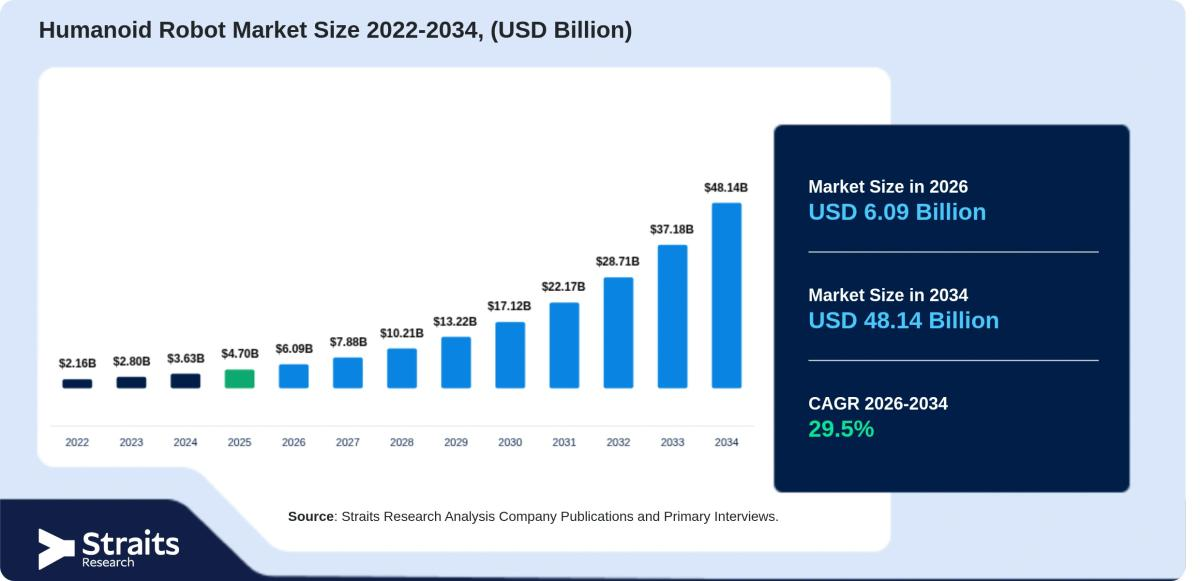
Humanoid Robot Market Forecast, 2034
The humanoid robot market is advancing as artificial intelligence, computer vision, sensors, actuators, and machine learning improve robots’ ability to perform human-like physical and cognitive tasks. Commercial experimentation across manufacturing, logistics, healthcare, research, and service environments is expanding the potential application base for general-purpose humanoid robots.
The global humanoid robot market size was valued at USD 4.7 billion in 2025 and is projected to reach USD 6.09 billion in 2026 and USD 48.14 billion by 2034, registering a CAGR of 29.5% during 2026–2034.
Market Drivers
Robotics-as-a-Service and Labor Shortages
Robotics-as-a-Service models can reduce the upfront investment associated with humanoid robots through subscription, leasing, or usage-based deployment. Workforce shortages across manufacturing, logistics, healthcare, and service industries are also encouraging companies to explore flexible robotic systems.
Advancement of Embodied Artificial Intelligence
Vision-language-action models are allowing humanoid robots to connect visual and language inputs with physical actions. These capabilities improve environmental understanding, task execution, and adaptability, supporting the transition from pre-programmed machines toward more general-purpose robots.
Expansion of Industrial Automation
Manufacturers are testing humanoid robots for material handling, machine tending, assembly, inspection, and other repetitive activities. Their human-like structure allows them to potentially operate within workspaces, tools, and workflows originally designed for people.
Growing Investment in Humanoid Robotics
Technology companies, robotics manufacturers, investors, and industrial organizations are directing capital toward AI models, actuators, sensors, batteries, simulation, and robot manufacturing. This investment is accelerating technology development and commercial deployment.
Market Challenges
High Technical Complexity and Development Costs
Humanoid robots require sophisticated actuators, sensors, processors, batteries, control systems, and AI software to reproduce human-like movement and interaction. Integrating these technologies while maintaining reliable operation can increase development and production costs.
Safety and Reliability Requirements
Humanoid robots operate near people and must maintain stable movement, accurate perception, and predictable responses. Manufacturers therefore need extensive testing and validation before deploying robots in manufacturing, healthcare, logistics, and public environments.
Limited Component Supply at Scale
Large-scale production requires dependable supplies of precision actuators, motors, reducers, sensors, batteries, semiconductors, and other specialized components. Supply constraints or inconsistent component quality can make mass production more difficult.
Specialized Skills and Integration Requirements
Deployment requires expertise in robotics, artificial intelligence, software engineering, controls, maintenance, and system integration. Organizations without these capabilities may face difficulties integrating humanoid robots into existing operational environments.
Market Segmentation
- By Type: Bipedal Humanoid Robots, Wheel-Based Humanoid Robots, Others
- By Component: Hardware, Software
- By Application: Education and Research, Healthcare and Medical Assistance, Entertainment and Gaming, Personal Assistance and Companionship, Industrial and Manufacturing, Others
- By End-User: Healthcare Institutions, Research Institutes, Manufacturing Companies, Entertainment Companies, Others
- By Region: North America, Europe, Asia Pacific, Middle East & Africa, Latin America
Regional Insights
Asia Pacific dominated the humanoid robot market in 2025, supported by established robotics ecosystems, manufacturing capabilities, artificial intelligence development, and investment in industrial automation. China, Japan, and South Korea are important contributors to regional development across manufacturing, research, healthcare, and service applications.
Europe is projected to register the fastest growth during 2026–2034, supported by advanced manufacturing, Industry 4.0 adoption, robotics research, and demand for flexible automation. Investments in artificial intelligence, human-robot interaction, and autonomous systems are also creating opportunities for commercial deployment.
North America benefits from strong artificial intelligence capabilities, robotics research, venture investment, and advanced manufacturing infrastructure. Humanoid robots are being evaluated across factories, warehouses, logistics operations, and research environments.
Latin America is supported by industrial automation, digital transformation, and modernization of manufacturing operations. Research institutions and industrial organizations are creating early opportunities for humanoid robots in manufacturing, education, logistics, and service applications.
The Middle East & Africa market is supported by smart-city programs, artificial intelligence initiatives, economic diversification, and investment in advanced automation. Hospitality, healthcare, retail, education, and government services provide potential applications for humanoid systems.
Key Players Analysis
The humanoid robot market includes robotics manufacturers, artificial intelligence developers, technology companies, and specialized humanoid robotics startups. Competition is shaped by AI capabilities, mobility, manipulation accuracy, battery performance, safety, hardware reliability, software adaptability, and commercial deployment experience.
Key players include Tesla, Inc.; Figure AI, Inc.; Agility Robotics; Boston Dynamics, Inc.; and Apptronik, Inc.
For detailed insights, visit: https://straitsresearch.com/report/humanoid-robot-market
About Us
Straits Research is a leading research and intelligence organization specializing in research, analytics, and advisory services, providing comprehensive business insights and market research reports across diverse industries.
Contact Us
Email: [email protected]
Tel: +1 646 905 0080 (U.S.), +44 203 695 0070 (U.K.)












Comments (0)