

How to Test a UAE E-Invoicing Compliance Solution Before Go-Live
Learn how to test a UAE e-invoicing compliance solution with real invoices, check data mapping, validation and rejections before go-live. E-Invoicing Software for UAE businesses

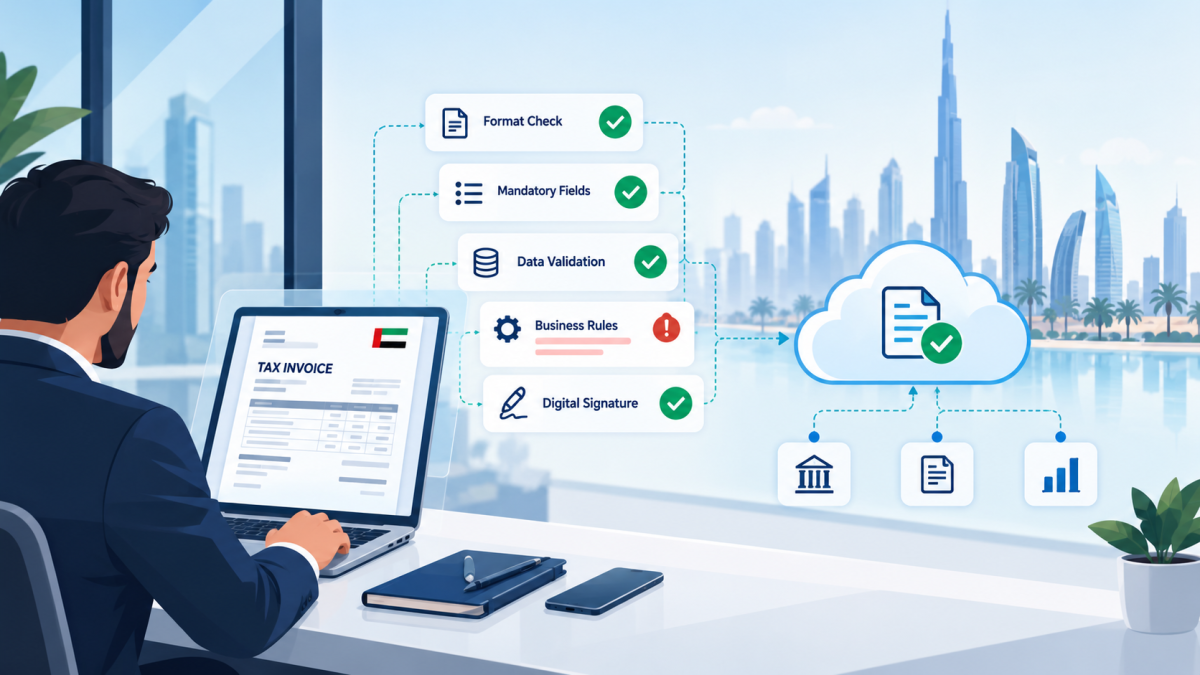
Many finance teams treat e-invoicing as a purchasing task: shortlist a vendor, sign the contract and wait for the deadline. The weakness in that approach is that a signed contract says very little about whether your real invoices will pass validation. Testing a UAE e-invoicing compliance solution against your own invoice data is where most problems surface, and it is far cheaper to fix them before go-live than after.
The timing makes this urgent. As of October 2026, businesses with annual revenue of AED 50 million or more must appoint an Accredited Service Provider (ASP) by 30 October 2026 and start issuing e-invoices on 1 January 2027. Other in-scope businesses follow later, with ASP appointment due by 31 March 2027 and issuing from 1 July 2027. The Ministry of Finance opened a pilot on 1 July 2026, and businesses can use the system voluntarily from that date, which gives you room to test.
Whether you have already appointed a provider or are still comparing options, a UAE e-invoicing compliance solution has to do more than produce an invoice file. It must take data from your ERP or billing system, shape it into the required format, pass validation and keep records you can retrieve later. Each of those steps can fail for a different reason.
The short version: test with real invoices, not samples. Check data mapping, format validity, rejection handling, incoming invoices and archiving, and do it while the pilot window and the deadlines still leave room to correct mistakes.
What the UAE System Expects From Your Invoices
Structured data, not a PDF
The UAE model covers business-to-business and business-to-government transactions, while business-to-consumer sales are out of scope for now. E-invoices must be structured, machine-readable XML based on PINT AE, the UAE’s Peppol specification. A PDF sent by email is not an e-invoice, so a tool that simply attaches a PDF to a message does not meet the requirement.
The provider sits in the middle
Invoices travel through an Accredited Service Provider connected to the Peppol network instead of going straight to the buyer or the tax authority. The provider validates each invoice and reports the data onward. That makes your testing partly about your own data quality and partly about how reliably the provider’s platform handles it. Both issuers and recipients need a provider, so the receiving side deserves just as much attention as the sending side.
Know which deadline applies to you
The AED 50 million threshold is based on annual revenue, so confirm how your business measures it and which category you fall into. Check the Ministry of Finance and Federal Tax Authority guidance for your own situation, because a testing plan built for the wrong deadline wastes weeks.
Five Tests for Your UAE E-Invoicing Compliance Solution
Treat these as a checklist you can hand to finance, IT and your provider. Run each one with a real batch of invoices that includes your awkward cases: credit notes, mixed tax rates, zero-rated sales and invoices with long line item lists.
| Test | What to check | Why it matters |
|---|---|---|
| Field mapping | Every mandatory field is filled from source data, including tax registration numbers and VAT amounts | A missing or misplaced field can make an otherwise correct invoice fail validation |
| Format validation | Output passes the UAE specification, not just a generic XML check | An invoice can be valid XML and still be rejected |
| Rejection handling | Failed invoices return a clear reason and can be corrected and resubmitted | Teams need to fix errors the same day, not investigate for a week |
| Incoming invoices | Supplier invoices are received, matched and recorded | Recipients must be connected too, and receiving is part of the first deadline |
| Archiving and retrieval | Invoices and acknowledgments can be searched and retrieved on request | Records must stay accessible for audits |
Do not stop after one clean run. A batch of twenty ordinary invoices proves very little. The failures usually appear with the odd transaction, such as a partially credited invoice or a customer record created years ago with incomplete details.
Where Invoice Data Usually Goes Wrong
Most failures trace back to the source system rather than the e-invoicing platform. Customer records may lack a tax registration number, product descriptions may exceed field limits, and tax codes may be inconsistent between modules. A clean connection between the ERP and the invoicing layer matters here, because every manual export adds another place for an error to enter. That is why many companies look at ERP-integrated e-invoicing software that connects directly with platforms such as SAP, Oracle or Microsoft Dynamics 365 instead of relying on spreadsheets and re-keying.
A data audit is the quickest way to find these problems. Pull the last three months of invoices and check the fields the system will need:
- Customer and supplier tax registration numbers are present and correctly formatted
- Item descriptions, units and quantities are recorded consistently
- A tax category and rate appear on every line
- Credit notes can be traced back to the original invoice
Fix the master records first. Correcting a customer record once is much easier than correcting hundreds of rejected invoices later.
Handling Rejections and Exceptions
No test cycle removes every error, so plan for what happens when an invoice is rejected after go-live. Decide who sees the rejection, how quickly it must be fixed, and whether corrections happen in the ERP or in the e-invoicing layer. Fixing the source record keeps your books and the submitted invoice aligned. Fixing only the outgoing file leaves a mismatch that someone has to reconcile later.
It also helps to agree service expectations with your provider: how fast it responds to platform problems, how it communicates regulatory changes and what happens if its network connection is interrupted. The rules were still being adjusted during 2026, and the first appointment deadline itself moved from 31 July to 30 October, so ask how updates reach your system and who tests them before they go live.
A Sensible Testing Sequence
Once the data is in better shape, a simple order of work keeps the effort manageable:
- Audit source data and correct customer and item master records.
- Run a small batch of ordinary invoices and review every rejection.
- Add the edge cases: credit notes, zero-rated sales, mixed tax rates and large invoices.
- Test receiving invoices from a few suppliers.
- Rehearse the correction process with the finance team, so people know what to do when a rejection arrives.
- Repeat with a full month of volume to check timing and performance as well as accuracy.
Use the Pilot Window to Find Problems Early
The deadlines are fixed, but the quality of your preparation is not. Appointing a provider satisfies one requirement, and it does not prove your invoices are ready. Teams that test with real data, rehearse rejections and tidy their master records before 1 January 2027, or before 1 July 2027 for later waves, will spend go-live resolving small issues instead of discovering large ones.
Start with the data audit this week, and treat testing as part of the compliance work rather than a step that comes after it.











Comments (0)