

Soft Robotics Market Projected to Register a 31% CAGR Through 2034
The global soft robotics market size was valued at USD 1.62 billion in 2025

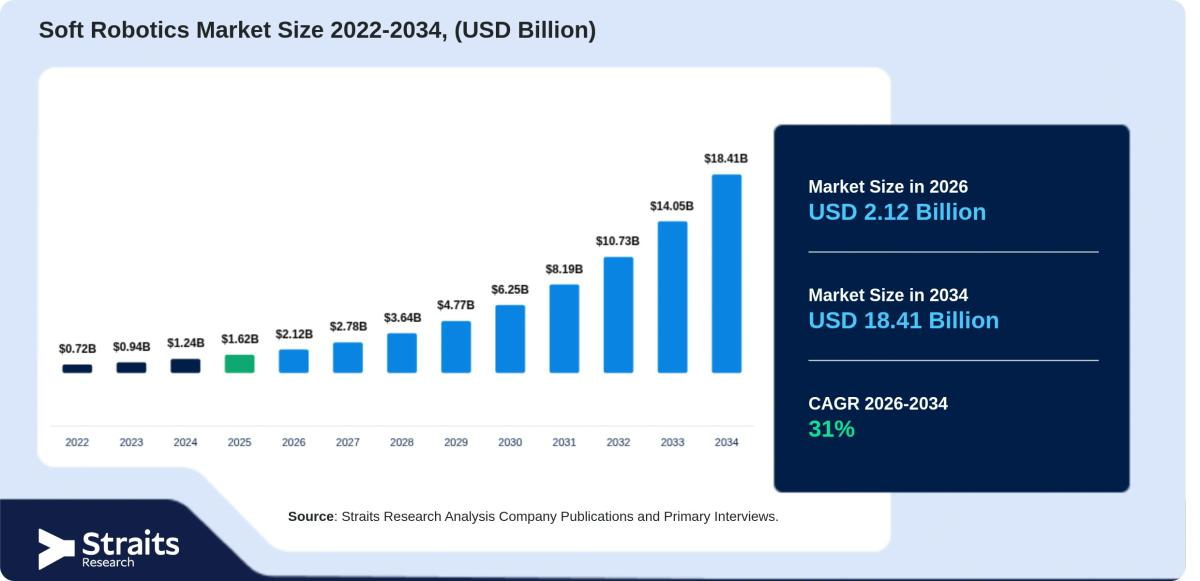
Soft Robotics Market Size, Forecast to 2034
The global soft robotics market size was valued at USD 1.62 billion in 2025 and is projected to grow from USD 2.12 billion in 2026 to USD 18.41 billion by 2034, registering a CAGR of 31% during the forecast period from 2026 to 2034. Asia Pacific dominated the soft robotics market in 2025, accounting for 34.6% of the global market.
Market Drivers
Increasing Adoption of Automation Across Industries
The adoption of automation across manufacturing, logistics, food processing, and other industries is driving demand for soft robotics. Flexible robotic systems can handle delicate, irregularly shaped, and varied objects while reducing the risk of damage. Their adaptability makes them suitable for production environments that require precision, operational flexibility, and safer human-machine interaction.
Expanding Healthcare and Rehabilitation Applications
The use of soft robotics in healthcare is gaining momentum due to its potential in rehabilitation, assistive devices, and medical procedures. Soft exoskeletons can support body movement and muscle training, while flexible robotic systems can perform delicate tasks with controlled force. These capabilities create opportunities for healthcare providers seeking improved patient support and more adaptable medical technologies.
Advancements in Materials, Sensors, and Artificial Intelligence
Developments in flexible materials, embedded sensors, and artificial intelligence are improving the responsiveness and functionality of soft robots. These technologies allow robotic systems to adapt their movements to objects and surrounding conditions, expanding their suitability for complex tasks. Enhanced sensing and control capabilities are also helping manufacturers integrate soft robotics into automated production and material-handling operations.
Market Challenges
High Development and Implementation Costs
The development of soft robotics requires specialized materials, actuators, sensors, control systems, and engineering expertise. These requirements can increase initial investment and make deployment difficult for smaller businesses with limited automation budgets. The need for customized designs and integration further adds to implementation costs.
Technical Complexity and Limited Standardization
Soft robots often rely on deformable structures that behave differently under varying loads, temperatures, and operating conditions. Predicting their movements and maintaining precise control can be more complex than managing conventional rigid robots. The absence of widely adopted design and testing standards can also complicate system validation, interoperability, and large-scale deployment.
Durability and Maintenance Limitations
Flexible materials and soft actuators can be vulnerable to wear, punctures, fatigue, and performance changes during repeated use. These limitations can affect reliability in demanding industrial environments where consistent operation is essential. Businesses may also face additional maintenance requirements and replacement costs when soft robotic systems operate continuously.
Market Segmentation
The soft robotics market is segmented by:
-
By Type: Soft grippers, cobots, inflated robots, exoskeleton
-
By Component: Hardware, software
-
By End-User: Healthcare, advanced manufacturing, food and beverages, logistics, others
-
By Region: North America, Europe, Asia Pacific, Middle East and Africa, Latin America
Regional Insights
North America Soft Robotics Market Analysis
North America benefits from established robotics research, advanced manufacturing capabilities, and investment in healthcare technology. Demand across logistics, medical rehabilitation, and industrial automation creates opportunities for companies developing flexible robotic systems. Collaborations between research institutions and technology providers also contribute to product development and commercialization.
Europe Soft Robotics Market Analysis
Europe has a strong industrial automation base and an established robotics ecosystem, creating favorable conditions for soft robotics adoption. Manufacturing companies are exploring flexible robotic solutions for precision handling, collaborative operations, and workplace safety. Research initiatives and technological innovation also contribute to regional market development.
Asia Pacific Soft Robotics Market Analysis
Asia Pacific held the largest share of the soft robotics market in 2025, supported by its manufacturing base and expanding automation investments. Industries across China, Japan, South Korea, and India are exploring flexible robotic technologies for production, logistics, food processing, and healthcare. The region's electronics, automotive, and consumer goods industries offer significant opportunities for adaptable robotic systems.
Middle East and Africa Soft Robotics Market Analysis
The Middle East and Africa market is shaped by industrial modernization, healthcare investment, and gradual adoption of automation technologies. Manufacturing facilities and logistics operators are exploring robotic solutions to improve productivity and handling precision. Market development depends on technology accessibility, specialized workforce availability, and investment in automation infrastructure.
Latin America Soft Robotics Market Analysis
Latin America presents opportunities for soft robotics through automation in food processing, manufacturing, agriculture-related operations, and logistics. Flexible grippers can help businesses handle delicate products and manage varied product formats. Adoption will depend on affordability, technical support, and the ability to integrate these systems into existing industrial operations.
Key Players Analysis
The soft robotics market includes specialized soft robotics developers, medical technology companies, industrial automation suppliers, and established robotics manufacturers. Established players compete through product reliability, technological expertise, application-specific solutions, and integration capabilities, while emerging companies focus on innovative materials, specialized gripping systems, wearable robotics, and cost-effective designs. Partnerships with manufacturers, healthcare providers, and research institutions also help companies expand their product capabilities and commercial reach.
Key industry participants include Bioservo Technologies AB, Cyberdyne Inc., Ekso Bionics Holdings, Inc., F&P Robotics AG, and Festo AG.
For Detailed Insights, Visit: https://straitsresearch.com/report/soft-robotics-market
About Us
Straits Research is a research and intelligence organization specializing in research, analytics, and advisory services, providing business insights and market research reports across diverse industries.
Contact Us
Email: [email protected]
Tel: +1 646 905 0080 (U.S.), +44 203 695 0070 (U.K.)














Comments (0)