

Quantum Computing Market Forecast to Reach USD 15.57 Billion by 2034, Registering a CAGR of 29.5%
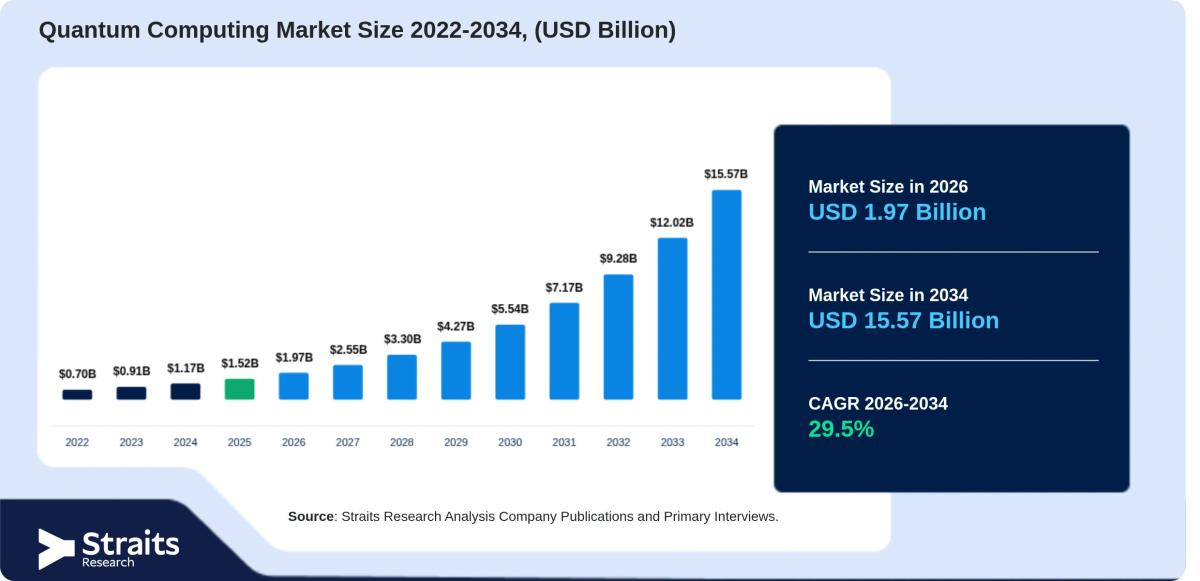
The global quantum computing market size was valued at USD 1.52 billion in 2025

Quantum Computing Market Forecast, 2034
The quantum computing market is advancing as organizations explore quantum systems for complex optimization, machine learning, drug discovery, materials science, financial modeling, and scientific simulation. Improvements in quantum processors, error correction, hybrid quantum-classical computing, and cloud-based access are helping move the technology from experimental research toward commercial applications.
The global quantum computing market size was valued at USD 1.52 billion in 2025 and is projected to reach USD 1.97 billion in 2026 and USD 15.57 billion by 2034, registering a CAGR of 29.5% during 2026–2034.
Market Drivers
Rising Investment in Quantum Technology
Governments, technology companies, universities, and research institutions are directing capital toward quantum hardware, software, networking, and supporting infrastructure. These investments are accelerating processor development and expanding the ecosystem required for commercial applications.
Advancement of Fault-Tolerant Quantum Computing
Improved qubit reliability, error correction, gate fidelity, and logical qubits are addressing technical barriers that limit useful quantum calculations. Progress in these areas is strengthening the potential for quantum systems to handle complex workloads.
Integration of Quantum and Classical Computing
Hybrid architectures allow quantum processors to work alongside conventional high-performance computing systems. This approach enables quantum systems to address specialized portions of computational workloads while classical infrastructure manages other processing requirements.
Expansion of Cloud-Based Quantum Services
Cloud platforms provide businesses, researchers, and developers with remote access to quantum processors without requiring specialized on-premise infrastructure. This model is lowering entry barriers and supporting experimentation across financial services, pharmaceuticals, materials, logistics, and scientific research.
Market Challenges
High Infrastructure and Operating Requirements
Quantum systems can require specialized cooling, control electronics, shielding, vacuum systems, or other highly controlled operating environments depending on the technology. These requirements increase capital and maintenance needs for organizations seeking direct access to quantum hardware.
High Error Rates and System Complexity
Quantum states are sensitive to environmental noise and operational imperfections, making error management a major technical requirement. Maintaining reliable computation while scaling qubit counts requires sophisticated hardware, control systems, and error-correction methods.
Shortage of Specialized Quantum Talent
Quantum computing requires expertise across quantum physics, mathematics, computer science, semiconductor engineering, software development, and system controls. Limited availability of professionals with cross-disciplinary skills can slow development and commercial implementation.
Difficulty Scaling Systems for Commercial Workloads
Quantum computers must improve qubit quality, connectivity, error correction, control, and computational stability simultaneously to support longer and more complex workloads. Achieving these improvements while maintaining manageable system costs remains a significant industry challenge.
Market Segmentation
- By Type: Software, Hardware
- By Application: Machine Learning, Optimization, Biomedical Simulations, Financial Services, Electronic Material Discovery, Others
- By Deployment: On-Premise, Cloud
- By Verticals: Defense, Healthcare and Pharmaceuticals, Chemicals, Banking and Finance, Energy and Power, Others
- By Region: North America, Europe, Asia Pacific, Middle East & Africa, Latin America
Regional Insights
North America dominated the quantum computing market in 2025, supported by substantial public and private investment, advanced research institutions, technology companies, and established high-performance computing infrastructure. The United States remains an important center for quantum hardware, software, cloud platforms, and commercial experimentation.
Europe is projected to register the fastest growth during 2026–2034, supported by public research programs, quantum infrastructure development, and collaboration among universities, technology companies, and research organizations. Applications across pharmaceuticals, chemicals, finance, manufacturing, and scientific research are creating additional opportunities.
Asia Pacific is supported by government-backed technology programs, semiconductor capabilities, advanced electronics industries, and growing investment in quantum research. China, Japan, South Korea, and Australia are developing quantum computing capabilities across hardware, software, communications, and scientific applications.
Latin America is developing its quantum computing ecosystem through university research, workforce training, cloud-based quantum access, and international collaborations. Finance, logistics, energy, and scientific research provide potential application areas as regional capabilities expand.
The Middle East & Africa market is supported by investments in artificial intelligence, advanced computing, digital transformation, and scientific infrastructure. Research institutions and technology organizations are exploring quantum computing for optimization, energy, materials science, cybersecurity, and other computationally intensive applications.
Key Players Analysis
The quantum computing market includes established technology companies, specialized quantum hardware developers, software providers, research-focused organizations, and cloud technology companies. Competition is shaped by processor architecture, qubit reliability, error correction, software ecosystems, cloud accessibility, scalability, and partnerships with research and commercial organizations.
Key players include Cambridge Quantum Computing Ltd.; Nokia Bell Labs; Toshiba Corporation; D-Wave Systems Inc.; and IonQ, Inc.
For detailed insights, visit: https://straitsresearch.com/report/quantum-computing-market
About Us
Straits Research is a leading research and intelligence organization specializing in research, analytics, and advisory services, providing comprehensive business insights and market research reports across diverse industries.
Contact Us
Email: [email protected]
Tel: +1 646 905 0080 (U.S.), +44 203 695 0070 (U.K.)












Comments (0)