

How a Grid-tied PV System Works with Hybrid Solar Inverter?
A grid-tied photovoltaic (PV) system allows homes and businesses to generate electricity from sunlight while remaining connected to the utility grid. When combined with a hybrid solar inverter, the system can do more than convert solar energy into usable electricity. It can also manage battery charging, coordinate power from multiple sources, and help provide backup power during grid outages when the system is properly configured.

1. Solar Panels Convert Sunlight into Electricity
The process begins with solar panels installed on a rooftop or another suitable location. When sunlight reaches the photovoltaic cells, they generate direct current (DC) electricity. However, most household appliances and commercial electrical equipment use alternating current (AC), so the generated electricity must be converted before it can power these loads.
The amount of electricity produced depends on sunlight intensity, panel orientation, temperature, shading, and the capacity of the PV array. A hybrid solar inverter uses maximum power point tracking (MPPT) to adjust the operating conditions of the solar panels, helping them produce as much available power as possible.
2. The Hybrid Solar Inverter Manages Power Conversion
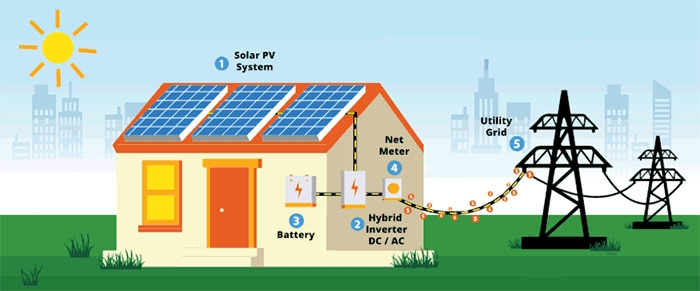
The hybrid solar inverter is the central component connecting the solar panels, household loads, battery storage, and utility grid. It converts DC electricity from the PV array into AC electricity compatible with the building's electrical system. Depending on its design, it can also convert electricity between AC and DC to charge or discharge a connected battery.
Unlike a basic grid-tied inverter, which primarily converts solar energy for use or export to the grid, a hybrid solar inverter can coordinate several power sources. Its control system determines how available solar power should be distributed according to energy demand, battery settings, grid conditions, and user preferences.
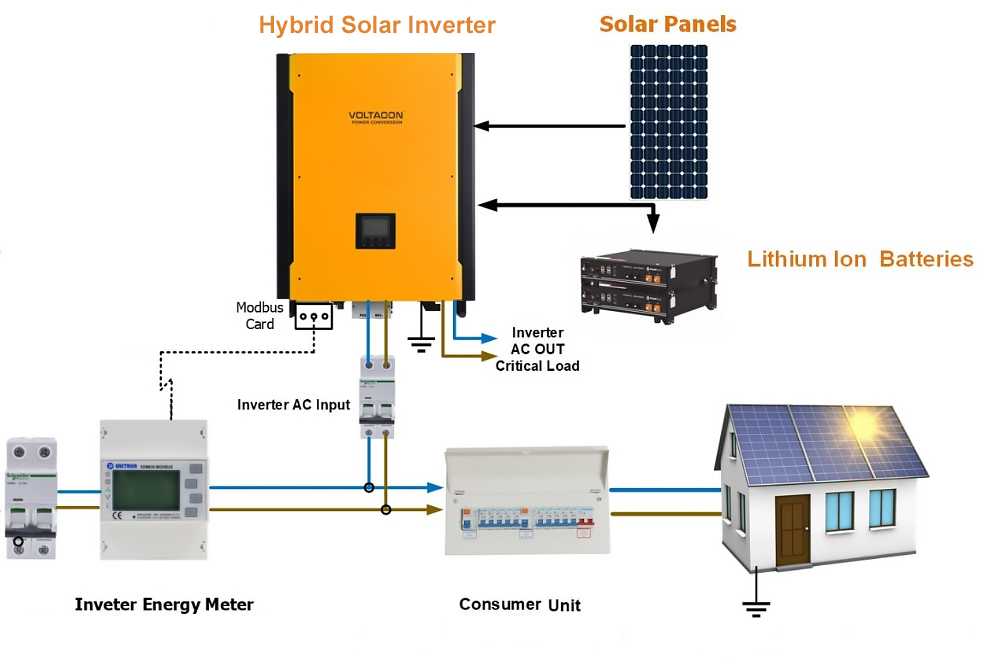
3. Solar Energy Powers Loads and Charges Batteries
When the solar panels generate electricity, the hybrid solar inverter can prioritize powering connected loads. If solar production exceeds immediate demand, the surplus energy may be used to charge the battery. Once the battery reaches its configured charging limit, excess electricity may be exported to the utility grid if the system and local utility rules permit it.
When solar production falls below demand, such as during cloudy weather or at night, the hybrid inverter may draw electricity from the battery or the grid. The selected operating mode determines which source is used first. For example, users may configure the system to prioritize solar self-consumption, maintain a battery reserve for emergencies, or charge the battery during designated off-peak periods when supported.
4. The Utility Grid Provides Additional Power
A grid-tied PV system remains connected to the utility network, allowing electricity to flow from the grid when solar generation and available battery energy are insufficient. When the system produces more electricity than the building consumes, surplus energy may be sent to the grid, depending on the inverter configuration, metering arrangement, interconnection agreement, and local regulations.
Grid-connected hybrid inverters must synchronize their AC output with the utility supply. They also incorporate grid-protection functions to help ensure safe operation. Importantly, a conventional grid-connected inverter generally shuts down during a utility outage to prevent electricity from feeding into power lines that may be under repair. A hybrid inverter can provide backup power only when it has suitable backup-output capability, compatible storage or another supported energy source, and the required isolation and transfer equipment.
5. Battery Storage and Backup Power Improve Flexibility
Battery storage is one of the main advantages of combining a hybrid solar inverter with a grid-tied PV system. During sunny periods, surplus solar electricity can charge the battery for later use. If the grid fails, a properly designed hybrid system can disconnect from the utility and supply designated backup loads using available battery energy and, when conditions allow, solar generation.
The backup function depends on the inverter's specifications, battery compatibility, system wiring, and installation design. Some systems can power selected essential circuits, while others support larger backup loads. Users should check continuous and surge power ratings, battery capacity, starting-current requirements, and whether the inverter can operate with solar panels during an outage.
6. Why Choose a Hybrid Solar Inverter?
A hybrid solar inverter combines solar conversion, battery management, and grid interaction in one integrated solution. This can simplify energy management, increase the use of self-generated electricity, and provide greater flexibility than a conventional grid-tied system without storage. Monitoring functions available on many models also help users track solar production, household consumption, battery status, and grid exchange.
When selecting a hybrid solar inverter, consider PV input voltage and power limits, MPPT channels, AC output capacity, battery voltage and compatibility, backup functionality, monitoring options, and local grid requirements. Correct system sizing and professional installation are essential for safe operation and dependable performance.
Inverter.com offers hybrid solar inverter solutions for different solar energy applications. By choosing a suitable model and configuring it for your household or business needs, you can build a PV system that coordinates solar generation, battery storage, and utility power more effectively. A well-designed grid-tied PV system with a hybrid solar inverter helps turn sunlight into a flexible energy resource while supporting greater control over how electricity is generated, stored, and consumed.














Comments (0)