

Four Ways to Start Exporting, Ranked by How Much Work You Keep
A comparison of four export strategies, ranked by how much work your company must handle internally, highlighting the key benefits, drawbacks, and factors to consider when choosing the right approach for international expansion.

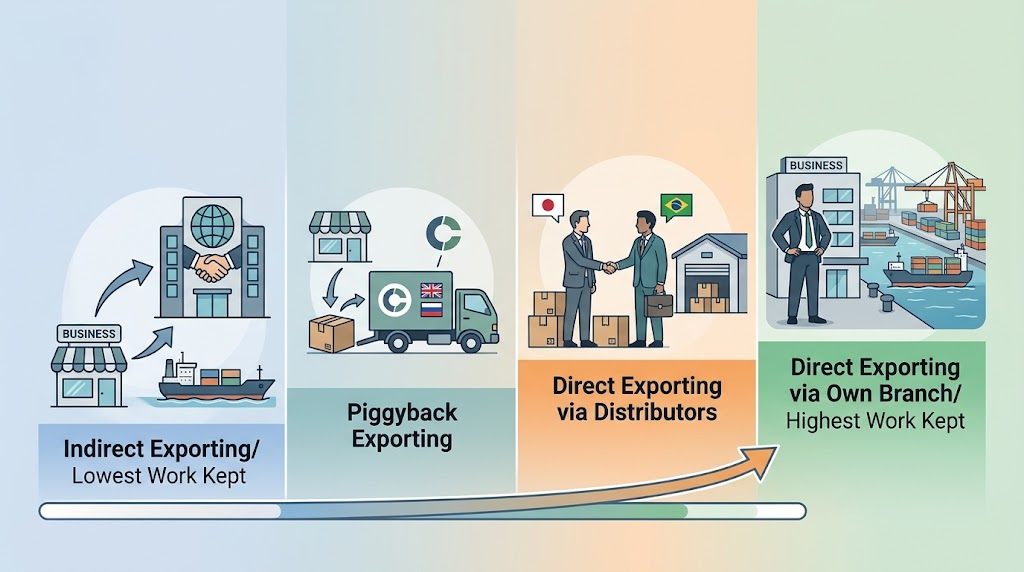
The route that leaves the least export work with your own team is an outsourced export team that sells your products abroad. Direct exporting leaves the most. This list ranks four routes on that one measure and states the main trade-off of each.
Disclosure: This list was written by OutsourcedExport, which is ranked first. The criterion is how much work your company keeps, and an outsourced team wins that by design. It does not mean the first option suits every product. We did not test these routes against each other.
How we evaluated
We compared four routes on one question: how much of the market research, partner finding, selling, and logistics does your company still handle? We also noted the main drawback of each. The export management company points come from an America's SBDC article (2012), so check current practice. The credit insurance figure comes from EXIM's own website.
- An outsourced export team (OutsourcedExport)
An outsourced export team suits companies that want international sales without building an export department. OutsourcedExport describes its work as selling your products in other countries, with services that include market research, distributor development, compliance coordination, logistics coordination, and retail distribution. The drawback is that you hand over part of your customer relationship, so agree on reporting and brand control in writing before you start.
- An export management company (EMC)
An EMC acts as your export department. America's SBDC describes it as functioning like a branch sales office or domestic wholesaler that makes money by selling your products, usually on commission, and says most do not take title to your goods. EMCs usually do not represent competing products. The drawback it names is loss of control over your brand and marketing, so it advises vetting working arrangements as carefully as financial ones. It also advises choosing one with a track record in your product type and target markets.
- Government and nonprofit support
Public support suits companies that can do the work themselves but need guidance and protection. America's SBDC says local centers offer no-cost business consulting. EXIM export credit insurance covers up to 95 percent of sales invoices if a foreign buyer fails to pay, and you pay a premium. The drawback is that this helps you manage risk and learn, but it does not find buyers or sell for you.
- Direct exporting
Direct exporting means you handle every part of the process. America's SBDC says it gives the best opportunity to grow sales and profit, but that the commitment of learning cross-border distribution and setting up in-country partnerships often is not worth the effort for small owners. The drawback is time and risk: every unknown lands on your team.
How do you choose a route?
Choose by two facts: how many people you can spend on export, and whether you already know which country to enter. If you have no spare people, routes 1 and 2 fit. If you cannot yet name a country, decide that first. The guide to selecting your next export market compares markets on demand, channel access, product readiness, and cash tied up. Then plan how you will find a partner. Distributor development covers moving from a list of names to qualified conversations. Start by writing down your product, your first-choice country, and the number of hours a week you can give to export.












Comments (0)