

Electric Mobility Market Approaches USD 2,805.50 Billion Amid Transport Decarbonization
The global electric mobility market size was valued at USD 486.21 billion in 2025

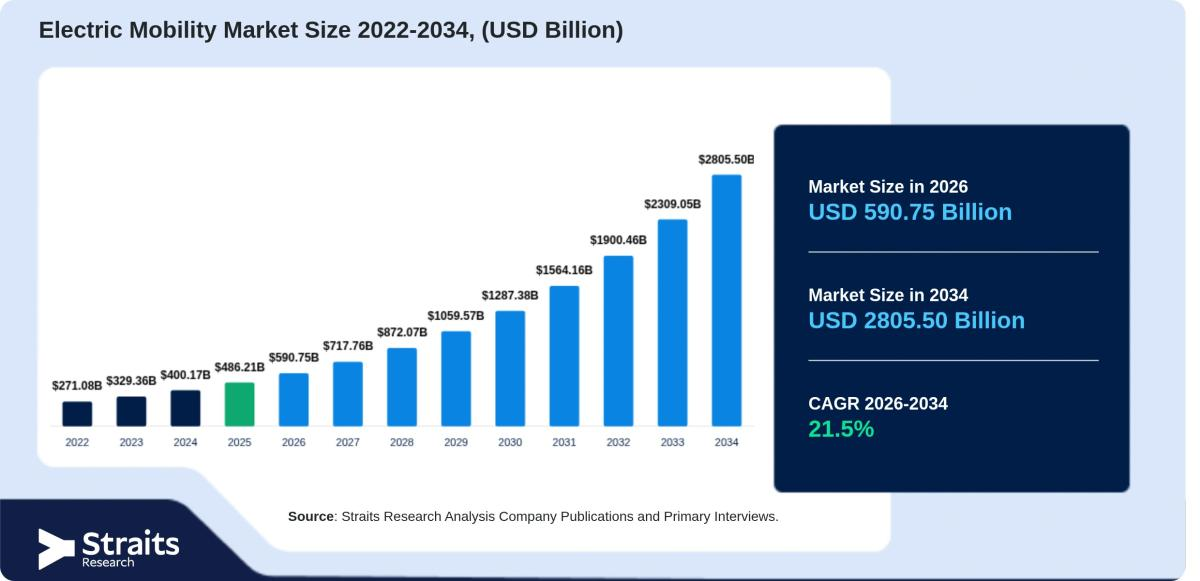
Electric Mobility Market Size, Forecast to 2034
Electric mobility refers to the use of electric-powered vehicles and transportation systems that rely on electric motors and battery technologies for propulsion. The market includes electric cars, scooters, bicycles, motorcycles, skateboards, and wheelchairs. These solutions are gaining importance as consumers, businesses, and governments seek alternatives to conventional fuel-powered transportation. Advancements in battery technology, charging infrastructure, and vehicle electrification are strengthening the adoption of electric mobility across personal and commercial transportation.
The global electric mobility market size was valued at USD 486.21 billion in 2025 and is projected to grow from USD 590.75 billion in 2026 to USD 2805.50 billion by 2034, registering a CAGR of 21.5% during the forecast period from 2026 to 2034. Asia Pacific dominated the market in 2025, accounting for 42.6% of global revenue.
Market Drivers
Rising Adoption of Electric Vehicles
The growing preference for low-emission transportation is a major driver of the electric mobility market. Consumers and commercial fleet operators are increasingly adopting electric cars, two-wheelers, buses, and delivery vehicles to reduce fuel expenses and environmental impact. Improvements in vehicle performance, battery efficiency, and model availability are making electric mobility more accessible across different customer segments. This transition is strengthening demand for electric vehicles and related mobility solutions.
Government Incentives and Emission Reduction Policies
Government initiatives supporting clean transportation are encouraging the adoption of electric mobility. Purchase subsidies, tax benefits, vehicle electrification targets, and investments in public charging infrastructure are improving the economics of electric vehicle ownership. Several countries are also introducing emission regulations and policies that encourage automakers to expand their electric vehicle portfolios. These measures are supporting investment across vehicle manufacturing, battery production, and charging infrastructure.
Expansion of Charging Infrastructure and Battery Technology
The expansion of public and private charging networks is improving the convenience of electric vehicle ownership. Fast-charging stations, highway charging corridors, and workplace charging facilities are helping address concerns related to charging accessibility and driving range. At the same time, advancements in lithium-ion batteries, battery management systems, and high-voltage architectures are improving vehicle performance and charging efficiency. These developments are strengthening consumer confidence and supporting wider electric mobility adoption.
Market Challenges
High Initial Purchase and Ownership Costs
The relatively high upfront cost of electric vehicles remains a major challenge, particularly in price-sensitive markets. Battery packs, power electronics, thermal management systems, and advanced electronic components contribute to manufacturing expenses. Although electric vehicles can offer lower operating costs over their lifetime, purchase prices and financing requirements may discourage consumers from switching from conventional vehicles. Affordable models and lower battery production costs remain important for broader adoption.
Inadequate Charging Infrastructure and Grid Limitations
Charging infrastructure remains unevenly distributed across urban, rural, and remote locations. Limited access to public charging stations can create inconvenience for users, particularly those without private parking or home charging facilities. High-power charging installations also require substantial electrical capacity, grid connections, and infrastructure upgrades. Delays in permitting and utility connections can further slow charging network expansion.
Battery Supply Chain and Recycling Constraints
Electric mobility depends on the availability of battery materials such as lithium, nickel, graphite, and cobalt. Supply disruptions, commodity price fluctuations, and geographic concentration of mineral processing can affect battery manufacturing costs. Battery disposal and recycling also require specialized infrastructure to recover valuable materials and manage environmental risks. These supply chain and lifecycle challenges create additional pressure on manufacturers and battery suppliers.
Market Segmentation
The electric mobility market is segmented by product, voltage, and battery.
- By Product: Electric Scooter, Electric Bicycle, Electric Skateboard, Electric Motorcycle, Electric Car, Electric Wheelchair
- By Voltage: Less Than 24V, 24V, 36V, 48V, Greater Than 48V
- By Battery: Sealed Lead Acid, NiMH, Li-ion
Regional Insights
Asia Pacific Electric Mobility Market Analysis
Asia Pacific dominated the electric mobility market with a 42.6% share in 2025. Strong electric vehicle manufacturing capabilities, government incentives, and expanding battery production support regional growth. China remains a major contributor due to its large electric vehicle manufacturing base and extensive charging infrastructure. India, Japan, and South Korea are also strengthening their electric mobility industries through investments in vehicle production, battery technologies, and clean transportation initiatives.
Europe Electric Mobility Market Analysis
Europe is projected to register the fastest growth, with a CAGR of 16.34% during the forecast period. Stringent emission regulations, government incentives, and investments in electric vehicle infrastructure are supporting regional adoption. Germany, the United Kingdom, France, and other European countries are encouraging vehicle electrification through clean transportation policies and investments in charging networks. Established automotive manufacturers are also expanding their electric vehicle portfolios to meet changing consumer preferences and regulatory requirements.
North America Electric Mobility Market Analysis
North America represents an important market for electric mobility due to increasing electric vehicle adoption and investments in domestic battery manufacturing. The United States is supporting market development through vehicle electrification initiatives, charging infrastructure expansion, and investments across the EV supply chain. Canada is also strengthening its position through battery manufacturing investments and policies that encourage zero-emission vehicle adoption. Growing interest in electric commercial fleets and passenger vehicles is creating additional opportunities.
Middle East and Africa Electric Mobility Market Analysis
The Middle East and Africa market is developing as governments and businesses invest in sustainable transportation and urban infrastructure. Smart city projects, electric public transportation initiatives, and expanding charging networks are supporting adoption, particularly in the United Arab Emirates and Saudi Arabia. In Africa, electric two-wheelers, buses, and other cost-efficient mobility solutions offer opportunities to address urban transportation needs. Improvements in charging access and vehicle affordability will remain important for regional expansion.
Latin America Electric Mobility Market Analysis
Latin America is witnessing increasing interest in electric mobility as governments and transportation operators explore cleaner alternatives to conventional vehicles. Brazil, Mexico, Chile, and Colombia are supporting market development through electric public transportation projects, vehicle incentives, and charging infrastructure investments. Electric buses and two-wheelers are gaining attention in urban transportation systems, while local manufacturing and battery supply chain investments could strengthen regional market development.
Key Players Analysis
The global electric mobility market is highly competitive, with established automotive manufacturers and specialized electric vehicle companies competing across passenger cars, two-wheelers, bicycles, and other electric transportation categories. Market participants focus on battery performance, vehicle range, charging speed, affordability, and connected mobility technologies. Investments in manufacturing capacity, strategic partnerships, and product innovation are helping companies strengthen their market positions.
Key players operating in the electric mobility market include:
- Tesla, Inc.
- Nissan Motor Corporation
- BMW Motorrad
- General Motors Company
- Honda Motor Co., Ltd.
- BYD Company Ltd.
- Accell Group
- Volkswagen AG
- Zero Motorcycles, Inc.
- Ford Motor Company
For Detailed Insights, Visit : https://straitsresearch.com/report/electric-mobility-market
About Us
Straits Research is a research and intelligence organization specializing in research, analytics, and advisory services, providing business insights and market research reports across diverse industries.
Contact Us
- Email: [email protected]
- U.S.: +1 646 905 0080
- U.K.: +44 203 695 0070







Comments (0)