

Different Types of Construction Aggregates and Their Uses
Learn about different construction aggregates and where they are used, from road bases and concrete to drainage, landscaping, and other projects.

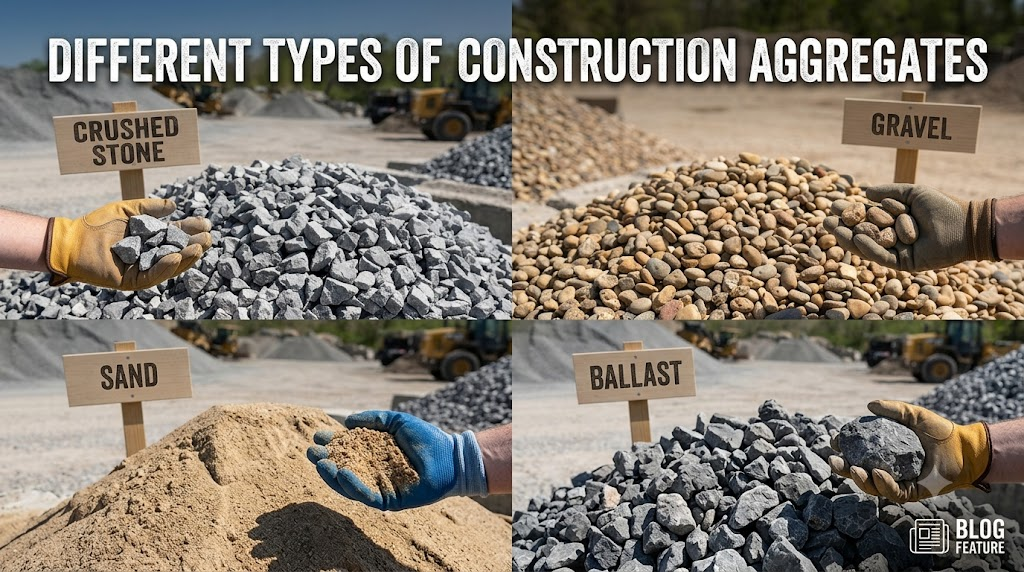
If you have ever ordered construction material before, you probably know how quickly a simple question can turn into five more questions. What size? Washed or unwashed? Crushed or natural? And do we really need that much?
It happens all the time. When we are looking for sand and gravel in San Bernardino County, it helps to know what the different materials are actually for. Once we understand that part, choosing gets a whole lot easier.
Sand... Not Just Sand
Let us start with sand because it sounds simple.
We need sand for things like concrete, mortar, plastering, bedding, and other construction work. But the sand used for one job may not be the best fit for another.
Washed sand is cleaned before it is sold, so it has less unwanted dust and fine material. Depending on what we are doing, that can be useful.
The funny thing is, two piles of sand can look pretty similar while being intended for completely different work. So yes, it is worth asking before loading up the truck.
Gravel Gets Around
Gravel is one of those materials that seems to show up everywhere.
Driveways. Walkways. Drainage areas. Landscaping. Construction sites.
The size makes a difference, though. Smaller pieces and larger pieces behave differently, and we do not want to find that out after the material has already been delivered.
For a driveway, for example, we may need something that can settle and compact well. For landscaping, the look and size might matter more.
Same basic material... different job.
Crushed Stone Has a Different Feel
Crushed stone is made by crushing larger rocks into smaller pieces. Unlike rounded gravel, the pieces usually have sharper edges.
That shape can be useful when we need material to fit together and create a firm layer. It is often used beneath driveways, roads, foundations, and other construction areas.
You probably will not notice the crushed stone once the project is finished. That is kind of the point. It is there to do its job underneath everything else.
Road Base Does the Heavy Lifting
Here is where things can get confusing.
People sometimes look at a finished driveway or road and think mostly about the concrete or asphalt on top. There is usually more going on underneath.
Road base is used as a supporting layer under surfaces such as roads, driveways, and parking areas. It gives the surface above something solid to sit on.
We do not really think about the base when everything looks good. But if the preparation underneath is wrong, problems can show up later. Nobody wants to redo a driveway because the first step was rushed.
Rip Rap Is for Bigger Problems
Rip rap is not the small stuff.
These are larger rocks used in areas where the ground needs protection, especially around slopes, drainage channels, banks, and places where water can cause erosion.
It is a pretty straightforward idea... put larger rock where smaller material or soil may get moved around.
It also works well when a project needs a rough, natural-looking finish instead of something overly neat.
Decorative Rock Can Change the Look of a Space
Not every rock has to disappear underneath something.
Decorative rock and cobblestones are often used in landscaping, garden areas, walkways, borders, and around driveways. Here, appearance becomes part of the decision.
Color, size, shape, and texture can all change the way an outdoor area looks. Sometimes a small change in the rock is enough to make the whole space feel different.
So, What Should We Actually Buy?
This is probably the part that matters most.
Do not start with, “Which aggregate is the best?”
Start with, “What are we doing with it?”
Those are two very different questions.
A driveway needs something different from a drainage area. Concrete needs suitable aggregate. A landscaping project gives us a completely different set of choices.
When buying sand and gravel in San Bernardino County, we should have a few basic details ready... what the project is, where the material will be used, and roughly how much space needs to be covered.
That gives the supplier something useful to work with. And it can save us from having a mountain of the wrong material sitting in the yard.









Comments (0)