

Understanding Various Sources of Working Capital Financing
Understand various sources of working capital financing to improve liquidity, manage cash flow, meet short-term expenses, and support business growth.

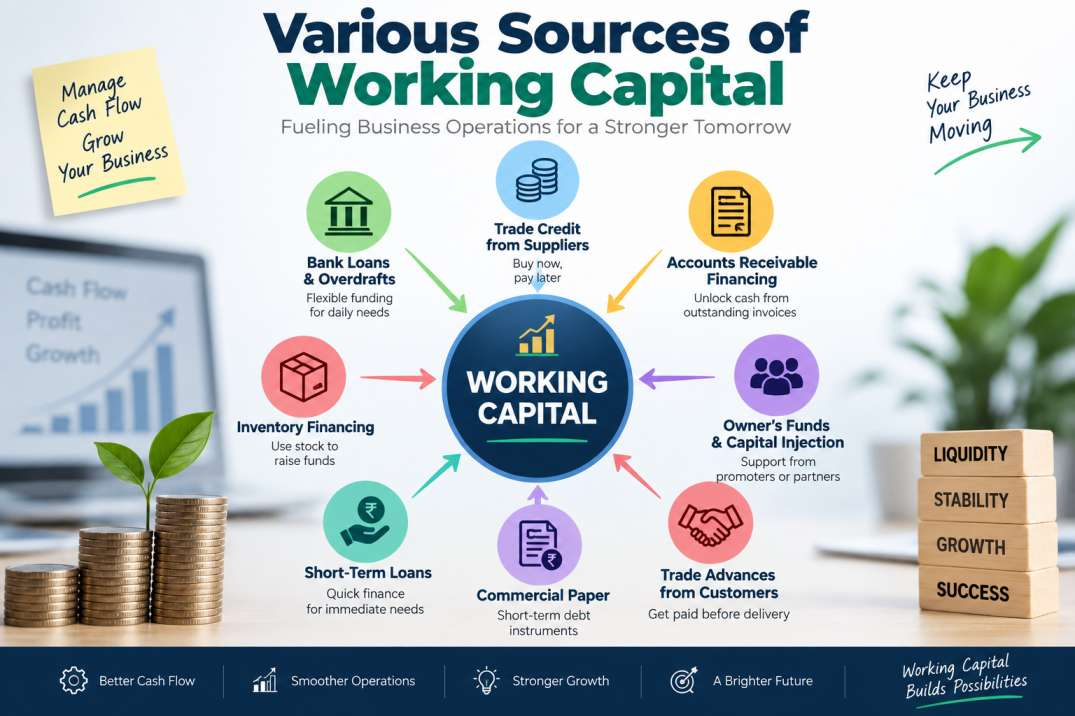
Working capital financing is essential for businesses that need funds to manage day-to-day operations and maintain healthy cash flow. Companies often need additional funds to purchase inventory, pay suppliers, manage salaries, cover operating expenses, and handle temporary gaps between payments and receipts.
Understanding the various sources of working capital can help businesses choose suitable financing solutions based on their cash flow requirements, business size, repayment capacity, and growth objectives. The right financing strategy can improve liquidity while allowing a business to operate smoothly and pursue new opportunities.
What Is Working Capital Financing?
Working capital financing refers to funds used to meet a business's short-term financial requirements. It is generally needed to manage the operating cycle between purchasing materials, producing or selling goods, and collecting payments from customers.
Working capital is calculated as:
Working Capital = Current Assets − Current Liabilities
When a business has sufficient working capital, it can manage short-term obligations without disrupting its normal operations.
Why Is Working Capital Financing Important?
Businesses can experience cash flow gaps even when they have strong sales. For example, a company may need to pay suppliers today while customers may make payments after 30, 60, or 90 days.
Working capital financing can help bridge this gap and provide funds when required. It can support:
-
Inventory purchases
-
Supplier payments
-
Employee salaries
-
Operating expenses
-
Business expansion
-
Seasonal demand
-
Customer credit periods
-
Unexpected financial requirements
Various Sources of Working Capital Financing
There are several financing options available to businesses. Each source has different features, costs, and eligibility requirements.
1. Retained Earnings
Retained earnings are profits that a business keeps instead of distributing them to owners or shareholders. These funds can be reinvested into daily operations, inventory, marketing, expansion, or other short-term requirements.
Retained earnings are an attractive source because they generally do not create additional debt or interest obligations.
2. Trade Credit
Trade credit allows businesses to purchase goods or services from suppliers and make payment after an agreed credit period. This can reduce immediate cash requirements and improve liquidity.
Businesses with established supplier relationships can use trade credit to maintain inventory while waiting for customer payments.
3. Working Capital Loans
Working capital loans are designed specifically to finance short-term business requirements. They can be used for purchasing raw materials, paying suppliers, managing inventory, covering salaries, and handling operating expenses.
Before choosing a loan, businesses should compare interest rates, processing fees, repayment terms, and other applicable costs.
4. Cash Credit
Cash credit is a flexible financing facility that provides eligible businesses with access to funds up to an approved limit. Businesses can use the available funds according to their working capital requirements.
It can be useful for companies with recurring or fluctuating cash flow needs.
5. Bank Overdraft
A bank overdraft allows an eligible business to withdraw funds beyond the available account balance, subject to an approved limit.
An overdraft can be useful for handling temporary cash shortages, urgent payments, or unexpected operating expenses. Interest is generally charged on the amount utilized.
6. Invoice Discounting
Invoice discounting allows businesses to access funds against eligible outstanding invoices before customers make their payments.
Instead of waiting for the entire credit period, businesses can convert receivables into working capital. This can be particularly useful for companies that regularly sell products or services on credit.
7. Bill Discounting
Bill discounting allows businesses to obtain funds against eligible bills before their maturity date. The financing provider generally deducts applicable charges before releasing the funds.
It can help businesses convert future receivables into immediate cash and maintain smoother cash flow.
8. TReDS Bill Discounting
TReDS, or Trade Receivables Discounting System, facilitates the financing of eligible trade receivables through a digital platform. Eligible MSMEs can use TReDS to obtain funds against approved invoices rather than waiting for the buyer's payment cycle.
This can improve liquidity and help businesses manage receivables more efficiently.
9. Customer Advances
Customer advances are payments received before products or services are delivered. Businesses can use these funds to purchase materials, manage production, and cover operational expenses.
Customer advances can reduce the need for external borrowing and are especially useful for businesses working with advance-payment or milestone-based contracts.
10. Commercial Paper
Commercial paper is a short-term debt instrument generally used by financially established companies to raise funds. It can provide access to short-term financing but may involve specific eligibility and creditworthiness requirements.
Therefore, it is generally more suitable for businesses with strong financial profiles and established access to financial markets.
Internal and External Sources of Working Capital
The various sources of working capital can broadly be divided into internal and external sources.
Internal sources may include retained earnings, additional capital contributed by owners, and efficient management of business assets.
External sources can include bank loans, cash credit, overdrafts, trade credit, invoice discounting, bill discounting, and other financing facilities.
Understanding this distinction can help businesses determine whether they should rely on existing resources or seek external funding.
How to Choose the Right Financing Source
Selecting the appropriate working capital financing option depends on several factors. Businesses should consider:
-
Amount of funding required
-
Duration of the funding requirement
-
Cost of financing
-
Repayment capacity
-
Customer payment cycle
-
Inventory requirements
-
Existing debt obligations
-
Collateral requirements
-
Business credit profile
-
Expected future cash flows
For short-term cash flow gaps, trade credit, overdrafts, or invoice-based financing may be appropriate. Businesses with recurring working capital requirements may consider cash credit or structured working capital loans.
Benefits of Effective Working Capital Financing
A well-planned working capital financing strategy can provide several benefits, including:
-
Improved business liquidity
-
Better cash flow management
-
Timely supplier payments
-
Consistent inventory levels
-
Reduced operational disruptions
-
Greater financial flexibility
-
Ability to manage delayed customer payments
-
Support for business expansion
-
Better utilization of business resources
Conclusion
Understanding the various sources of working capital is important for businesses seeking to maintain liquidity and manage daily financial requirements effectively. Retained earnings, trade credit, working capital loans, cash credit, bank overdrafts, invoice discounting, bill discounting, TReDS, and customer advances offer different ways to address short-term funding needs.
Businesses should evaluate their cash flow cycle, financing costs, repayment capacity, and growth objectives before selecting a financing option. Choosing the right working capital source can help maintain smooth operations, strengthen liquidity, and support sustainable business growth.










Comments (0)