

ICSI Treatment in Pakistan | A Real Path Forward for Couples Facing Infertility
Learn about ICSI treatment Pakistan costs and advanced male infertility treatment Pakistan at Fertility Center Lahore. Read our clear breakdown today!

Starting a family shouldn't feel like an uphill battle, but for many couples in Pakistan, conception doesn't happen the way they hoped. When that's the case, ICSI — a highly targeted form of fertility treatment — has become one of the most reliable options available, especially when male infertility is part of the picture.
At Fertility Center Lahore, the goal isn't just to offer a procedure. It's to walk patients through a confusing, emotional process with clear information, honest pricing, and a lab that meets international standards. Here's what you actually need to know.
What Happens During ICSI?
ICSI stands for Intracytoplasmic Sperm Injection. It's a more precise cousin of standard IVF. With regular IVF, thousands of sperm are placed in a dish near an egg and left to fertilize it on their own — nature does the work. ICSI skips that gamble entirely.
Instead, an embryologist studies sperm samples under a high-powered microscope, hand-picks a single healthy sperm cell, and uses an ultra-fine needle to inject it directly into the egg. Because fertilization doesn't depend on the sperm's ability to swim or penetrate the egg naturally, this technique gets around many of the biological hurdles that stop conception from happening.
When Doctors Recommend ICSI for Male Infertility
Roughly half of all fertility struggles trace back to male factors, and ICSI was essentially built to solve those problems. Doctors typically recommend it when:
- Sperm count is very low. Standard IVF needs a decent volume of sperm to work; ICSI only needs one viable cell per egg.
- Sperm can't swim well. Poor motility means sperm may never reach the egg on their own — direct injection removes that obstacle.
- Sperm are abnormally shaped. Misshapen sperm often can't break through an egg's outer layer, so the embryologist selects the best-formed one manually.
- A prior IVF cycle didn't result in fertilization. Switching to ICSI after a failed IVF attempt often changes the outcome significantly.
- Sperm had to be retrieved surgically, through procedures like TESA or TESE. Since surgical retrieval usually yields a limited number of sperm, ICSI is the only realistic option.
What Does ICSI Actually Cost in Pakistan?
Money is usually one of the biggest sources of stress for couples considering fertility treatment, and vague pricing only makes it worse. Here's a realistic breakdown of what patients can expect across Pakistan, based on typical costs at centers like GENOVA IVF and Fertility Center:
| Treatment Phase | Estimated Cost (PKR) | What's Covered |
|---|---|---|
| Initial consultation & testing | 15,000 – 35,000 | Bloodwork, ultrasound, semen analysis |
| Standard IVF cycle | 400,000 – 600,000 | Egg retrieval, lab culture, embryo transfer |
| ICSI lab procedure fee | 50,000 – 100,000 | Micromanipulation, single-sperm injection |
| Surgical sperm extraction (TESA) | 80,000 – 150,000 | Minor procedure for zero-sperm cases |
| Hormonal medication | 150,000 – 250,000 | Injections to stimulate egg development |
Because these costs can add up fast, many clinics — including GENOVA IVF — offer phased payment plans, letting patients pay as they move through each stage rather than all at once upfront.
The ICSI Process, Step by Step
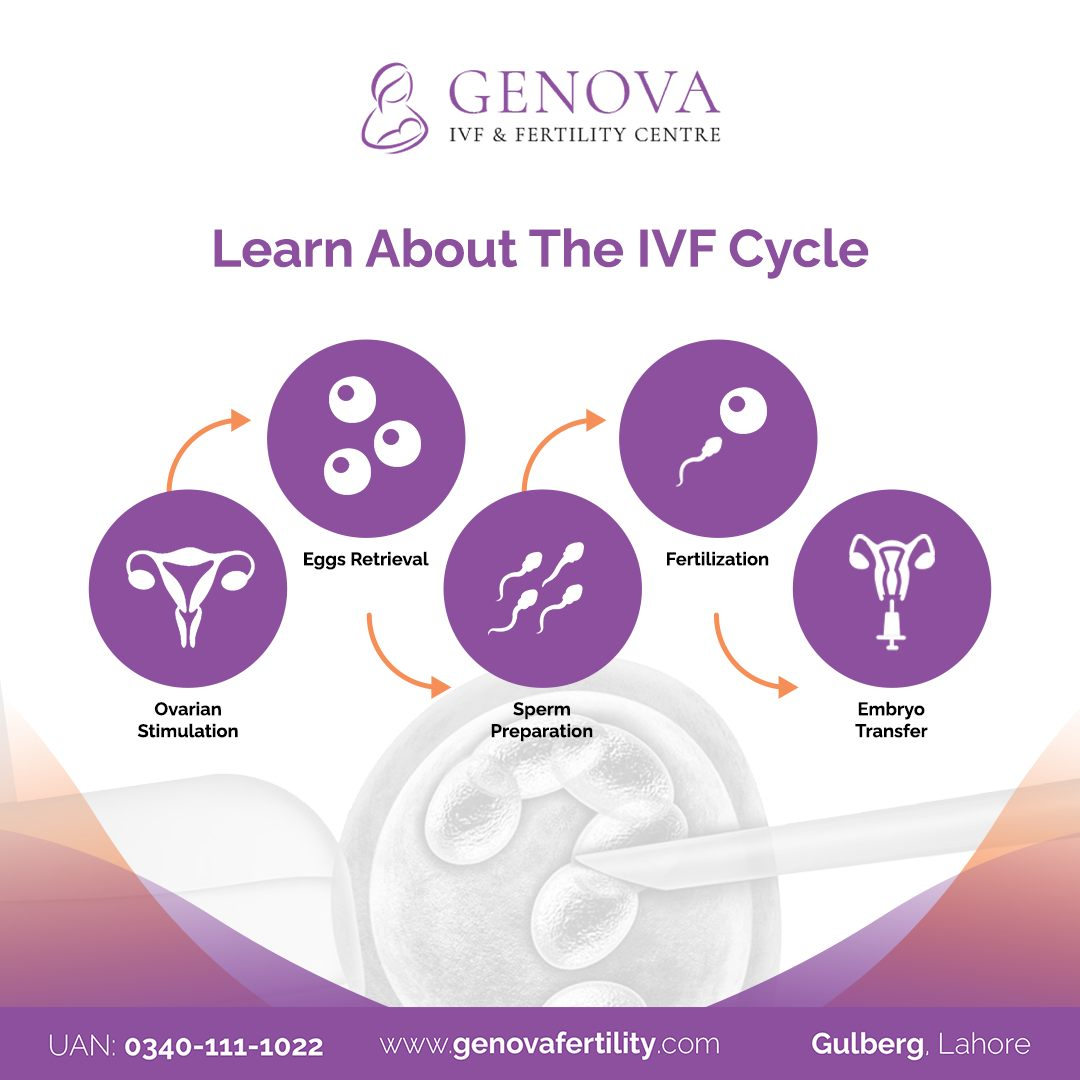
1. Assessment and testing. Both partners are evaluated early on — the female partner through an ultrasound, the male partner through a semen analysis conducted privately.
2. Ovarian stimulation. For about 10 to 12 days, the female partner takes fertility medication designed to help the ovaries mature several eggs instead of just one.
3. Egg and sperm retrieval. Once the eggs are mature, they're collected in a short procedure done under light sedation — patients don't feel pain during this step. Sperm is collected the same day; if none is present naturally, a minor procedure called TESA retrieves it directly from testicular tissue.
4. The ICSI injection itself. In the lab, embryologists select the healthiest sperm and inject it directly into each mature egg.
5. Embryo growth and transfer. The fertilized eggs are monitored in incubators for three to five days. The strongest embryo is transferred into the uterus, and any remaining healthy embryos can be frozen for later use.
Beyond ICSI: Other Options for Male Infertility
Surgical sperm retrieval (TESA/TESE). Men diagnosed with azoospermia — meaning no sperm shows up in the ejaculate — aren't necessarily out of options. TESA uses a fine needle under local anesthesia to extract sperm directly from testicular tissue, which can then be used in an ICSI cycle.
Treating varicoceles. Enlarged veins in the scrotum can raise testicular temperature enough to hurt sperm production. A relatively minor corrective procedure can restore normal blood flow and, over time, improve both sperm count and shape.
Sperm freezing. For men facing chemotherapy, long-term travel, or other circumstances that might affect fertility down the road, sperm can be frozen and stored for future ICSI cycles.
What Actually Affects ICSI Success Rates
ICSI has strong success rates overall, but a few factors tend to move the needle:
- Age of the female partner — women under 35 generally have higher-quality eggs, which improves the odds per cycle.
- Sperm DNA quality — even with direct injection, the genetic integrity of the sperm affects embryo development.
- Lab conditions — a well-controlled, high-precision embryology lab makes a measurable difference in outcomes.
- Lifestyle factors — not smoking, eating well, and maintaining a healthy weight all support better egg and sperm quality.
Why Patients Choose Fertility Center Lahore
Picking a clinic is a big decision, and it's rarely just about the procedure itself. Patients at Fertility Center Lahore point to a few consistent reasons for choosing it:
- Experienced embryologists and male fertility specialists guiding the process
- Clean-room lab technology built to protect embryo survival rates
- Private, dignified spaces for sperm collection and confidential results
- Transparent, phased payment plans instead of one large upfront bill
Common Questions
Does ICSI hurt?
Not really. Egg retrieval happens under light anesthesia, so the female partner is asleep and feels nothing. Sperm collection or TESA uses local numbing, so there's little to no discomfort.
How is ICSI different from regular IVF?
In IVF, sperm and egg are left together in a dish to fertilize naturally. In ICSI treatment Pakistan, an embryologist manually injects one selected sperm into the egg — which is why it's the go-to option for male fertility issues.
Can someone with zero sperm count still have a biological child?
In many cases, yes. Even when no sperm shows up in the ejaculate, it can often be retrieved directly from testicular tissue via TESA and used successfully with ICSI.
Infertility is a hard road, but nobody has to walk it without answers. If you're considering ICSI or want to understand your options for male infertility treatment, reaching out to Fertility Center Lahore for a private consultation is a solid first step.






Comments (0)