

What Does Digitally Anonymised Mean? Understanding Digital Anonymisation
What does digitally anonymised mean? Learn how digital anonymisation protects personal information, reduces privacy risks, and supports responsible data use.
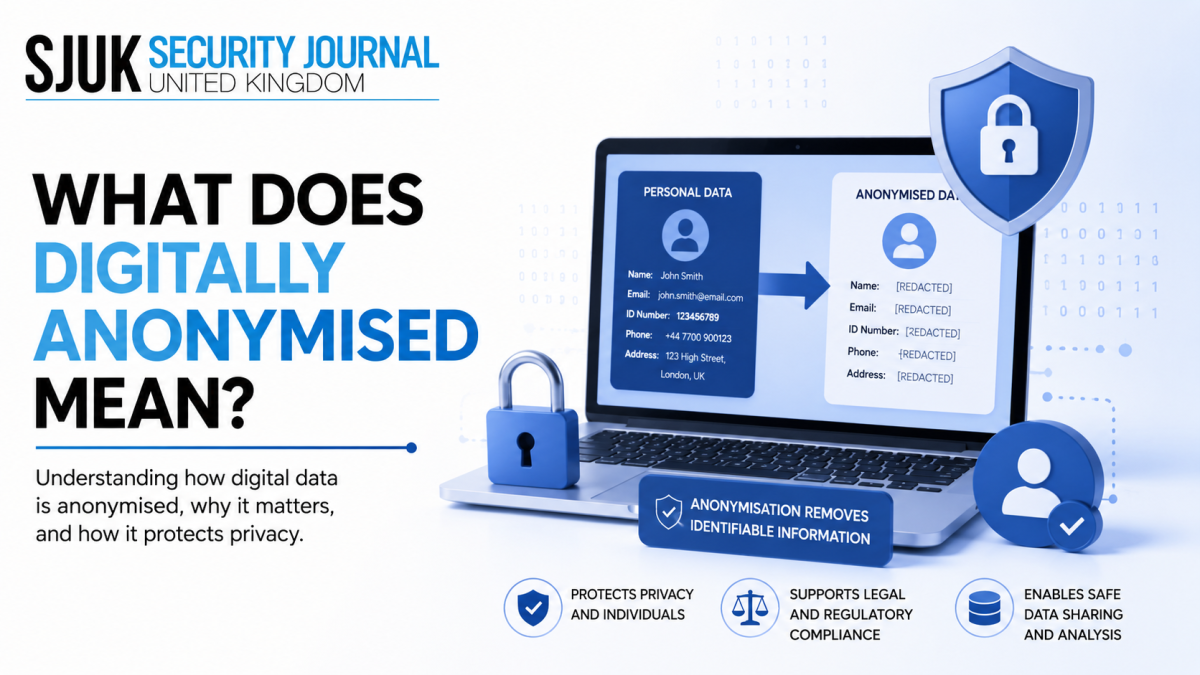
As organisations collect and process increasing amounts of personal and business information, protecting individual privacy has become an important part of responsible data management. One term that frequently appears in discussions about privacy, cybersecurity and data protection is digitally anonymised.
But what does digitally anonymised mean, and how does anonymisation work? Understanding the concept can help businesses, employees and individuals recognise how personal information may be handled, shared and analysed while reducing the risk of identifying specific people.
What Does Digitally Anonymised Mean?
Digitally anonymised means that information containing details about an individual has been processed or modified so that the person can no longer reasonably be identified from the available data.
For example, an organisation may collect information containing names, email addresses, telephone numbers and other identifiers. Through anonymisation, identifying information can be removed, altered or transformed so the resulting dataset cannot reasonably be connected to a particular individual.
The purpose is to allow useful information to be retained for activities such as research, statistical analysis, reporting or service improvement without directly exposing someone's identity.
An important distinction is that anonymisation is intended to prevent identification, rather than simply hide information from casual view.
How Does Digital Anonymisation Work?
Digital anonymisation can involve several techniques depending on the type of information being processed and the intended use of the dataset.
Removing Direct Identifiers
One of the simplest approaches is removing information that directly identifies a person.
This can include:
-
Full names
-
Email addresses
-
Telephone numbers
-
Home addresses
-
Customer identification numbers
-
Passport or licence details
Removing these fields reduces the amount of directly identifiable information available in the dataset.
However, simply deleting names does not always make information anonymous.
Generalising Information
Organisations can also make information less specific.
For example, instead of recording an individual's exact age as 37, a dataset might use an age range such as 35–39. Similarly, an exact address could be replaced with a broader geographical area.
Generalisation reduces the precision of information that could otherwise contribute to identifying someone.
Aggregating Data
Data can be combined into groups rather than presented as individual records.
For instance, instead of publishing the spending activity of each customer, an organisation could publish the total spending for a particular customer segment.
Aggregation can make it more difficult to associate a particular activity with one individual while preserving useful statistical information.
Masking or Transforming Data
Some datasets use techniques that modify sensitive values. Depending on the circumstances, organisations may use masking, tokenisation, hashing or other transformations.
These approaches should not automatically be considered equivalent to anonymisation. If the original person can still be identified using additional information or a separate key, the resulting data may instead be considered pseudonymised or otherwise protected data.
Why Is Digital Anonymisation Important?
Digital anonymisation can help organisations balance the need to use information with the need to protect privacy.
Businesses, researchers and public-sector organisations may need large datasets to identify trends, evaluate services or develop technologies. At the same time, exposing personal information can create privacy and security risks.
Anonymisation can therefore support activities such as:
-
Statistical research
-
Data analysis
-
Product development
-
Academic studies
-
Business reporting
-
Service improvement
-
Machine learning research
-
Security analysis
The effectiveness of anonymisation depends on how carefully the data is processed and what other information might be available.
Digitally Anonymised vs Pseudonymised Data
These terms are sometimes confused, but they describe different concepts.
Anonymised data is intended to prevent an individual from being identified from the information.
Pseudonymised data, by contrast, replaces identifying information with a pseudonym or identifier. The person may still be identifiable if additional information, such as a separate key, is available.
For example, replacing "John Smith" with "Customer 48291" does not necessarily make the information anonymous. If an organisation has a separate database that connects Customer 48291 to John Smith, identification remains possible.
This distinction is particularly important when organisations design data-processing and privacy procedures.
Can Anonymised Data Still Be Identified?
A key consideration is that removing obvious identifiers does not automatically guarantee anonymity.
Someone may potentially be identified by combining supposedly anonymous information with other datasets.
For example, a dataset containing age, occupation, location and a precise timestamp might appear anonymous. However, if those characteristics are sufficiently unique, they could potentially be matched with publicly available information or another dataset.
For this reason, organisations need to consider the overall possibility of re-identification rather than simply removing names and contact details.
What Are the Benefits of Digital Anonymisation?
Digital anonymisation can provide several practical benefits when appropriately implemented.
Privacy Protection
Reducing identifying information can help protect individuals from unnecessary exposure of their personal details.
Data Sharing
Anonymised datasets can potentially be shared for research, analytics or reporting while reducing privacy risks.
Business Insights
Organisations can analyse broader patterns and trends without necessarily requiring access to identifiable customer records.
Reduced Exposure
Limiting identifiable information within datasets can reduce the consequences associated with unauthorised access or inappropriate disclosure.
Supporting Responsible Data Use
Anonymisation can form part of a broader privacy strategy that helps organisations use information while considering individual privacy.
What Are the Challenges of Digital Anonymisation?
Anonymisation is not simply a matter of deleting a person's name.
Modern datasets can contain numerous attributes that, when combined, may reveal someone's identity. Location information, dates, behavioural patterns and demographic characteristics can all contribute to re-identification risks.
Another challenge is maintaining the usefulness of the data. Removing or generalising too much information may make a dataset less valuable for analysis.
Organisations therefore need to consider both privacy protection and data utility when designing anonymisation processes.
How Can Organisations Improve Data Anonymisation?
A structured approach can help organisations reduce privacy risks.
First, they should identify what personal and sensitive information exists within their datasets. They can then determine which information is genuinely necessary for the intended purpose.
Organisations should also assess whether individuals could potentially be identified by combining different data fields or external information.
Technical safeguards, access controls, secure storage and appropriate governance should complement anonymisation. Regular reviews are also useful because datasets, technologies and external information sources can change over time.
Staff handling data should understand the difference between anonymisation, pseudonymisation and other privacy techniques.
Examples of Digitally Anonymised Data
Consider a healthcare organisation analysing patient information.
Instead of providing analysts with individual names and addresses, the organisation could produce aggregated statistics showing the number of patients within particular age groups and regions.
Similarly, a retailer studying purchasing behaviour might analyse grouped transaction patterns without exposing individual customer names or contact details.
In cybersecurity research, organisations may also process datasets to remove or transform identifying information before sharing broader trends and technical findings.
These examples demonstrate how organisations can retain analytical value while reducing the direct exposure of personal identities.
Conclusion
Understanding what does digitally anonymised mean is increasingly important as organisations collect, analyse and share more digital information. Digital anonymisation involves processing data so that individuals cannot reasonably be identified from the resulting information, although simply removing names does not necessarily guarantee anonymity.
Effective anonymisation requires consideration of the entire dataset, potential combinations of information and the possibility of re-identification. It should also be supported by appropriate security controls, governance and responsible data-management practices.
For further insights into cybersecurity, privacy, digital risks and security developments, Security Journal UK provides industry-focused information to help professionals stay informed about the changing security landscape.

International Security Journal delivers the latest security news, expert insights, industry trends, and innovative solutions covering physical security, cybersecurity, surveillance, access control, and emerging technologies. Visit here: https://internationalsecurityjournal.com/









Comments (0)