

Travel Retail Market Outlook Projects Sustained Growth Through 2034
The global travel retail market size was valued at USD 75.1 billion in 2025

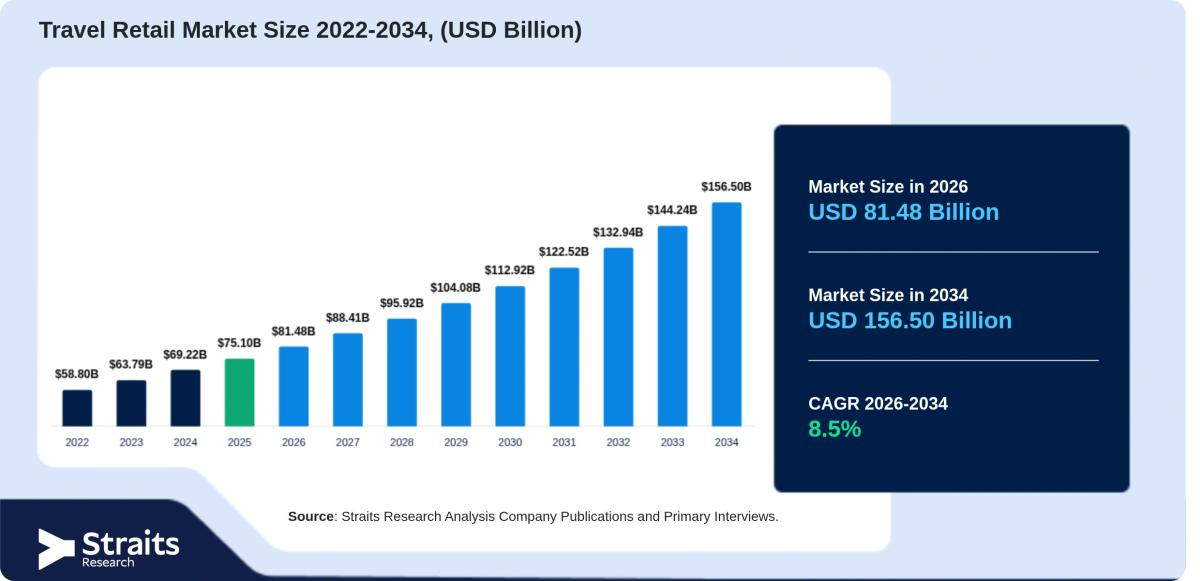
Travel Retail Market Size, Forecast to 2034
The travel retail market comprises the sale of products through duty-free and duty-paid outlets located at airports, airlines, seaports, cruise terminals, border shops, and other travel hubs. The market includes cosmetics and fragrances, wines and spirits, confectionery, fine foods, tobacco products, fashion, and accessories. International tourism, passenger traffic, premium product demand, and investments in transportation infrastructure influence market performance. Retailers are also improving in-store experiences and digital shopping services to attract travelers and increase purchases during their journeys.
The global travel retail market size was valued at USD 75.1 billion in 2025 and is projected to grow from USD 81.48 billion in 2026 to USD 156.50 billion by 2034, registering a CAGR of 8.5% during the forecast period from 2026 to 2034. Asia Pacific dominated the travel retail market in 2025, accounting for 42.5% of the global market.
Market Drivers
Expansion of International Travel and Tourism
The expansion of international tourism and passenger traffic increases the number of potential customers at airports, seaports, and other travel hubs. Higher passenger volumes create more opportunities for retailers to sell cosmetics, fragrances, premium beverages, confectionery, and fashion accessories. Investments in airport infrastructure and international connectivity further support the expansion of retail spaces and product offerings.
Rising Demand for Premium and Luxury Products
International travelers increasingly encounter premium brands and exclusive product collections through travel retail outlets. Duty-free pricing, limited-edition products, and curated brand experiences can encourage purchases among travelers seeking luxury goods and gifts. Retailers are responding through premium store formats, exclusive product launches, and partnerships with established brands.
Adoption of Digital and Omnichannel Retail Solutions
Digital technologies are helping travel retailers connect with consumers before, during, and after their journeys. Online pre-ordering, reserve-and-collect services, digital loyalty programs, and personalized promotions improve shopping convenience for passengers with limited time. These services also allow retailers to engage travelers beyond traditional physical stores and improve sales conversion.
Market Challenges
Dependence on Passenger Traffic and Travel Conditions
Travel retail sales depend heavily on passenger volumes, international mobility, and traveler spending patterns. Economic downturns, geopolitical tensions, public health emergencies, and transport disruptions can reduce footfall and affect purchasing behavior. Such uncertainty makes revenue planning difficult for retailers operating in travel-dependent locations.
Limited Shopping Time for Travelers
Passengers often have limited time to browse retail outlets because of security checks, transfers, boarding schedules, and other travel requirements. Congested stores, long queues, or inconvenient payment processes can discourage purchases. Retailers need efficient store layouts, clear product displays, quick checkout options, and digital purchasing services to convert passenger traffic into sales.
Complex Regulatory and Duty-Free Requirements
Travel retail operations must comply with customs rules, tax regulations, product restrictions, and different requirements across international markets. Alcohol, tobacco, cosmetics, and other regulated products may face specific sales or transportation conditions. Compliance requirements can increase operational complexity and require retailers to maintain accurate inventory controls and documentation.
Market Segmentation
The travel retail market is segmented by:
-
By Product Type: Cosmetics and fragrances, wines and spirits, confectionery and fine foods, tobacco products, fashion and accessories, others.
-
By Sector: Duty-free, duty-paid.
-
By Sales Channel: Airport and airline shops, seaport and cruise line shops, border, downtown and hotel shops, others.
Regional Insights
North America Travel Retail Market Analysis
North America is projected to be the fastest-growing regional market during the forecast period. International passenger traffic, airport retail investments, and demand for premium beauty, fashion, and luxury products support regional expansion. Digital shopping services and improved retail experiences also provide opportunities for operators to increase customer engagement and sales.
Europe Travel Retail Market Analysis
Europe accounted for 28.4% of the global travel retail market in 2025. The region benefits from established tourism destinations, international airport networks, and demand for premium cosmetics, fragrances, fashion accessories, and beverages. Airport modernization and curated retail experiences help operators attract international travelers and strengthen product sales.
Asia Pacific Travel Retail Market Analysis
Asia Pacific dominated the travel retail market in 2025. Strong tourism activity, expanding airport infrastructure, and demand for premium cosmetics, luxury goods, and specialty products contribute to regional leadership. Major travel markets such as China and Japan provide opportunities for retailers through international passenger traffic and interest in distinctive shopping experiences.
Middle East and Africa Travel Retail Market Analysis
The Middle East and Africa travel retail market benefits from international airport connectivity, tourism development, and investments in aviation infrastructure. Major travel hubs attract passengers seeking luxury products, fragrances, fashion accessories, and premium gifts. Continued investment in airport facilities and tourism destinations can support further retail expansion.
Latin America Travel Retail Market Analysis
Latin America offers opportunities through international tourism, cross-border travel, and demand for branded products at airports and other travel hubs. Cosmetics, fragrances, confectionery, and fashion accessories provide important product categories for retailers serving both leisure and business travelers. Improvements in passenger facilities and digital retail services can help strengthen market access.
Key Players Analysis
The travel retail market includes global travel retail operators, duty-free specialists, airport concessionaires, and regional retail businesses. Established companies compete through international brand partnerships, retail network coverage, product selection, store design, and operational efficiency. Emerging and regional operators focus on localized product assortments, competitive pricing, and differentiated customer experiences. Digital engagement, concession agreements, supply chain management, and the ability to respond to changing passenger preferences remain important competitive factors.
Key industry participants include Avolta AG, China Duty Free Group, Lagardère Travel Retail, Lotte Duty Free, and DFS Group.
For Detailed Insights, Visit: https://straitsresearch.com/report/travel-retail-market
About Us
Straits Research is a research and intelligence organization specializing in research, analytics, and advisory services, providing business insights and market research reports across diverse industries.
Contact Us
Email: [email protected]
Tel: +1 646 905 0080 (U.S.), +44 203 695 0070 (U.K.)











Comments (0)