

Plastic Resin Market Poised for Steady Expansion Across Manufacturing Industries
The global plastic resin market size was valued at USD 925.85 billion in 2025

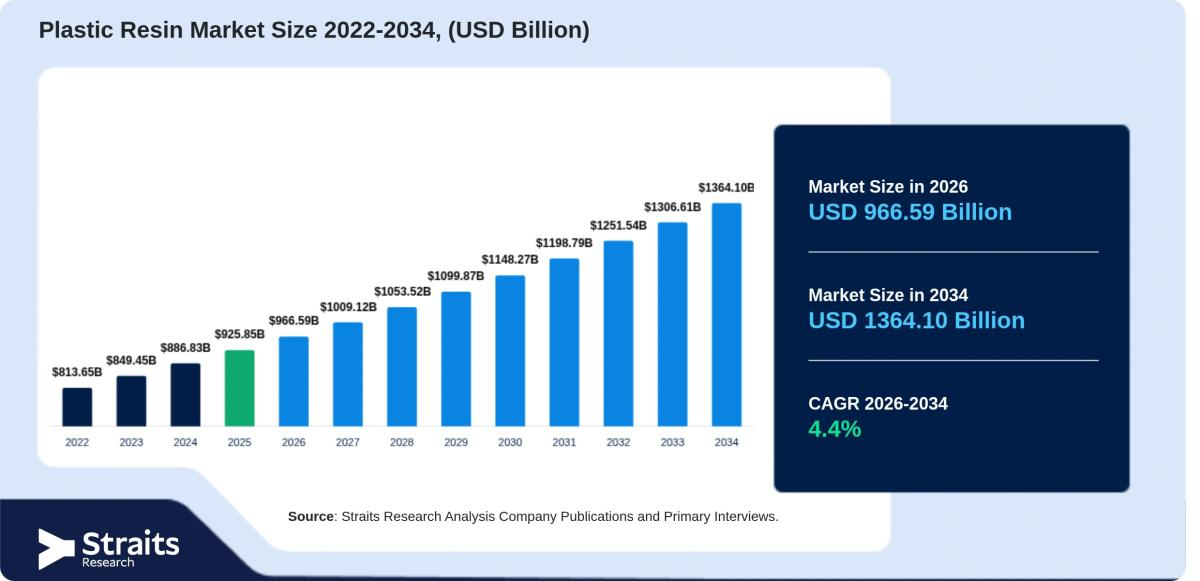
Plastic Resin Market Size, Forecast to 2034
The plastic resin market comprises polymer materials used as primary raw materials to manufacture products across packaging, automotive, construction, electronics, healthcare, agriculture, and consumer goods industries. These resins provide properties such as durability, flexibility, chemical resistance, and lightweight performance, making them suitable for a wide range of applications. Advances in engineering plastics, recycled polymers, and bio-based materials are expanding resin applications, while demand from manufacturing and packaging continues to shape the market.
The global plastic resin market size was valued at USD 925.85 billion in 2025 and is projected to grow from USD 966.59 billion in 2026 to USD 1,364.10 billion by 2034, registering a CAGR of 4.4% during the forecast period from 2026 to 2034. Europe dominated the plastic resin market in 2025, accounting for 34.2% of the global market.
Market Drivers
Rising Demand for Lightweight and Durable Materials
Plastic resins offer a combination of low weight, durability, and design flexibility that supports their use across automotive, construction, packaging, and consumer goods applications. Automotive manufacturers use specialized resins to reduce component weight, while construction companies rely on plastic materials for pipes, insulation, fittings, and structural applications. These performance benefits continue to support resin consumption across industrial and consumer markets.
Expansion of Packaging and Consumer Goods Manufacturing
The demand for plastic resins is closely linked to the production of flexible packaging, rigid containers, bottles, and protective materials. Food and beverage manufacturers, pharmaceutical companies, and e-commerce businesses require packaging that offers durability, moisture resistance, and efficient transportation. The continued expansion of packaged consumer products supports demand for polyethylene, polypropylene, polyethylene terephthalate, and other widely used resins.
Growing Adoption of Engineering Plastics in Advanced Applications
Engineering plastics are gaining importance in electrical and electronic equipment, automotive systems, medical devices, and industrial machinery. These materials offer enhanced mechanical strength, thermal stability, and chemical resistance compared with many conventional plastics. Demand for high-performance components in electric vehicles, electronic devices, and specialized medical equipment is encouraging manufacturers to expand their engineering resin portfolios.
Market Challenges
Environmental Regulations and Plastic Waste Management
Governments are strengthening requirements related to packaging waste, recyclability, recycled content, and producer responsibility. These regulations can require resin manufacturers and downstream processors to redesign products, improve material traceability, and invest in recycling infrastructure. Compliance costs and restrictions on certain single-use plastic applications can affect demand patterns and production strategies.
Volatility in Feedstock and Energy Prices
Plastic resin production depends heavily on petrochemical feedstocks such as ethane, propane, and naphtha, along with substantial energy inputs. Changes in crude oil and natural gas prices can affect manufacturing costs and selling prices. Supply disruptions, changing refinery operating rates, and regional differences in feedstock availability can also influence profit margins and competitive positioning.
Technical Limitations of Recycled Resin Production
Recycled resins can vary in purity, color, composition, and mechanical performance depending on the quality of the waste stream and the recycling process. Producing consistent materials for demanding applications requires effective sorting, cleaning, decontamination, and processing technologies. These requirements can increase costs and limit the use of recycled resins in applications that require strict performance or safety standards.
Market Segmentation
The plastic resin market is segmented by:
-
By Product: Crystalline, non-crystalline, engineering plastics, super engineering plastics
-
By Application: Packaging, automotive, construction, electrical and electronics, logistics, consumer goods, textiles and clothing, furniture and bedding, agriculture, medical devices, others
-
By Region: North America, Europe, Asia Pacific, Middle East and Africa, Latin America
Regional Insights
North America Plastic Resin Market Analysis
North America is expected to be the fastest-growing regional market, supported by its established petrochemical industry, manufacturing capacity, and demand from packaging, automotive, healthcare, construction, and consumer goods applications. Investment in advanced polymers, lightweight materials, and recycling technologies is creating additional opportunities. The region's access to petrochemical feedstocks also supports resin production and supply-chain integration.
Europe Plastic Resin Market Analysis
Europe held the largest share of the plastic resin market in 2025, supported by demand from automotive, packaging, construction, electrical and electronics, and consumer goods industries. The region's established chemical manufacturing base and advanced material development capabilities contribute to resin consumption. Circular economy initiatives and the adoption of recycled and bio-based polymers are also influencing product development and production strategies.
Asia Pacific Plastic Resin Market Analysis
Asia Pacific benefits from extensive manufacturing activity, expanding urban populations, and demand for plastic products across packaging, electronics, automotive, construction, and consumer goods. China and India contribute through large manufacturing sectors, while Japan and South Korea support demand for specialized and high-performance polymers. Investments in petrochemical capacity and downstream processing continue to shape regional resin production and consumption.
Middle East and Africa Plastic Resin Market Analysis
The Middle East and Africa market benefits from access to hydrocarbon feedstocks, petrochemical production infrastructure, and demand from construction, packaging, agriculture, and industrial manufacturing. Investment in downstream chemical production is creating opportunities for resin producers to serve domestic and export markets. Market development also depends on infrastructure expansion, recycling capabilities, and demand from regional manufacturing sectors.
Latin America Plastic Resin Market Analysis
Latin America's plastic resin market is supported by demand from packaging, agriculture, automotive, construction, and consumer goods industries. Brazil and Mexico offer important opportunities through their manufacturing bases and demand for processed plastic products. Investments in recycling infrastructure, sustainable packaging, and domestic polymer processing are influencing regional market development.
Key Players Analysis
The plastic resin market includes large petrochemical producers, integrated oil and gas companies, specialty polymer manufacturers, and regional resin suppliers. Established players compete through production scale, feedstock access, product performance, cost efficiency, and distribution networks. Companies are also expanding recycled and renewable resin portfolios, developing advanced polymers, and investing in circular material technologies to address evolving customer requirements and environmental regulations.
Key industry participants include BASF SE, SABIC, Dow Inc., DuPont, and LyondellBasell Industries N.V.
For Detailed Insights, Visit: https://straitsresearch.com/report/plastic-resin-market?utm_source=chatgpt.com
About Us
Straits Research is a research and intelligence organization specializing in research, analytics, and advisory services, providing business insights and market research reports across diverse industries.
Contact Us
Email: [email protected]
Tel: +1 646 905 0080 (U.S.), +44 203 695 0070 (U.K.)











Comments (0)