

Negative Reviews and Brand Reputation: How Businesses Should Respond

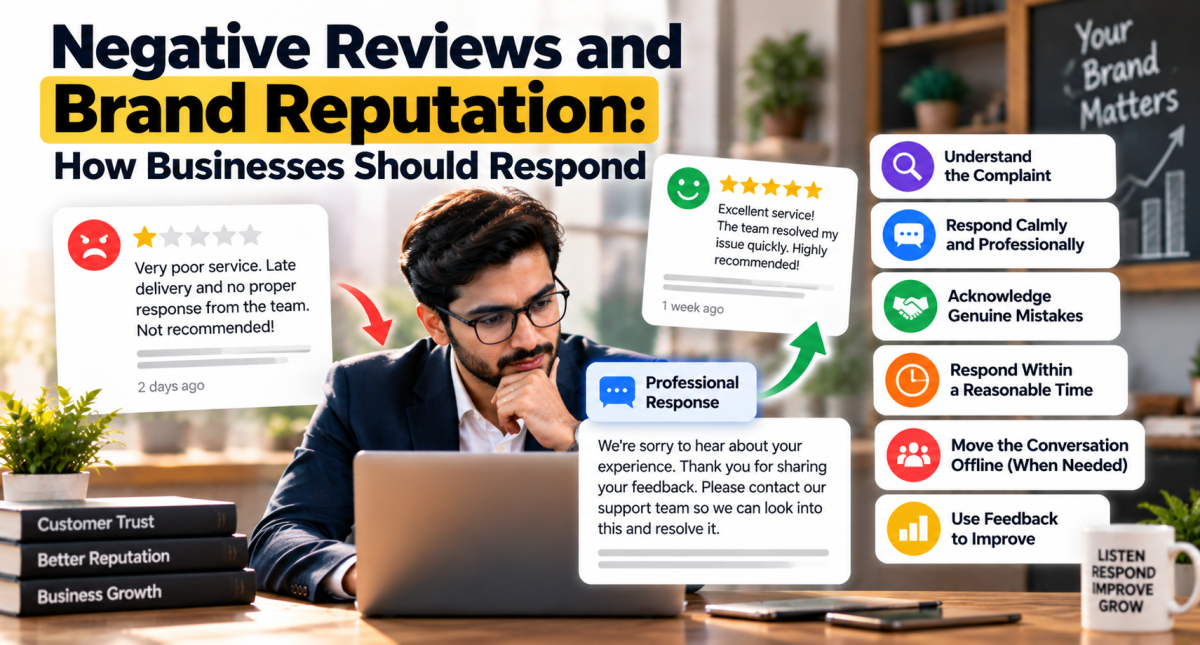
Negative reviews are an unavoidable part of doing business online. Even companies that offer quality products and reliable services can receive complaints from customers. A delayed delivery, a misunderstanding, an unexpected charge, or an unsatisfactory experience can lead someone to share negative feedback publicly.
For businesses, the challenge is not simply receiving a bad review. It is deciding how to respond without damaging customer relationships or creating further concerns among potential buyers.
Today, people often check online reviews before choosing a company, purchasing a product, or booking a service. This makes negative reviews and brand reputation closely connected. A professional response can demonstrate accountability, while an aggressive or dismissive reply may create a poor impression.
Understanding how to handle negative feedback is therefore an important part of building and maintaining a trustworthy online presence.
Why Negative Reviews Matter for Brand Reputation
Online reviews give customers an opportunity to share their experiences and help others make informed decisions. When people research a business, they may look beyond its website and advertisements to understand what previous customers have to say.
A few negative reviews do not automatically mean a business has a poor reputation. Customers may consider the overall feedback, the nature of the complaints, how recently they were posted, and whether the company has responded.
For example, a customer comparing two service providers may notice that both have received complaints. However, one company responds politely, explains how it handles concerns, and offers a reasonable next step. The other company ignores the reviews.
The first business may appear more willing to take responsibility, even though it has received negative feedback.
This is why businesses should treat reviews as an opportunity to communicate with customers rather than simply viewing them as a threat to their reputation.
1. Understand the Complaint Before Responding
The first step in handling a negative review is to understand what the customer is actually saying.
Sometimes, a complaint points to a genuine service problem. In other cases, the customer may have misunderstood a policy or expected something different from what the business offered.
Responding without understanding the situation can make the problem worse.
Before writing a reply, businesses should check the available details, identify the issue, and determine whether further investigation is needed.
For instance, if a customer complains about receiving the wrong product, the business should review the order and delivery information before making assumptions.
A clear understanding of the complaint makes it easier to prepare a relevant and constructive response.
2. Respond Calmly and Professionally
Negative feedback can be frustrating, particularly when a business believes a complaint is unfair. However, public arguments rarely help protect a brand's reputation.
A defensive response may draw more attention to the disagreement and make potential customers question the company's approach to customer service.
Businesses should avoid insults, sarcasm, personal accusations, and unnecessary arguments.
Instead, the response should acknowledge the concern and explain the next step in a respectful manner.
For example, a business could say:
"We're sorry to hear that your experience did not meet your expectations. We would appreciate the opportunity to understand what happened and help resolve your concern. Please contact our support team so we can look into the matter."
The response is polite without making unsupported promises or admitting facts that have not been verified.
3. Acknowledge Genuine Mistakes
When a business has made a mistake, acknowledging it can be more effective than trying to justify every decision.
Customers generally want their concerns to be taken seriously. A sincere apology, followed by a practical solution, can help reduce frustration and demonstrate accountability.
Suppose a customer receives an appointment confirmation but discovers that the business has not reserved the requested time. Rather than blaming the customer or making excuses, the company can apologize for the confusion and explain how it will address the issue.
However, businesses should avoid making promises they cannot keep. If an investigation is required, the response should explain that the matter will be reviewed.
The aim is to communicate honestly and follow through on any commitments.
4. Respond Within a Reasonable Time
An unanswered negative review can leave the impression that a business is not paying attention to customer concerns.
Regular review monitoring helps companies identify complaints and respond while the issue is still relevant.
The appropriate response time depends on the platform, the seriousness of the complaint, and the information required to investigate it. Urgent issues may need immediate attention, while more complicated cases may require additional time.
Businesses should establish a process for monitoring platforms such as Google Business Profile, social media channels, industry directories, and other relevant review websites.
A timely response does not need to be lengthy. It simply needs to acknowledge the concern and communicate what happens next.
5. Know When to Move the Conversation Offline
Some complaints can be addressed publicly, while others require a private conversation.
Issues involving order details, payment information, account access, personal information, or complicated service disputes should generally be handled through an appropriate private channel.
The public response should still acknowledge the concern rather than simply telling the customer to contact the company.
For example, a retailer responding to a refund complaint can recognize the inconvenience and direct the customer to its official support channel for assistance with the transaction.
Businesses should never request sensitive personal information in a public reply.
Moving the conversation offline should help resolve the problem, not become a way to avoid responding publicly.
6. Identify Repeated Complaints
Individual reviews can provide useful information, but recurring complaints may reveal deeper operational problems.
If several customers report delayed deliveries, unclear pricing, poor communication, or difficulties obtaining refunds, the business should investigate the pattern.
A systematic approach to review management can help categorize feedback and identify common themes.
Businesses can examine complaints related to:
-
Product or service quality
-
Delivery and appointment delays
-
Staff behaviour
-
Customer support
-
Pricing and billing
-
Refunds and returns
-
Communication problems
Once the recurring issues are identified, the relevant teams can work on improving the underlying process.
This is where reputation management becomes more than responding to public comments. It becomes a way to understand customer expectations and improve the business.
7. Do Not Try to Hide Every Negative Review
Some businesses become so concerned about their online image that they try to remove every negative comment.
However, legitimate criticism is a normal part of customer feedback. Removing or concealing genuine complaints is not a sustainable way to build trust.
Instead, businesses should focus on responding appropriately and improving the customer experience.
If a review appears to contain spam, impersonation, irrelevant content, or another potential policy violation, the business can report it through the relevant platform's official process. Removal is not guaranteed, and a negative opinion alone does not necessarily violate a platform's rules.
Businesses should also avoid purchasing fake positive reviews to offset criticism. Authentic feedback is more useful for customers and supports a more credible reputation over time.
8. Encourage Honest Customer Feedback
A business should not rely only on customers who voluntarily leave reviews. It can also invite customers to share honest feedback after a purchase or completed service.
For example, a company may send a follow-up message asking customers to review their experience.
The request should be neutral and should not pressure people to leave positive comments. Businesses must also follow the relevant platform's review policies.
A consistent flow of genuine feedback can give potential customers a broader understanding of the business and help companies identify areas for improvement.
The purpose is not to eliminate negative feedback with positive ratings. It is to understand the customer experience more accurately.
9. Connect Review Management With Brand Reputation Management
Review responses are only one part of a company's wider online reputation.
Customers may also encounter brand mentions, social media discussions, news articles, business listings, and other information when researching a company.
For this reason, businesses should consider how review management fits into their broader online reputation management strategy.
A well-rounded approach may include:
-
Monitoring reviews and brand mentions
-
Maintaining accurate business information
-
Responding to customer concerns
-
Reviewing customer sentiment
-
Addressing recurring service problems
-
Communicating business updates clearly
-
Encouraging genuine customer feedback
For businesses receiving reviews across multiple locations or platforms, professional reputation management support can help organize these activities and maintain consistent communication.
10. Measure Whether Responses Are Making a Difference
Businesses should regularly review how they handle negative feedback.
Useful measures may include response time, response rate, recurring complaint categories, customer resolution rates, and changes in review sentiment.
These indicators can help management understand whether the review response process is working and where improvements are needed.
However, businesses should not evaluate success solely by their average star rating. A lower rating may reflect a temporary issue, while a higher rating does not necessarily mean that all customer concerns have been resolved.
The quality of customer interactions and the actions taken to address problems are equally important.
How Professional Review Management Services Can Help
As businesses grow, monitoring multiple review platforms and responding to every complaint can become difficult to manage internally.
Professional review management services can help companies organize review monitoring, prepare appropriate responses, identify recurring customer concerns, and generate reports on customer feedback.
The most useful approach combines these activities with the business's own customer service and operational teams.
An agency can help identify what customers are saying, but the business must still address genuine issues and fulfil its commitments.
When both sides work together, review management can support a more consistent customer experience and a stronger online reputation.
Final Thoughts
Negative reviews do not automatically destroy a brand's reputation. The way a business responds can influence how customers interpret the complaint and evaluate the company's willingness to take responsibility.
By understanding the issue, responding professionally, acknowledging genuine mistakes, and addressing repeated concerns, businesses can turn negative feedback into an opportunity to improve.
Effective brand reputation management is not about making every customer comment positive. It is about showing that the business listens, communicates honestly, and takes meaningful action when something goes wrong.
Over time, this approach can help businesses build stronger customer relationships and create a more trustworthy presence online.














Comments (0)