

Centrifuge Market Growth Analysis: North America Leads the Global Market in 2025
The global centrifuge market size was valued at USD 508.88 million in 2025

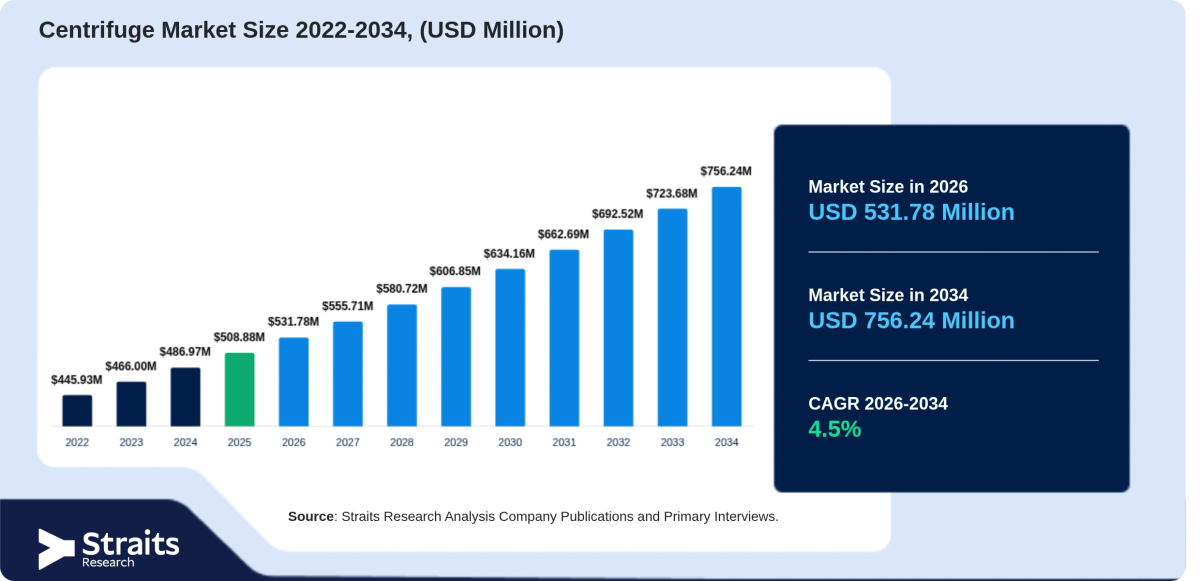
Centrifuge Market Forecast, 2034
The global centrifuge market is experiencing steady growth, driven by increasing demand for laboratory separation technologies, expanding biopharmaceutical research and manufacturing, rising clinical diagnostic testing, and growing applications across biotechnology and life sciences. According to the latest report by Straits Research, the global centrifuge market is expected to witness continued growth during the forecast period 2026–2034. Expanding pharmaceutical research, clinical laboratories, biotechnology activities, and demand for efficient sample-processing technologies are further supporting market expansion.
The global centrifuge market size was valued at USD 508.88 million in 2025 and is projected to grow from USD 531.78 million in 2026 to USD 756.24 million by 2034 at a CAGR of 4.5% during the forecast period 2026–2034.
Market Drivers
The primary driver of the centrifuge market is the growing demand for centrifugation in clinical diagnostics and laboratory testing. Centrifuges are widely used to separate blood, plasma, serum, urine, and other biological samples, making them essential equipment across diagnostic and pathology laboratories.
Another significant growth driver is the expansion of biopharmaceutical manufacturing. Centrifugation supports cell harvesting, clarification, separation, and purification processes involved in the production of biologics, vaccines, recombinant proteins, and other advanced therapies.
The increasing volume of biotechnology and life sciences research is also contributing to market growth. Pharmaceutical companies, biotechnology firms, universities, and research institutes use centrifuges across molecular biology, genomics, cell biology, microbiology, and drug discovery applications.
Additionally, technological advancements in centrifugation equipment are creating new opportunities for manufacturers. Automated controls, improved temperature management, high-speed operation, enhanced safety features, and flexible rotor configurations are improving laboratory efficiency and supporting the adoption of advanced centrifuge systems.
Market Challenges
Despite favorable growth prospects, the centrifuge market faces several challenges. One of the primary concerns is the high acquisition cost of advanced centrifuges, particularly refrigerated centrifuges, ultracentrifuges, and high-speed systems, which can limit adoption among laboratories with restricted budgets.
Another challenge is the maintenance requirement associated with centrifuge equipment. High-speed operation places significant mechanical stress on rotors and other components, requiring regular inspection, calibration, maintenance, and replacement of parts.
The market also faces challenges related to energy consumption, particularly for refrigerated centrifuges that require continuous temperature control during laboratory operations. Manufacturers must improve energy efficiency while maintaining required performance and temperature stability.
Furthermore, operating advanced centrifugation systems can require trained laboratory personnel. Smaller laboratories and facilities with limited technical expertise may face difficulties related to equipment operation, maintenance, safety procedures, and workflow integration.
Market Segmentation
The centrifuge market is segmented based on product, application, and end user.
By product, the market includes laboratory centrifuges and industrial centrifuges. Laboratory centrifuges include microcentrifuges, refrigerated centrifuges, ultracentrifuges, and other laboratory systems, while industrial centrifuges include sedimentation and filtration centrifuges. Laboratory centrifuges are widely used for sample preparation, biological separation, clinical testing, and research applications.
By application, the market includes clinical diagnostics, research and development, and biotherapeutic manufacturing. Clinical diagnostics represents a major application because centrifuges are routinely used for separating blood components, serum, plasma, urine, and other samples before analysis. Research and development applications span molecular biology, genomics, cell biology, microbiology, and pharmaceutical research, while biotherapeutic manufacturing uses centrifugation for cell harvesting, clarification, and purification processes.
By end user, the market comprises clinical and pathology laboratories, pharmaceutical and biotechnology companies, academic and research institutes, and others. Clinical and pathology laboratories use centrifuges for routine diagnostic sample processing, while pharmaceutical and biotechnology companies employ them across drug development, biologics manufacturing, and research activities. Academic and research institutes also use centrifugation equipment across a broad range of scientific applications.
Regional Insights
Regionally, the centrifuge market is analyzed across North America, Europe, Asia-Pacific, the Middle East & Africa, and Latin America.
North America represents a significant centrifuge market, supported by established healthcare infrastructure, strong pharmaceutical and biotechnology industries, advanced clinical laboratories, and extensive life sciences research activities. Demand for automated and high-performance laboratory equipment is supporting market development across the region.
Asia-Pacific is emerging as a rapidly developing market due to expanding healthcare infrastructure, increasing pharmaceutical manufacturing, growing biotechnology activities, and rising investments in diagnostic laboratories and scientific research. Increasing healthcare expenditure and laboratory modernization are also supporting the adoption of advanced centrifugation technologies.
Europe represents an important market owing to its established pharmaceutical industry, advanced healthcare systems, strong biotechnology sector, and extensive academic research infrastructure. Demand for efficient, automated, and reliable laboratory equipment is supporting centrifuge adoption across clinical and research applications.
Latin America is developing as healthcare infrastructure, pharmaceutical activities, diagnostic services, and biotechnology capabilities expand. Increasing investments in laboratory facilities are creating opportunities for centrifuge manufacturers.
The Middle East & Africa market is supported by healthcare modernization, expanding diagnostic services, pharmaceutical development, and investments in laboratory infrastructure. Growing demand for advanced clinical and research equipment is contributing to market development.
Key Players Analysis
The centrifuge market is competitive, with established laboratory equipment manufacturers and specialized centrifuge companies focusing on product innovation, automation, safety, temperature control, rotor technologies, and application-specific solutions.
Key companies operating in the market include Thermo Fisher Scientific, Eppendorf, Beckman Coulter, Danaher Corporation, Sartorius AG, Scilogex, Hettich Lab Technology, Labnet International, QIAGEN, Bio-Rad Laboratories, and Boekel Scientific.
These companies are focusing on advanced centrifugation systems with automated operation, improved temperature management, enhanced safety features, flexible rotor configurations, and higher processing efficiency. Product development, application-specific solutions, laboratory workflow integration, and expansion across pharmaceutical, biotechnology, clinical, and research applications remain important strategies in the global centrifuge market.
For detailed insights, visit:https://straitsresearch.com/report/centrifuge-market
About Us
Straits Research is a leading research and intelligence organization specializing in research, analytics, and advisory services, providing comprehensive business insights and market research reports across diverse industries.
Contact Us
Email: [email protected]
Tel: +1 646 905 0080 (U.S.), +44 203 695 0070 (U.K.)









Comments (0)