

Secondary Tickets Market Forecast to Reach USD 7.89 Billion by 2034, Registering a CAGR of 9.7%


Secondary Tickets Market Forecast, 2034
The secondary tickets market is expanding as consumers seek access to sold-out concerts, sporting events, festivals, theater performances, and other live experiences. Digital marketplaces, mobile ticket transfers, verified resale systems, and organizer-authorized platforms are improving convenience and transaction security across the resale ecosystem.
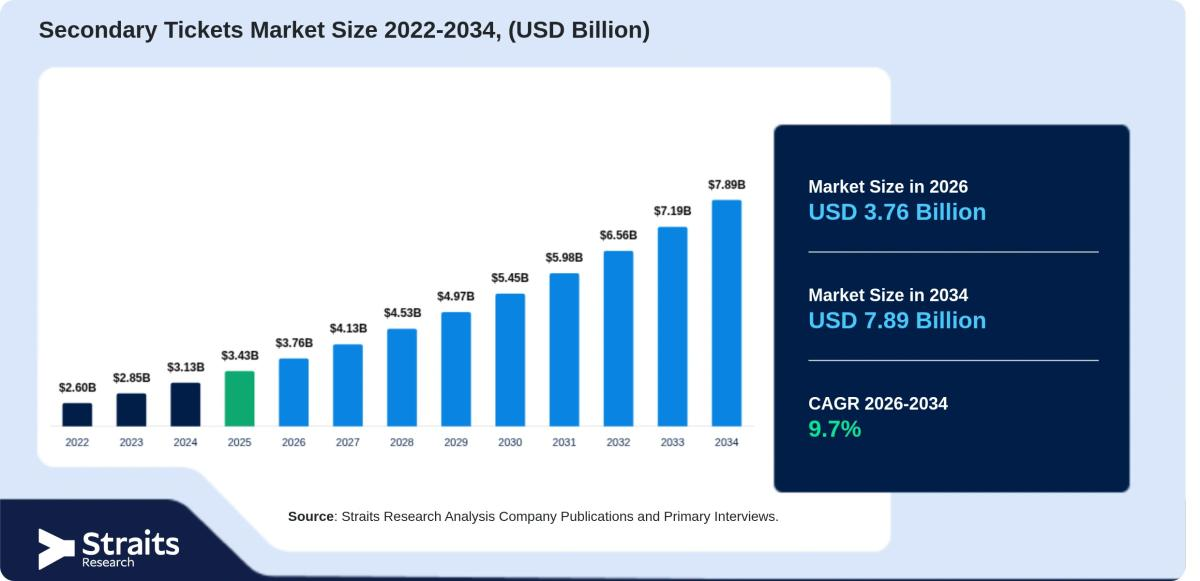
The global secondary tickets market size was valued at USD 3.43 billion in 2025 and is projected to reach USD 3.76 billion in 2026 and USD 7.89 billion by 2034, registering a CAGR of 9.7% during 2026–2034.
Market Drivers
Demand for Live Events and Sold-Out Experiences
Strong consumer interest in concerts, sports, festivals, theater, and other live events creates demand for resale tickets when primary inventories become unavailable. Digital ticket delivery and online transfers also make last-minute purchases more convenient.
Expansion of Digital Ticketing Platforms
Mobile applications, digital wallets, interactive seat maps, and online payment systems are simplifying secondary ticket transactions. These tools allow buyers and sellers to complete transactions remotely while improving access to event inventory.
Growth of Organizer-Authorized Resale Channels
Event organizers and ticketing providers are integrating resale functions into official ticketing ecosystems. Direct links between original ticket records and resale transactions can improve ticket authentication, ownership verification, and transfer management.
Increasing Adoption of Dynamic Pricing
Resale platforms use pricing technologies to adjust ticket values according to event demand, seat location, timing, and inventory availability. Dynamic pricing provides sellers with flexible pricing options while allowing platforms to manage large and changing ticket inventories.
Market Challenges
Stricter Regulation of Ticket Resale
Governments are introducing controls covering resale prices, service fees, ticket quantities, and seller activity. Such measures can change established resale models and increase compliance requirements for marketplace operators.
Fraud and Counterfeit Ticket Risks
Counterfeit tickets, duplicate listings, payment fraud, and unauthorized transfers can undermine consumer confidence in resale marketplaces. Platforms need robust verification, identity checks, payment security, and transaction monitoring to maintain buyer protection.
Pricing Transparency Requirements
Regulatory attention toward mandatory fees is requiring resale platforms to present total ticket costs more clearly. Changes to checkout structures and pricing disclosures can require technology upgrades and adjustments to established revenue models.
Migration Toward Informal Resale Channels
Consumers and sellers may use social media, messaging applications, classifieds, or direct exchanges outside formal marketplaces. These channels can reduce platform transaction volumes while creating additional risks related to ticket authenticity and payment protection.
Market Segmentation
-
By Event Type: Sports Events, Concerts & Music Festivals, Theater & Performing Arts, Festivals, Others
-
By Platform: Online Platforms, Web-based Platforms, Mobile Applications, Offline/Broker Channels, Peer-to-Peer Exchanges
-
By Pricing Model: Fixed Price, Dynamic Pricing, Auction-based Pricing, Face Value Resale, Premium Pricing
-
By Region: North America, Europe, Asia Pacific, Middle East & Africa, Latin America
Regional Insights
North America
North America accounted for the largest regional share in 2025, supported by established digital ticketing infrastructure and strong demand for professional sports, concerts, theater, and festivals. Mobile ticketing, verified resale platforms, and integration between primary and secondary ticketing are strengthening the regional ecosystem.
Asia Pacific
Asia Pacific is projected to record the fastest growth during 2026–2034, supported by expanding live entertainment, international concerts, sporting events, smartphone adoption, and digital payments. Younger consumers and mobile-first purchasing behavior are also creating opportunities for organized resale platforms.
Europe
Europe benefits from a strong live entertainment culture covering football, concerts, music festivals, theater, and cultural events. Authorized resale channels and digital ticketing are becoming increasingly important as organizers seek better ticket traceability and consumer protection.
Latin America
Latin America is supported by football, concerts, festivals, and other large entertainment events that generate high-demand ticket inventory. Smartphone adoption and digital payment infrastructure are helping move ticket resale toward structured online marketplaces.
Middle East & Africa
The Middle East & Africa market is developing alongside investments in sports, entertainment, tourism, stadiums, and large-scale event infrastructure. International events and digital ticketing systems are creating opportunities for organized secondary ticket platforms.
Key Players Analysis
The secondary tickets market includes established resale marketplaces, integrated ticketing providers, peer-to-peer platforms, and specialized ticket exchanges. Competition is shaped by ticket availability, platform reliability, pricing transparency, buyer protection, mobile ticket delivery, verification capabilities, and access to high-demand events.
Key players include StubHub, Ticketmaster, SeatGeek, viagogo, and AXS.
For detailed insights, visit: https://straitsresearch.com/report/secondary-tickets-market
About Us
Straits Research is a leading research and intelligence organization specializing in research, analytics, and advisory services, providing comprehensive business insights and market research reports across diverse industries.
Contact Us
Email: [email protected]
Tel: +1 646 905 0080 (U.S.), +44 203 695 0070 (U.K.)











Comments (0)