

Headless AEM: Delivering Content via Content Fragments and GraphQL
Learn how headless AEM uses Content Fragments and GraphQL API to deliver structured content across websites, mobile apps, and digital channels.
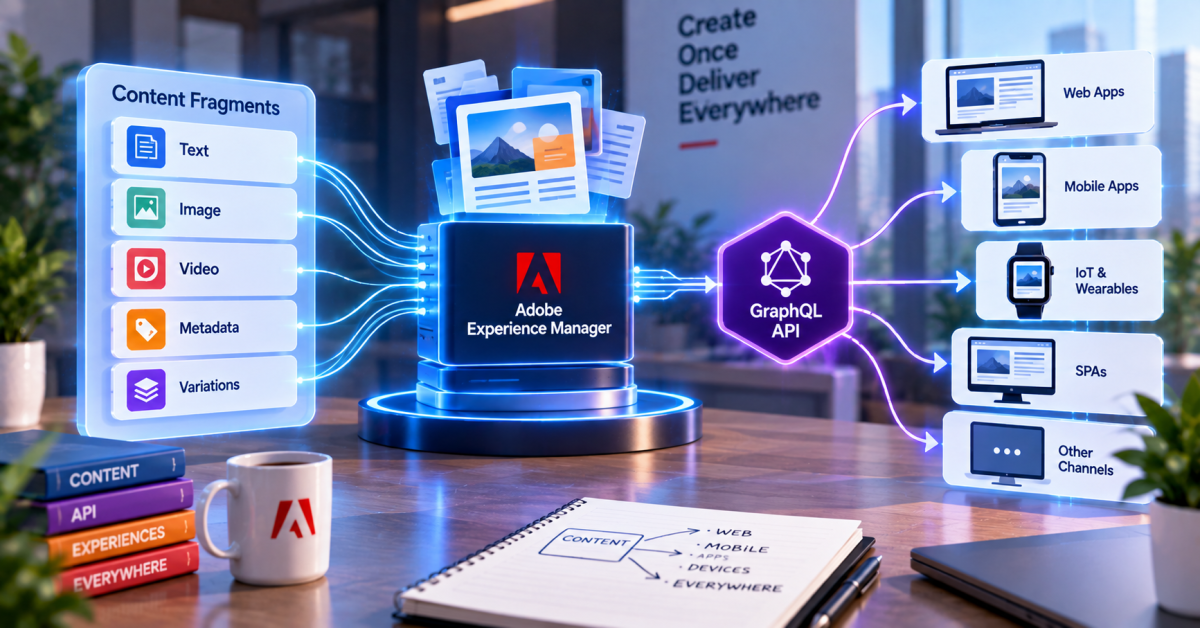
Modern digital experiences are no longer limited to traditional websites. Businesses now deliver content through websites, mobile apps, ecommerce platforms, digital displays, portals, and other connected experiences.
This shift has increased interest in headless content management, where content is created and managed separately from the presentation layer. Adobe Experience Manager supports this approach through structured content, Content Fragments, APIs, and GraphQL.
Understanding headless AEM content fragments helps organizations see how AEM can move beyond traditional page-based content management and support flexible content delivery across multiple channels.
What Is Headless AEM?
Headless AEM separates content management from the front-end experience.
In a traditional CMS setup, authors create content and pages that are closely connected to how the content will appear on a website. A headless approach instead focuses on creating structured content that can be delivered through APIs to different front-end applications.
For example, the same product information could be delivered to:
-
A React website
-
A mobile application
-
An ecommerce experience
-
A digital kiosk
-
A customer portal
The front-end application decides how the content should look, while AEM manages the underlying content.
This is the basic idea behind a headless CMS with Adobe Experience Manager.
What Are AEM Content Fragments?
Content Fragments are structured pieces of content designed to be reused across different channels.
Unlike traditional page content, a Content Fragment is not primarily tied to a specific page layout.
A product Content Fragment might contain fields such as:
-
Product name
-
Short description
-
Long description
-
Product category
-
Price
-
Product image reference
-
Features
-
Specifications
The same structured information can then be delivered to multiple applications.
This makes AEM Content Fragments for headless content delivery particularly useful when organizations need content consistency across channels.
Why Content Fragments Matter in Headless AEM
The main advantage of Content Fragments is separation.
Content authors can manage structured information without needing to know how a particular application will display it.
For example, a marketing team could update a product description once in AEM. A connected website and mobile application could then retrieve the updated information through the appropriate delivery mechanism.
This reduces the need to maintain separate copies of the same content.
It can also create a more efficient workflow for organizations managing large amounts of reusable content.
How AEM GraphQL API Fits Into Headless Delivery
GraphQL provides a way for applications to request the specific content and fields they need.
The AEM GraphQL API can be used with Content Fragments to query structured content.
Instead of requesting a large response containing unnecessary information, a client can request specific fields.
For example, a product application might request:
-
Product name
-
Product description
-
Product image
-
Product specifications
A different application could request additional fields from the same content model.
This approach gives developers more control over how content is retrieved and consumed.
A Simple Headless AEM Architecture
A typical headless workflow can be represented as:
Content Model → Content Fragment → GraphQL/API → Front End → Customer Experience
Here is what each stage does:
1. Content Model
Developers or content architects define the structure of the information.
For example:
Product
-
Name
-
Description
-
Category
-
Price
-
Features
-
Image
2. Content Fragment
Authors create actual content based on the defined structure.
For example:
Product Name: Running Shoe X
Category: Sports Shoes
Description: Lightweight running shoe for daily training
3. API Layer
The structured content becomes available to applications through an API such as GraphQL.
4. Front End
A React, mobile, or other application requests the required content.
5. Customer Experience
The application presents the content using its own design and user interface.
This separation allows teams to evolve the front end without completely rebuilding the content management layer.
AEM Content Delivery API vs GraphQL
The terms AEM content delivery API and GraphQL are often discussed together, but they should not be treated as identical concepts.
An API provides the mechanism through which an application accesses content. GraphQL is a specific query language and API approach that allows clients to request structured data.
The appropriate delivery method depends on the AEM architecture, implementation requirements, content structure, and application needs.
Organizations should evaluate:
-
Required response structure
-
Front-end technology
-
Content model complexity
-
Caching requirements
-
Performance requirements
-
Security considerations
-
Developer experience
-
Number of consuming channels
Headless AEM vs Traditional AEM Sites
Traditional AEM Sites authoring is primarily focused on building web pages and digital experiences using components and page structures.
Headless AEM focuses more heavily on reusable structured content that can be consumed by applications independently of page layouts.
| Area | Traditional AEM Sites | Headless AEM |
|---|---|---|
| Main focus | Web experiences | Structured content delivery |
| Content | Pages and components | Content Fragments |
| Front end | Closely connected to AEM | Separate application |
| Delivery | Web pages | APIs |
| Common consumers | Websites | Websites, apps and other channels |
| Development approach | Component-based | API-driven |
| Flexibility | Strong for managed web experiences | Strong for multi-channel delivery |
These approaches are not necessarily mutually exclusive. An organization can use traditional AEM Sites for some experiences and headless delivery for others.
Benefits of Headless AEM
1. Multi-channel content delivery
The same structured content can support multiple digital channels.
2. Front-end flexibility
Development teams can use technologies such as React or other modern frameworks without making the CMS responsible for the entire presentation layer.
3. Content reuse
Content authors can maintain structured information in one central environment instead of recreating it for every channel.
4. Faster content updates
When applications consume centralized content, updates can be managed from the content platform rather than manually changing every front-end implementation.
5. Better separation between content and presentation
Content teams can focus on content while developers focus on the customer-facing application.
When Should You Consider Headless AEM?
Headless AEM can make sense when an organization needs to deliver the same content across multiple digital experiences.
Common scenarios include:
-
Mobile applications
-
React or JavaScript web applications
-
Ecommerce platforms
-
Customer portals
-
IoT experiences
-
Digital kiosks
-
Personalized applications
-
Omnichannel content delivery
For a company managing only a straightforward website, traditional AEM Sites may be sufficient.
For organizations with several consuming applications, a headless architecture can provide greater flexibility.
Challenges to Consider
Headless architecture is not automatically better for every project.
Organizations should consider several challenges.
Content modeling
Poorly designed content models can make content difficult to reuse or maintain.
API design
Developers need to define efficient ways for applications to request and consume content.
Front-end responsibility
With a headless approach, more presentation responsibility moves to the application layer.
Governance
Organizations need clear rules for content ownership, models, naming, publishing, and versioning.
Performance
API calls, caching, response size, and application architecture all need to be considered when designing the solution.
Best Practices for Headless AEM
A strong implementation starts with the content model rather than the front-end design.
Build reusable content models
Design Content Fragment models around business entities and reusable information.
Avoid designing content around one screen
A Content Fragment should represent meaningful content rather than simply copying the structure of a particular web page.
Keep APIs efficient
Applications should request only the information they actually need.
Plan for multiple channels
Consider how content may be used by websites, mobile apps, and future digital experiences.
Establish governance
Define ownership, approval processes, naming standards, and publishing rules before the content library becomes large.
Test with real content
A content model that works with five entries may behave differently when thousands of Content Fragments are introduced.
Final Takeaway
Headless AEM content fragments provide a structured approach to creating reusable content that can be delivered independently from a traditional web page.
With Content Fragments, organizations can define reusable content structures. The AEM GraphQL API can then allow applications to query that structured content and use it within their own experiences.
This makes AEM suitable for organizations looking beyond traditional CMS workflows and exploring a headless CMS with Adobe Experience Manager.
The key is not simply choosing headless because it is modern. The architecture should match the organization's channels, content requirements, development capabilities, governance model, and long-term digital strategy.
Note: Specific AEM APIs, GraphQL capabilities, delivery options, configurations, and implementation patterns can vary by AEM version, deployment model, architecture, and Adobe configuration.

DWAO is an Adobe Gold Partner specializing in Adobe Experience Cloud consulting, implementation, migration, and managed services for businesses across the USA. With certified Adobe experts and enterprise implementation experience, DWAO helps organizations maximize platforms including Adobe Analytics, Adobe Target, Adobe Experience Manager (AEM), Real-Time CDP, Adobe Journey Optimizer, Adobe Campaign, Marketo Engage, Adobe Commerce, and Workfront. From strategy and implementation to ongoing support, audits, optimization, and training, DWAO delivers scalable Adobe solutions designed around measurable business outcomes. Its US-led consulting teams and global delivery capabilities support organizations across industries, including financial services, healthcare, retail, technology, manufacturing, travel, and hospitality. DWAO combines Adobe-certified expertise, enterprise delivery experience, and AI-accelerated implementation approaches to help businesses build better digital experiences, improve customer journeys, and get greater value from their Adobe technology investments. For More Details Please Visit https://adobepartner.co/




Comments (0)