

Structural Integrity: Why Epoxy Injection is Critical for Commercial Concrete Crack Repair
Everyone in business knows very well that a building’s soundness depends on its base, and yet, nobody pays much attention to its care until deterioration occurs. Slabs, pillars, and coverings of the parking areas receive constant, heavy loads. Naturally, the combination of heavy loads and various influences from outside leads to the presence of serious cracks requiring well-thought-out commercial concrete repair. In either case, ignoring the situation can lead to both safety and performance problems, which is why structural engineers have introduced state-of-the-art techniques like epoxy injection as a way of fixing commercial concrete cracks.
Many managers tend to postpone the treatment of cracks, believing that cracks are just the property’s normal wear and tear. Nevertheless, in the industrial sphere, a tiny crack can develop into a huge disaster caused by constant vibrations produced by heavy machines or hauling forklifts.
In this article, we are going to explore:
● How structural fractures compromise the internal reinforcement of your building.
● The technical reasons why traditional surface sealants fail under heavy loads.
● The step-by-step science behind how epoxy resin physically bonds a split slab back together.
● Why restoring structural integrity reduces long-term operational liabilities.
● The financial return on investment of prioritizing deep chemical welding over cosmetic patches.
The True Danger Behind Structural Fractures
When a crack develops in a commercial setting, it is rarely just a cosmetic blemish. Concrete has incredible compressive strength, meaning it can support immense weight pressing straight down on it. However, its tensile strength, which is its ability to resist pulling, twisting, or bending forces, is remarkably weak. That is why commercial structures are built with a grid of steel reinforcement bars embedded inside the pour.
When a crack tears through the concrete matrix, it breaks the moisture-tight seal protecting that internal steel. Once rain, washdown water, or industrial chemicals seep into the fracture, the steel begins to corrode. As steel rusts, it expands up to four times its original size. This internal expansion exerts incredible pressure on the surrounding material, leading to massive structural spalling that can completely destabilize walls, columns, or warehouse floors.
Why Surface Patches Fail Industrial Slabs
The most common mistake maintenance crews make is running to the local hardware store for a tub of standard concrete caulk or hydraulic cement. While these materials are fine for a backyard patio, they are completely useless for an industrial floor or parking deck. Surface caulking simply sits like a band-aid over the top of the wound. It does nothing to address the depth of the crack, which often extends all the way through the slab.
Furthermore, these over-the-counter fillers have zero structural strength. When a heavy delivery truck or a 10,000-pound forklift drives over a patched crack, the concrete on either side of the fracture flexes independently. Because the surface patch has no structural bonding capability, the constant shifting quickly tears the filler away from the edges, reopening the gap and rendering the fix useless within weeks.
The Power of Epoxy Injection
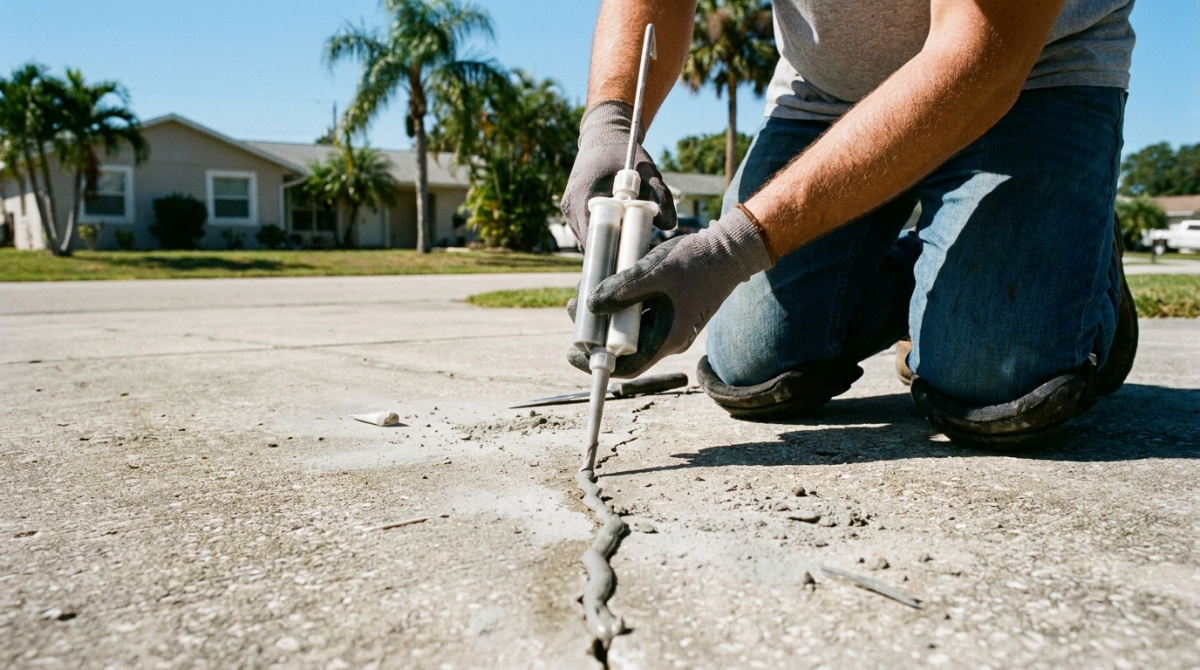
Advanced chemical welding comes into play at this stage. Instead of just masking the issue, experienced professionals utilize either a high-pressure or low-pressure injection method to inject low-viscosity structural epoxy resin straight down into the fracture itself. The process requires the sealing of the crack surface using a temporary paste and placing small injection ports along the way.
This particular resin has been specially formulated to maintain a surface tension that is less than that of water; hence, it is capable of entering even the thinnest hairline fissures. When the mixture of resin is pumped through the holes, it enters deep inside the surface, filling the air gap by pushing out all air and moisture trapped inside. Once the epoxy hardens, a chemical reaction occurs that leads to the formation of a stronger bond than the original substance. Thus, the epoxy does not create an artificial intermediary, but instead becomes a part of the initial structure.
Eliminating Long-Term Liability and Hazards
Beyond saving the building from structural collapse, deep resin injection eliminates everyday operational hazards. In a busy warehouse or retail distribution center, an uneven crack creates a serious trip hazard for employees and customers alike. It also wreaks havoc on material-handling equipment. Forklifts traveling at high speeds across open floor joints experience heavy tire and axle damage, resulting in unexpected equipment downtime and expensive repair bills.
By restoring a completely flat, structurally sound surface, you protect your workers, your machinery, and your bottom line. Addressing these issues before they warrant a visit from safety inspectors or lead to a workplace injury is a foundational requirement for responsible facility management.
The Bottom Line: True Return on Investment
It is easy to look at the upfront cost of specialized resin injection and hesitate, but proactive maintenance always wins out over emergency reconstruction. If you allow a structural fracture to deteriorate to the point where the slab begins to sink or crumble, the only option left is to tear out the entire section, re-compact the subgrade, and pour new concrete from scratch.
That level of heavy reconstruction means shutting down your business operations, moving inventory, blocking off traffic, and losing revenue for days or even weeks. Spending a fraction of that amount on targeted resin injection keeps your doors open and extends the operational lifespan of your existing slab by decades.
Conclusion
For a commercial property to be durable, a proactive maintenance program is needed that addresses issues at their source instead of just treating the problems superficially. Knowing how cracks form and using advanced resin technology to seal the cracks together, companies can prevent expensive interruptions in operations and premature failures of their structures.
When you need a professional company to assess and meet your structural needs, SMD Concrete Forming is the local expert you can rely on.
With years of experience and skilled craftsmanship, SMD Concrete Forming can tackle any construction project. Whether your property requires major infrastructure improvements or specialized commercial concrete crack repair, they provide the lasting quality and durability your business demands from a trusted specialist.




Comments (0)