

Decarbonization Without Derailing Production: How Dinesh Saraogi Helps Plants Balance Both
Learn how Dinesh Saraogi helps steel plants balance decarbonization, production continuity, technology adoption, and operational efficiency through phased strategies.
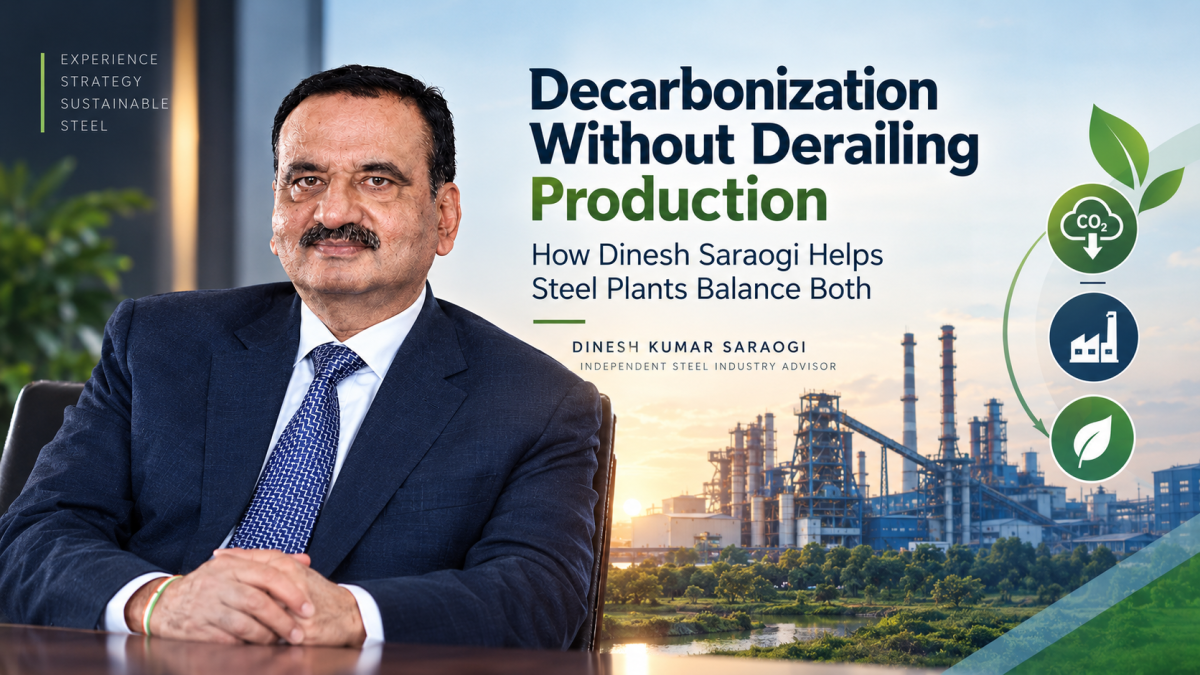
Decarbonization has moved from being a compliance checkbox to a defining business priority for the steel industry. Customers want low-carbon supply chains, regulators are tightening emission thresholds, and global benchmarks are also shifting faster than a lot of domestic producers had anticipated. Yet for plant leadership, the pressure to decarbonize runs headlong into a much more serious concern: production cannot stop, output targets cannot slip, and existing customer commitments cannot be jeopardized while the plant works on its emission profile.
The tension between the urgency of achieving the decarbonization goal and the practical reality of running a plant on a daily basis is where a lot of initiatives lose momentum. Dinesh Saraogi draws on decades of experience across multiple steel plant operations, execution, and strategic planning and works with plants to design decarbonization pathways that help respect this balance rather than treat it as an afterthought.
Why do decarbonization efforts disrupt industrial production?
A lot of companies have the instinct to treat decarbonization as a parallel project and let operations continue as usual until the two invariably collide. Problems tend to surface in new predictable ways:
Untested technologies are introduced too quickly: Switching to a DRI-EAF route, adjusting fuel mix, or introducing coal gasification without proper piloting can lead to unplanned outages and a lot of business inconsistencies.
Energy efficiency changes made in isolation: Equipment upgrades or process changes aimed at reducing emissions sometimes shift bottlenecks elsewhere in the plant. This reduces throughput even as emissions fall.
Workforce readiness gaps: New processes and equipment require operators. Without proper operators, sound technical decisions can also underperform on the floor.
Sequencing errors: Attempting too many changes simultaneously can make it difficult to isolate what is working and what isn't. So, this is again something that teams need to consider while designing decarbonization paths for themselves.
None of these problems are inevitable. However, in Dinesh Saraogi experience, these problems are largely a function of how the transition is planned and sequenced and not the cost of decarbonization alone.
Building a proper roadmap:
According to Dinesh Kumar Saraogi, rather than treating decarbonization as a single large initiative, a more workable approach is to break it down into stages so that it can be adopted without causing any kind of major disruption to the plant operations.
Baseline and priorities: Before making any kind of massive technology decision, the plant's actual emissions profile will have to be mapped. This includes understanding where carbon is being generated, which processes are the biggest contributors, and which interventions offer the best return without leading to any risk.
Pilot before scaling: Whether it's a shift towards DRI-EAF, an experiment with coal gasification, or a new energy management system, testing at a limited scale allows plants to validate the performance and understand the operational friction before making any kind of capital investment or operating at full production capacity.
Sequence around production cycles: A lot of major interventions like new material handling systems, furnace modifications, equipment retrofits, etc., are planned around maintenance windows and lower-demand periods whenever possible. This makes the shift smoother instead of you having to force anything in the middle of active production schedules.
Build internal capacity alongside technology shifts: New systems are only as efficient as the workers handling them. Training and workshops run in parallel with implementation. So, operators are ready when new processes go live rather than learning on the fly.
Monitor and adjust: Decarbonization is not a one-time change. Plants that succeed in adopting that path will have to treat it as an ongoing process. This involves tracking performance data, defining approaches, and adjusting the benchmarks as and when required.
Where does independent advisor support add maximum value?
Plant teams are always focusing on hitting the production targets. This is precisely why an outside perspective is useful at the planning stage. Dinesh Saraogi's role in these engagements involves:
● Evaluating which decarbonization levers make sense given a plant's specific feedstock, infrastructure, and market positioning.
● Structuring a phased roadmap that the teams can execute without having to derail from the existing production commitments.
● Conducting project evaluations before the capital is committed. That way, the decisions can be grounded in realistic feasibility.
● Running seminars and presentations that bring plant teams and leadership up to speed on the current state of decarbonization.
● Providing an independent, non-vendor influenced view when plants are comparing multiple technologies or equipment proposals.
In Conclusion:
The steel industry does not have the luxury of choosing between decarbonization and production continuity. Both these things will have to happen together. What separates plants that manage this transition well from those that do not is the sequencing, realistic evaluation, and willingness to treat decarbonization as an operational discipline.
With a career built on solving exactly this kind of operational complexity, Dinesh Kumar Saraogi Jindal Steel works with steel companies to design decarbonization strategies that hold up against the real production pressure.

Dinesh Kumar Saraogi is a well-known business leader and former CEO of Jindal Steel with over 40 years of experience in the global steel industry. Recognized for his expertise in steel manufacturing, greenfield project development, and operational excellence, Dinesh Kumar Saraogi CEO has successfully led large-scale industrial projects in India and overseas.Mr Saraogi has been accredited with many prestigious awards, including the Best Corporate Leader Award of Odisha, 2013 and the Best Corporate Leader Award of the Year 2014 .











Comments (0)