

AI Voice Agents for Gyms, Fitness Studios, and Membership Businesses
Learn how independent gyms, boutique fitness studios, yoga and Pilates studios, and multi-location fitness operators can use AI voice agents to answer routine calls, capture requests, route exceptions, and improve response consistency.

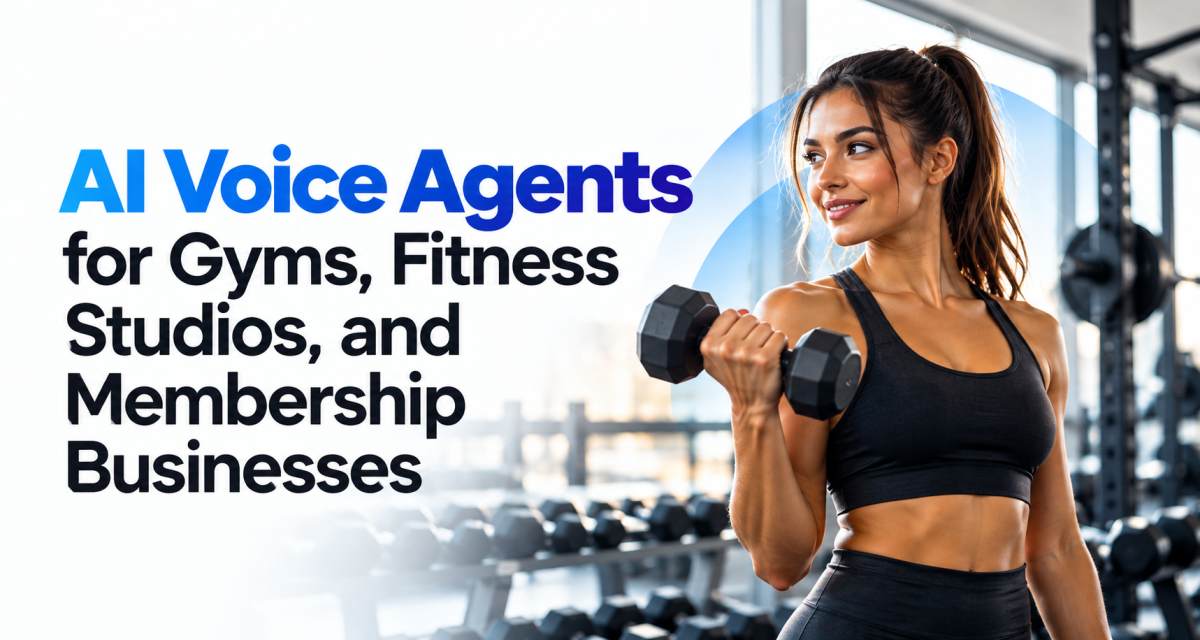
For independent gyms, boutique fitness studios, yoga and Pilates studios, and multi-location fitness operators, phone calls are often moments of high intent. A caller may be ready to buy, need a time-sensitive answer, or simply want reassurance that the business will respond. Yet staff cannot answer every call immediately. An AI voice agent can provide a prompt first response, handle defined routine requests, and route exceptions to the right person.
At peak hours, staff check members in, help instructors, sell memberships, and answer phones. Prospective members often call when they are ready to ask about pricing, classes, trials, or opening hours. This guide explains practical use cases, implementation choices, measurements, and safeguards. The goal is better access and consistency—not a promise that automation can solve every service problem.
Why phone responsiveness matters
Phone demand is uneven: several callers can arrive together, employees may be occupied with work that cannot be interrupted, and some people naturally call outside standard hours. For independent gyms, boutique fitness studios, yoga and Pilates studios, and multi-location fitness operators, common opportunities include membership FAQs; tour and trial requests; class timetable questions; membership-freeze requests; introductory-offer lead capture. Each should have a clear start, approved answer or action, and a defined point where a person takes over.
A missed call can mean a lost lead, a customer calling repeatedly, an employee being interrupted, or a small question becoming a complaint. Review call reasons as well as volume. A large number of calls about one policy may reveal confusing website copy, an unclear process, or information that customers cannot find.
What the technology actually does
An AI voice agent can understand common caller intents, respond from approved information, collect details, follow a defined workflow, and transfer a call with context. Depending on the setup, it may create a callback request, schedule a meeting, or update a connected system. It is not an unrestricted substitute for staff. Its access, knowledge, and decision boundaries must be explicit.
Start with clear use cases
Choose recurring requests with predictable answers and a low cost of error. A useful workflow has a clear trigger, a limited set of questions, an approved action, and a defined fallback. Avoid beginning with the most complicated or emotionally sensitive call type. Small, well-designed workflows are easier to test, explain to employees, and improve after launch.
Make the caller experience natural
Keep the greeting short, ask one question at a time, and use ordinary language rather than internal department names. Let callers correct misunderstandings and repeat important details. The system should identify itself appropriately and should not pretend to be human. When a transfer is needed, explain what happens next and send the receiving employee a concise summary.
Connect the workflow to real systems
Integrations should follow the process definition. Decide whether the agent needs a calendar, CRM, ticketing system, order database, or knowledge base, and grant only the permissions required. Define what happens if a connected system is unavailable. Never say a booking, order, ticket, or account change is complete until the relevant system confirms it.
Measure service quality, not just automation
Track eligible calls, missed-call rate, routing accuracy, callback completion, repeat contacts, and staff time spent on routine requests. Pair those measures with call reviews and customer feedback. A high containment rate is not success if callers cannot reach a person. A short call is not success if the customer must phone again to finish the task.
Privacy and responsible deployment
Collect only what the task requires, explain how information is used, and apply suitable retention and access controls. Review applicable consent, recording, disclosure, and privacy requirements with qualified counsel. Do not ask for passwords, one-time codes, or unnecessary sensitive details. Keep transcripts and recordings restricted and document how information moves between connected systems.
Training and continuous improvement
Give employees a clear explanation of what the agent handles, what it will not handle, and how to flag errors. Review call samples frequently during the pilot, then keep auditing a representative sample after launch. Assign a business owner to maintain answers and routing rules. The knowledge base must change when policies, promotions, schedules, products, or team responsibilities change.
A practical pilot plan
Week one: review calls and select a narrow use case. Week two: prepare approved answers, routing, data permissions, and escalation rules. Week three: test ordinary calls, unclear speech, interruptions, and failed integrations. Week four: compare results with the baseline, review mistakes, gather staff feedback, and decide whether to revise or expand. Keep a named owner accountable after the pilot.
Industry-specific workflows
Begin with one or two use cases drawn from the actual call mix: membership FAQs; tour and trial requests; class timetable questions; membership-freeze requests; introductory-offer lead capture. For each one, document what the agent may ask, which source is authoritative, what it can do, and when it must stop and transfer. The agent should confirm key details before taking consequential action. If it cannot verify information, it should say so and arrange human follow-up rather than guess.
Operational safeguards are especially important in this sector. Avoid medical or injury advice. Keep membership terms and promotions accurate and route billing disputes and sensitive matters to staff. Staff should be able to correct a bad answer, take over a conversation, and see a concise summary of the caller’s request. A useful system supports employee judgment instead of making employees responsible for cleaning up an opaque process.
A reliable measurement framework
Set a baseline before launch. Useful measures include missed-call rate, time to answer, eligible requests completed, accurate routing, callback completion, repeat calls, complaints, and staff feedback. Define what counts as a successful resolution before collecting results. Review a sample of calls for factual accuracy and whether the caller could reach a human when needed.
Use a balanced scorecard. Efficiency measures show whether the workflow is saving time; quality measures show whether it is helping people. Compare results across time periods and call types rather than relying on one unusually quiet or busy day. If the agent creates more repeat calls or inaccurate expectations, revise the workflow even if it handles a large number of interactions.
Where My CallPilot may fit
My CallPilot focuses on AI calling and voice workflows for businesses looking to handle inbound calls more consistently. Depending on requirements, teams can assess calling, IVR, assistant, knowledge-base, call-transfer, campaign, and analytics capabilities. Verify feature availability, integrations, security controls, and fit for your specific workflow before deployment. Explore Voice Ai Agents and the conversational ai platform options at My CallPilot as a starting point for planning.
Industry data and interpretation
The Health & Fitness Association’s 2025 benchmarking report analyzed data from 175 companies representing more than 17,000 facilities; reporting operators showed median revenue growth of 9.9% in 2024. This does not prove AI causes growth.
Salesforce’s 2025 State of Service report surveyed 6,500 service professionals. In the survey, 79% of service leaders said investment in AI agents was fundamental to meeting current business demands. This is a reported opinion among respondents, not proof that every organization needs the same solution.
Salesforce also reported that service teams estimated AI handled 30% of cases at the time and expected that share to reach 50% by 2027. These are survey estimates across service organizations, not forecasts for this specific sector or a guarantee of results.
Implementation checklist
· Choose one high-volume, low-risk call reason.
· Approve answers and assign an owner to maintain them.
· Set identity checks and least-privilege access before connecting systems.
· Define clear human escalation for urgent, sensitive, complex, or uncertain calls.
· Test interruptions, accents, background noise, and failed integrations.
· Review privacy, recording, consent, and retention obligations.
· Give staff a way to report errors and request changes.
· Evaluate customer outcomes alongside efficiency metrics.
Frequently asked questions
What is an AI voice agent?
It is software that converses with callers, answers approved questions, follows configured workflows, and can route or summarize requests. Its abilities depend on its setup and integrations.
Can it replace human employees?
It is best used for bounded, routine tasks and as a first response. Humans remain essential for complex decisions, exceptions, sensitive conversations, and relationship-building.
How should a business start?
Audit call reasons, choose a narrow workflow, prepare accurate knowledge, set escalation rules, test with real scenarios, and compare results with a baseline.
How can answers stay accurate?
Use approved sources, assign a content owner, review updates regularly, and instruct the system to escalate when a fact cannot be verified.
What should a company measure?
Track missed calls, routing accuracy, resolution quality, repeat contacts, callback completion, complaints, and staff feedback—not only the number of automated calls.
Final takeaway
For independent gyms, boutique fitness studios, yoga and Pilates studios, and multi-location fitness operators, the best starting point is not automating every conversation. Select routine requests that can be handled accurately, define boundaries, and make human support easy to reach. A measured pilot will reveal which calls are suitable, where customers still need people, and what should improve next.
Explore My CallPilot at https://mycallpilot.ai/ to assess whether its AI calling, IVR, call transfer, knowledge base, and analytics capabilities fit your workflow.













Comments (0)