

What Clinics Overlook When Sourcing Dental Instruments
ISO-certified dental instruments manufacturer since 1967. Precision-forged surgical steel, export-ready compliance docs. Request a sample quote today.

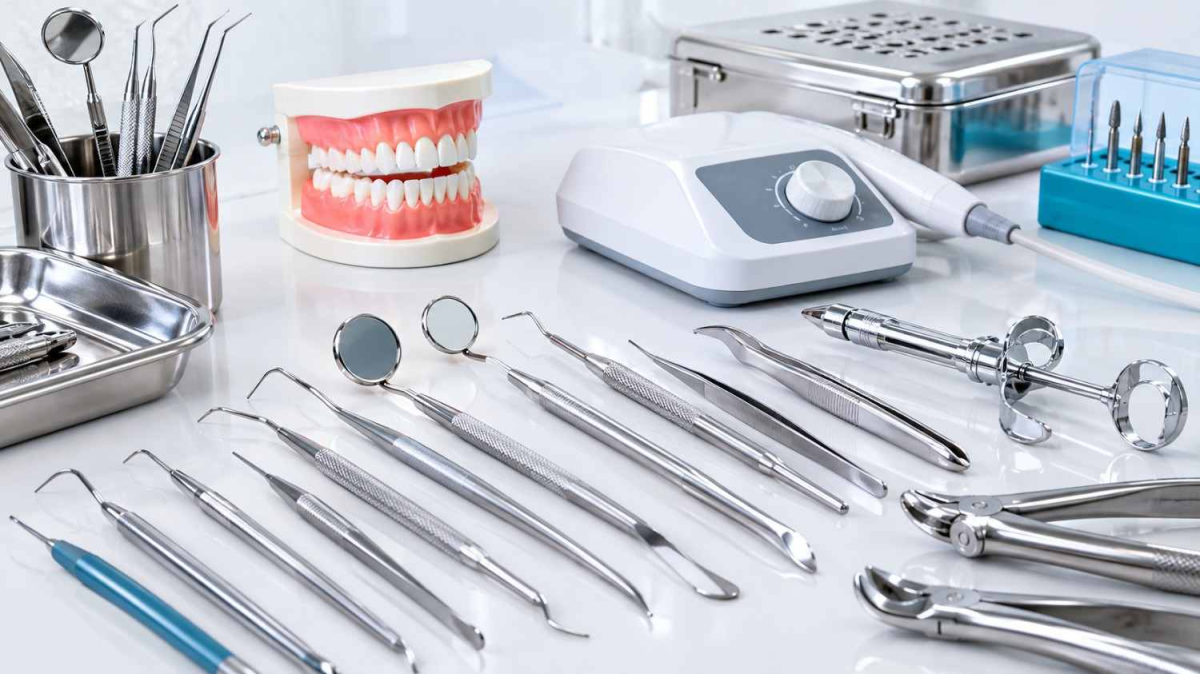
Most procurement managers open a supplier catalog and go straight to price. That's the first mistake. Dental instruments look identical in a product photo — the difference shows up eighteen months later, when a scaler's tip starts pitting or a forceps hinge loosens under autoclave cycles. Buyers who skip the spec sheet end up paying for that mistake twice: once in the original order, and again when they reorder from someone else.
The Spec Detail Most Buyers Skip
Every catalog lists "surgical grade stainless steel." Almost none specify which grade. That's the gap. Dental instruments made from AISI 410 martensitic steel hold an edge but corrode faster in humid clinical storage; 420 and 430 grades trade some edge retention for better corrosion resistance. A supplier who won't name the exact grade on the spec sheet is either unsure or hiding a cost-cutting substitution.
Hand Instruments
Scalers, curettes, and probes — forged, not stamped, if you're buying for repeated sterilization cycles.
Diagnostic Instruments
Mouth mirrors, explorers, tweezers — dimensional tolerance matters more here than most buyers realize.
Extraction and Surgical Instruments
Forceps, elevators, needle holders — hinge tolerance and jaw alignment decide whether these survive 500+ autoclave runs.
Material certificates (mill test reports) should accompany every bulk order. Most exporters don't offer them unless you ask.
Four Questions That Actually Test a Supplier
Not every seller of dental instruments deserves a purchase order. Before you sign anything, run them through these five questions — and pay closer attention to how vaguely they answer than to how confidently.
1. Which steel grade, and can you show the mill certificate?
Bad answer: "It's medical grade steel." That phrase means nothing without a grade number attached.
2. Is your ISO 13485 or ISO 9001 certificate current, not expired?
Bad answer: silence, or a certificate dated three years back with no renewal mentioned.
3. Can you share export documentation history for your target market?
Bad answer: vague reassurance with no country names or shipment references.
4. What's your actual lead time under full order load, not your best-case quote?
Bad answer: a single number with no mention of seasonal or raw-material delays.
Why These Features Actually Protect Your Margin
-
Verified steel grading cuts warranty returns and protects your reorder margin.
-
Autoclave-tested hinge tolerance on forceps and elevators reduces mid-batch instrument failure.
-
Mill test certificates speed up customs clearance in regulated import markets.
-
Consistent batch finishing means fewer rejected units at your own quality check.
-
Documented defect policy removes the guesswork when something does go wrong.
-
Working with established dental equipments manufacturers reduces the compliance risk you'd otherwise carry alone.
None of this is about "premium quality." It's about what breaks, what gets rejected at customs, and what costs you a repeat client.
Why Location Is a Supply Chain Decision, Not Just an Address
Jalandhar isn't a random address on a letterhead. It's one of India's oldest surgical instrument manufacturing clusters, with forging, grinding, and finishing units within a few kilometers of each other. That density shortens production timelines that a scattered supply chain simply can't match. Surgifact operates from Raja Garden, Basti Danishmandan — near Vishal Tools — inside this cluster, which means raw material sourcing, forging, and finishing happen without the freight delays a fragmented setup adds.
For buyers researching dental instruments manufacturers in India, this regional concentration is worth checking before anything else. A supplier who subcontracts forging to three different cities isn't lying about capability — but their lead times will reflect it.
About Us
We've been forging dental and surgical instruments out of Jalandhar since 1967. That's not a marketing line — it's three generations of the same family running the same forging floor. We're ISO-certified, and we treat that certificate as a minimum, not a selling point.
Here's something only someone who's run this floor for years would tell you: we stopped accepting third-party polishing subcontracts in 2019 after two export batches came back with inconsistent mirror finish under microscope inspection. We brought polishing in-house. It slowed our throughput for about four months. It also stopped the finish complaints entirely.
We work directly with dental instruments suppliers, wholesalers, and brand owners who need consistency across repeat orders, not just a good first sample.
Request a Quote — Here's What We Need From You
Send us your instrument list, target steel grade (or ask us to recommend one for your climate and use case), and order quantity. Our minimum order quantity starts at 500 pieces per SKU for custom-branded orders. We respond to quote requests within 24 business hours with pricing, lead time, and sample availability. If you need mill certificates or ISO documentation attached to your quote, mention it upfront — we'll include it in the same email.
Conclusion
Sourcing decisions made on price alone tend to surface their real cost during the second or third reorder. Buyers who ask about steel grade, defect policy, and certification upfront avoid that cycle entirely. If you're evaluating dental instruments manufacturers, start with the questions in this article — not the catalog photos. The suppliers who answer them plainly are usually the ones worth a long-term contract.
Frequently Asked Questions
What should buyers check before choosing dental instruments manufacturers in India?
Start with the steel grade and mill certificate, not the price list. A supplier who can't name their exact grade is guessing, and that guess shows up in your defect rate later.
Do you work with dental instruments exporters outside India?
Yes. We ship to overseas distributors and wholesalers, and we prepare export documentation, including certificates of origin, on request. Note that document turnaround adds a few days to first-time orders while we verify destination-market requirements.
What's the minimum order quantity for custom branding?
500 pieces per SKU. Smaller sample orders are available for evaluation before you commit to a full run.
How do dental instruments suppliers usually handle defective batches?
It varies a lot, honestly — which is exactly why you should ask for a written policy before ordering. We replace verified manufacturing defects within an agreed window; we don't offer blanket case-by-case discretion.
Are your dental equipments ISO-certified?
Yes, and we keep the certificate current rather than treating it as a one-time badge. We'll share a copy with any serious inquiry.
Can I get material certificates with a bulk order?
Yes, mill test reports are available on request for bulk shipments. We'd recommend requesting them by default, not as an afterthought.
How fast do you respond to a new inquiry?
Within 24 business hours with pricing and lead time. Sample dispatch timing depends on stock availability, which we'll confirm in that same response.






Comments (0)