

Why Modern Audits Need Better Evidence, Not More Paper
Modern audit management is moving beyond spreadsheets as organisations seek stronger evidence, real-time visibility and risk-based assessments.

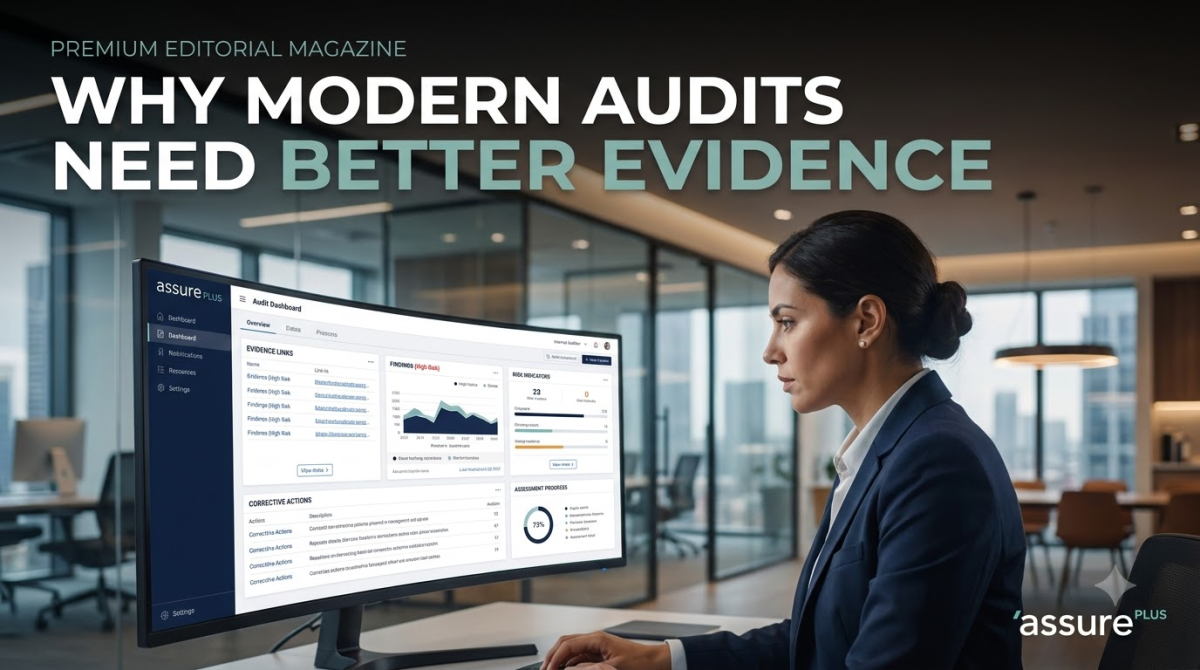
An audit can generate a large amount of documentation without necessarily producing better insight. Teams may have completed checklists, collected files and prepared reports, yet still struggle to answer a basic question: what do the findings actually tell the organisation about its controls and risks?
That question is becoming more relevant as audit functions move toward more technology-enabled and risk-based approaches. The newly published ISO 19011:2026 places explicit emphasis on evidence-based and risk-based auditing, alongside stronger guidance for managing, monitoring and improving audit programmes.
Why is audit evidence becoming more important?
Evidence gives an audit its foundation. Without reliable evidence, an assessment can become dependent on assumptions, incomplete records or individual interpretations.
The problem is that evidence is often stored across different systems. An auditor may need to search through spreadsheets, email threads, shared drives and business applications before finding the information needed to support a finding.
A centralised audit process can make the relationship between an assessment, its evidence, findings and corrective actions much easier to follow.
Can audit management make assessments more useful?
The purpose of an audit is not simply to identify whether a requirement has been met. A well-managed audit should help an organisation understand where controls are working, where weaknesses exist and which issues deserve attention.
This requires visibility across the audit lifecycle. Planning, fieldwork, evidence collection, findings, recommendations and follow-up activities need to remain connected.
AssurePlus describes its audit capabilities around centralised audit programmes, checklists, workpapers, evidence links, findings, corrective actions and real-time dashboards.
For organisations considering a more connected audit assessment process, this structure can reduce the need to reconcile information manually across separate tools.
What makes a risk-based audit different?
A risk-based audit does not treat every area of the organisation as equally important. It considers where weaknesses could have the greatest effect and directs attention accordingly.
ISO 19011:2026 includes risk and opportunity considerations when establishing an audit programme, as well as guidance for monitoring and reviewing the programme.
Technology can support this approach by giving audit teams better visibility into previous findings, recurring issues, control performance and related risk information.
The result can be a more focused audit programme that spends time where the organisation has the greatest exposure rather than simply repeating the same checks on a fixed schedule.
How can incident data improve audit assessments?
Incidents can provide useful evidence about whether controls work in practice. A recurring operational or compliance incident may indicate a weakness that deserves closer examination during an audit.
This creates an opportunity to connect audit information with incident management. AssurePlus's incident capabilities include evidence collection, corrective actions, historical records and trend analysis.
Using structured incident information as part of wider governance reviews can help auditors see patterns that may not be obvious from individual control tests.
What should organisations expect from audit management?
Modern audit management should reduce the administrative work surrounding an assessment while improving the quality of information available to auditors and leadership.
The goal is not to produce more evidence. It is to make evidence easier to connect, review and act upon.
When audit programmes, evidence, findings, corrective actions and related incidents are managed as connected information, audits can become more useful to the wider organisation. They can identify weaknesses, support accountability and provide leadership with a clearer basis for deciding where improvement is needed.
Conclusion
Modern audits need more than large volumes of documentation. They need reliable evidence, clear findings and a practical connection between assessments, risks and corrective actions. A well-managed audit process can help organisations understand not only whether a requirement has been met, but where controls and processes need improvement.
By combining risk-based assessment with organised evidence and continuous follow-up, organisations can make audits more useful beyond the final report. The focus shifts from simply completing an audit to using its findings to strengthen governance, accountability and ongoing organisational improvement.



Comments (0)