

How AI Is Transforming the Insurance Industry for a Smarter Future

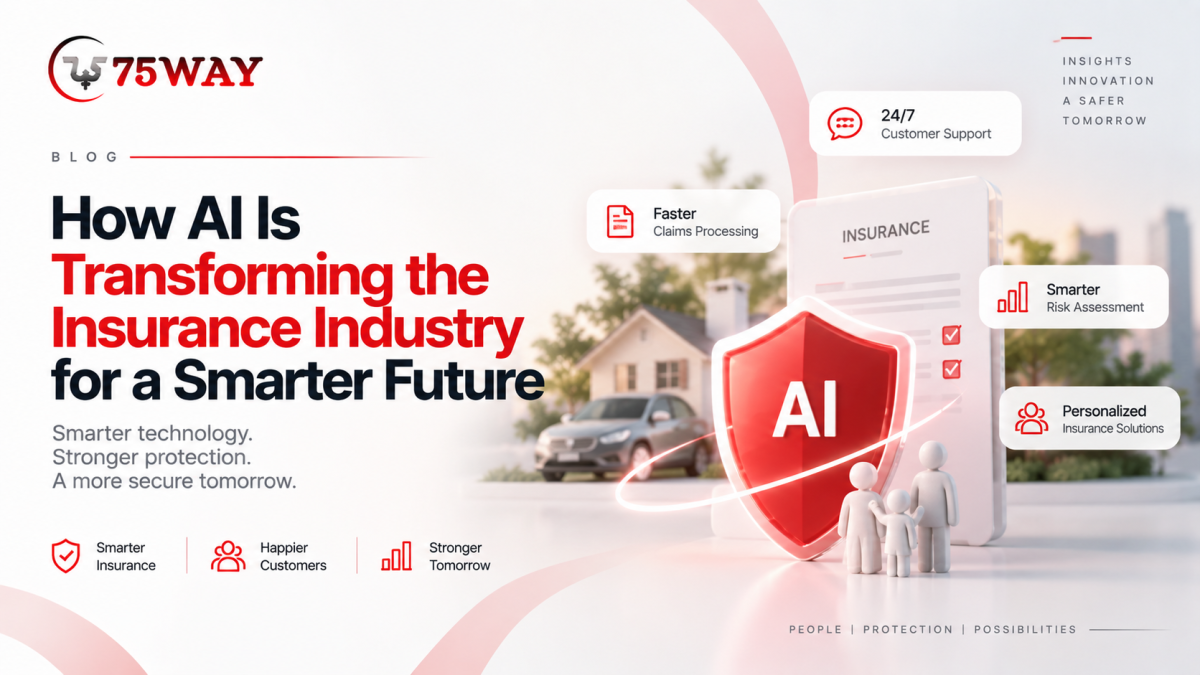
Insurance is becoming increasingly digital as customers expect faster communication, simpler claims, personalized services, and convenient access to policies. AI for insurance is helping insurers address these expectations by combining automation, predictive analytics, natural language processing, and data-driven decision-making. From identifying suspicious claims to assisting customers with policy questions, intelligent technology is changing how insurance companies manage everyday operations. However, successful adoption requires more than implementing advanced algorithms. Insurers must also focus on data quality, security, transparency, regulatory considerations, and meaningful customer experiences.
Why Artificial Intelligence Matters in Insurance
The insurance industry handles enormous amounts of information. Customer profiles, policy documents, claims records, payment histories, risk assessments, correspondence, and market data all contribute to complex workflows.
Many of these processes have traditionally depended on manual reviews and rule-based systems. While conventional approaches remain valuable, they can become difficult to scale as customer volumes and data requirements increase.
Artificial intelligence can analyze large datasets quickly, identify patterns, and automate repetitive activities. This allows employees to concentrate on tasks requiring professional judgment, empathy, investigation, and relationship management.
The technology can be applied across the insurance lifecycle, including underwriting, claims processing, customer support, fraud detection, risk analysis, document processing, and policy administration.
The most successful implementations are likely to be those that solve specific operational problems rather than attempting to automate everything simultaneously.
Improving Customer Experiences With Intelligent Technology
Customer expectations have changed significantly across financial services. Policyholders increasingly want immediate answers, simple digital processes, and personalized interactions.
Intelligent systems can help insurers provide faster responses to common questions and guide customers through routine processes.
For example, a virtual assistant could explain general policy information, provide claim-status updates, help users locate documents, or direct customers toward the appropriate service channel.
Personalization can also improve engagement. Insurers can analyze permitted customer information to understand preferences and interactions, allowing them to present more relevant communications and services.
The goal should be convenience without sacrificing trust. Insurance involves sensitive financial and personal information, so automated experiences must be designed around privacy, security, and transparency.
Automating Claims Processing
Claims management is one of the areas where intelligent automation can have a substantial impact.
A traditional claim may involve forms, photographs, invoices, policy documents, communication records, and multiple stages of verification. Processing these materials manually can consume considerable time.
Intelligent document-processing systems can extract relevant information from structured and unstructured documents. Image-analysis technologies can also assist with evaluating submitted photographs in certain insurance scenarios.
Automated workflows can then route claims according to predefined criteria, helping teams prioritize cases and reduce administrative delays.
Automation does not necessarily mean removing human involvement. Complex claims, disputed cases, and situations requiring investigation can still be escalated to experienced professionals.
The result can be a hybrid process in which technology handles routine work while specialists focus on cases requiring deeper analysis.
Detecting Fraud More Effectively
Fraud remains a significant challenge for insurers across different product categories. Suspicious activity may involve exaggerated claims, inconsistent information, unusual patterns, or coordinated behavior.
Traditional systems often depend on predefined rules. While rules remain useful, intelligent models can examine broader behavioral patterns and identify relationships across large datasets.
For example, an analytical system could compare claim characteristics, timing, locations, customer histories, and other permitted information to identify cases that may warrant further investigation.
This does not mean that every flagged claim is fraudulent. Unusual activity can have legitimate explanations.
Human investigators should therefore remain involved in reviewing high-risk cases. Intelligent detection should function as an investigative aid rather than an automatic accusation mechanism.
AI Solutions for Insurance Companies
Insurance organizations have different products, customers, infrastructure, and operational requirements. As a result, AI solutions for insurance companies should be designed around specific business challenges instead of relying on a one-size-fits-all approach.
A health insurer may prioritize claims analysis and member support, while an automobile insurer may focus on accident assessment and risk modeling.
A property insurer could benefit from image analysis and catastrophe-risk forecasting, whereas a life insurer may place greater emphasis on customer engagement and underwriting support.
Before implementing technology, insurers should identify the workflow that creates the greatest opportunity for improvement. Establishing measurable goals can make it easier to determine whether an implementation is producing meaningful results.
Enhancing Underwriting With Data Analytics
Underwriting requires insurers to assess risk before determining appropriate policy terms. This process can involve evaluating customer information, historical records, property characteristics, financial factors, and other relevant data.
Advanced analytics can help underwriters process information more efficiently and identify patterns that deserve closer attention.
Predictive models can support risk segmentation and provide additional insights during evaluation.
However, underwriting is a high-impact activity, which means automated systems require careful oversight. Models trained on historical information can potentially reproduce existing biases or produce inaccurate results when circumstances change.
Insurers should therefore validate models regularly and establish processes for monitoring performance, fairness, and explainability.
Technology should enhance professional decision-making rather than remove accountability.
Delivering 24/7 Customer Assistance
Insurance customers do not always need assistance during traditional business hours. Questions about policies, documents, claims, payments, and account information can arise at any time.
This has increased interest in AI solutions for 24/7 customer service in insurance. Conversational systems can provide automated assistance outside normal working hours and handle repetitive questions without requiring an employee for every interaction.
An intelligent assistant can potentially help customers find information, understand basic processes, initiate service requests, and identify the appropriate next step.
For sensitive requests, the system can require authentication or transfer the conversation to a qualified representative.
A well-designed service model combines automation with human support instead of treating technology as a complete replacement for customer service teams.
Personalizing Insurance Recommendations
Customers have different circumstances, financial priorities, and risk profiles. Generic communication may therefore have limited effectiveness.
Personalized systems can analyze permitted behavioral and account information to identify relevant products, educational resources, or service opportunities.
For instance, a customer experiencing a significant change in circumstances may benefit from receiving information about appropriate coverage options.
Personalization can also improve communication frequency. Instead of sending unnecessary messages, insurers can focus on timely and relevant interactions.
However, organizations should avoid excessive personalization that makes customers uncomfortable. Clear privacy practices and appropriate controls are essential for maintaining trust.
Intelligent Document Processing
Insurance businesses handle extensive documentation. Applications, policy forms, claims submissions, invoices, identification documents, inspection reports, and correspondence can all contain valuable information.
Manually extracting information from these documents can be time-consuming and susceptible to errors.
Intelligent document processing combines technologies such as optical character recognition, natural language processing, and machine learning to identify and extract relevant information.
The extracted information can then be transferred into appropriate workflows or systems.
This can reduce repetitive data-entry work and potentially improve processing speed. Human review can still be incorporated where documents are ambiguous or where accuracy requirements are particularly high.
Predictive Risk Management
Insurance is fundamentally built around understanding and managing risk. Predictive analytics can help organizations evaluate potential future outcomes using historical and current information.
Models may analyze patterns related to claims frequency, customer behavior, environmental conditions, asset characteristics, or other relevant variables.
For example, property insurers may use data to better understand exposure to certain environmental risks. Automobile insurers can analyze driving-related information where appropriate and legally permissible.
Predictions should always be treated as estimates rather than certainties. Unexpected economic, environmental, technological, or social changes can affect real-world outcomes.
Combining predictive models with expert knowledge can provide a more balanced approach to risk management.
AI Insurance Solutions for Operational Efficiency
Beyond customer-facing applications, AI insurance solutions can improve internal operations.
Insurance companies often manage repetitive workflows involving data validation, document classification, correspondence, reporting, scheduling, and case routing.
Automating these activities can reduce administrative workloads and allow employees to dedicate more time to complex tasks.
Intelligent workflow systems can also help prioritize work according to urgency or predefined business criteria.
For example, claims requiring immediate attention can be routed to specialized teams, while straightforward cases can follow automated processing paths.
Operational automation can create benefits beyond speed. Standardized workflows may improve consistency and make it easier for organizations to monitor performance.
Improving Communication With Natural Language Processing
Insurance language can sometimes be difficult for customers to understand. Policy documents often contain technical terms, conditions, exclusions, and complex explanations.
Natural language processing can help organizations create tools that summarize or organize information in more accessible ways.
For example, an internal assistant could help employees locate relevant sections of policy documentation. Customer-facing systems could provide simplified explanations while clearly directing users to the official policy language.
Such tools should avoid presenting simplified summaries as legally authoritative interpretations.
The objective is to make information easier to navigate while maintaining accuracy and appropriate human oversight.
Building Trust Through Responsible AI
Trust is particularly important in insurance because automated systems can influence claims, pricing, risk assessment, and customer experiences.
Customers and regulators may reasonably want to understand how important decisions are made.
Insurers should therefore establish governance frameworks covering model development, testing, monitoring, data usage, security, documentation, and accountability.
Explainability can be especially important for high-impact decisions. Employees should have processes for reviewing questionable outputs and escalating cases when automated results appear inaccurate.
Responsible adoption is not simply a technical requirement. It is also an organizational commitment to fairness, transparency, privacy, and customer protection.
Data Security and Privacy Considerations
Insurance companies manage highly sensitive information, including financial details, personal identifiers, policy information, claims records, and potentially health-related data depending on the insurance product.
Strong security practices should therefore be incorporated throughout the technology lifecycle.
Organizations should consider encryption, secure authentication, role-based access controls, protected APIs, monitoring, vulnerability assessments, secure infrastructure, and appropriate data-retention practices.
Data minimization can also be valuable. Systems should not collect or process information without a legitimate business purpose.
Before deploying an intelligent system, organizations should understand where information is stored, who can access it, how it is processed, and how long it is retained.
Choosing the Right Technology Partner
Successful implementation requires more than selecting a promising technology. Insurance businesses need development partners that understand software architecture, data management, security, integrations, testing, and long-term maintenance.
They should also evaluate whether a technology provider understands the complexity of insurance workflows.
Relevant experience can help teams anticipate integration challenges and design solutions around actual operational requirements.
Organizations should assess previous projects, technical capabilities, development methodology, quality assurance practices, communication processes, and post-launch support.
For businesses exploring intelligent insurance technology, 75way Technologies can help develop tailored solutions designed around specific operational requirements and customer experiences.
Challenges of Implementing Artificial Intelligence
Despite its potential, intelligent technology introduces several challenges.
Legacy systems can make integration complicated, especially when organizations rely on multiple platforms that were developed at different times.
Data quality can also become a major obstacle. Incomplete or inconsistent information may reduce the effectiveness of analytical models.
Workforce adoption is another consideration. Employees need appropriate training to understand how intelligent tools work, how to interpret outputs, and when human intervention is necessary.
There are also financial, security, regulatory, and maintenance considerations.
A phased implementation can help insurers address these challenges gradually. Starting with a clearly defined use case allows organizations to measure outcomes before expanding into more complex applications.
The Future of Intelligent Insurance
The insurance industry is likely to become increasingly data-driven as intelligent technologies mature.
Automated claims workflows may become more sophisticated. Conversational assistants may provide more contextual support. Predictive analytics may help insurers understand changing risks, while intelligent tools may assist employees with research and documentation.
At the same time, customer expectations will continue to evolve. Policyholders will increasingly expect fast, transparent, personalized, and convenient services.
The future will therefore depend not only on technological capability but also on responsible implementation.
Insurers that combine intelligent automation with strong governance, human expertise, secure infrastructure, and customer-focused design will be better positioned to create sustainable digital experiences.
Conclusion
Artificial intelligence is creating new opportunities across the insurance value chain. From claims processing and fraud detection to underwriting, customer support, risk analysis, and operational automation, intelligent systems can help insurers improve efficiency and deliver more responsive services.
However, technology should be implemented strategically. Data quality, privacy, security, fairness, transparency, regulatory considerations, and human oversight must remain central to the transformation.
Businesses exploring AI solutions for insurance should begin by identifying specific challenges where intelligent technology can create measurable value. A focused roadmap can help organizations introduce automation responsibly while building a foundation for future innovation.
The insurance companies that succeed in this transformation will not necessarily be those that adopt the greatest number of AI tools. They will be the organizations that use intelligent technology thoughtfully to simplify processes, strengthen decision-making, protect customers, and create better long-term experiences.
Frequently Asked Questions
How is AI used in the insurance industry?
Artificial intelligence can support claims processing, fraud detection, underwriting, customer service, risk analysis, document processing, personalization, marketing, and operational automation.
What are the benefits of AI for insurance companies?
The technology can help automate repetitive work, analyze large datasets, improve response times, identify unusual patterns, support employees, personalize customer interactions, and streamline operational workflows.
Can AI automate insurance claims?
It can automate portions of the claims process, such as document extraction, classification, case routing, and preliminary assessment. Complex or disputed cases may still require experienced professionals.
How can AI help with insurance fraud detection?
Intelligent models can analyze transaction and claims patterns to identify unusual behavior or inconsistencies. Flagged cases can then be reviewed by investigators before any action is taken.
Is AI suitable for customer service in insurance?
Yes. Conversational assistants can handle many routine questions around the clock, provide general information, guide customers through processes, and transfer more complex cases to human representatives.
What challenges should insurers consider before adopting AI?
Key challenges include data quality, legacy-system integration, privacy, cybersecurity, regulatory requirements, model bias, explainability, employee adoption, implementation costs, and ongoing monitoring.
Can AI replace insurance professionals?
It is better viewed as an assistance and automation technology. Professionals remain important for complex decisions, investigations, negotiations, customer relationships, compliance, and situations requiring empathy and judgment.





Comments (0)