

How Can Laboratory Shakers Create More Reproducible Sample Workflows?
Explore how laboratory shakers improve sample mixing, parallel processing, temperature-controlled workflows and reproducibility across modern scientific applications.

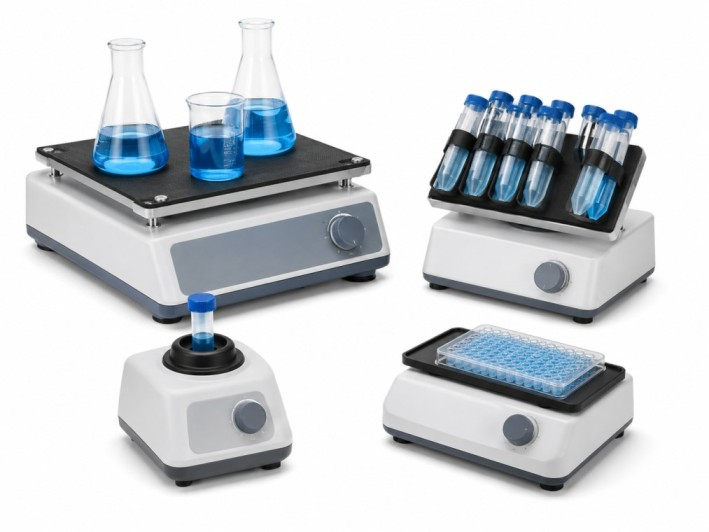
Improving Controlled Motion, Parallel Processing and Sample Consistency in Modern Laboratories
Successful laboratory work often depends on maintaining samples under repeatable physical conditions. Shakers provide controlled mechanical movement that helps researchers keep liquids in motion, improve contact between components and process multiple samples with reduced dependence on manual mixing. Their versatility makes them valuable across chemical preparation, biotechnology, microbiology, analytical testing and general research environments.
Rather than simply replacing hand shaking, laboratory shakers allow movement speed, duration and sample arrangement to be controlled more consistently. This can help laboratories establish procedures that are easier to repeat between different experiments and operators.
Why Is Reproducible Motion Important?
Manual agitation can vary considerably from one person to another. Differences in speed, duration and movement pattern may affect how thoroughly a sample is mixed.
Laboratory shakers reduce this variability by providing defined mechanical motion.
Researchers can use controlled agitation to maintain suspended material, improve reagent contact or support sample preparation before further analysis. When operating parameters are documented, the same conditions can also be repeated in later experiments.
This makes shaker equipment particularly useful where reproducibility is more important than simply achieving rapid mixing.
Matching the Movement to the Sample
Not every sample should be shaken in the same way.
The suitable motion depends on factors such as liquid volume, container shape, viscosity and sample sensitivity. Faster movement may be useful when rapid mixing is needed, while gentler agitation may be preferable for delicate biological materials.
The objective is to produce enough movement to achieve the required result without causing excessive foaming, splashing or mechanical stress.
Researchers should therefore consider shaking speed as part of the complete method rather than viewing maximum speed as the ideal setting.
Processing Microplates More Efficiently
Modern laboratory workflows often involve microplates containing many individual wells. Mixing each well manually would be inefficient and difficult to standardise.
Microtiter Shakers provide controlled movement for microplate-based applications where multiple samples need comparable agitation.
This can be useful during reagent mixing, incubation-related workflows or other procedures that require liquids within multiple wells to remain consistently mixed.
Because microplate volumes are relatively small, shaking conditions should be selected carefully. Excessive movement may lead to splashing or cross-well contamination, while insufficient agitation may not provide adequate mixing.
When Is Stronger Mechanical Mixing Needed?
Some laboratory materials are more difficult to mix using platform-based shaking alone.
High-viscosity liquids, larger vessels or more demanding formulations may require stronger mechanical action.
Overhead Mixers And Stirrers provide another approach for applications where a driven mixing element is required inside the sample.
These systems can complement laboratory shakers rather than directly replace them.
A shaker may be ideal for processing several containers simultaneously, whereas an overhead mixer can provide greater mechanical force for a particular vessel.
Understanding the difference allows laboratories to choose equipment according to the physical behaviour of the sample.
Combining Temperature and Agitation
Some laboratory procedures require both controlled movement and controlled temperature.
Thermoshakers Thermocyclers support workflows where thermal conditions form part of sample processing.
Combining heating or temperature management with movement can be useful when reaction conditions, dissolution or sample preparation depend on both factors.
Researchers should consider temperature and agitation together because changing one may influence the other. Higher temperatures can alter liquid viscosity, while vigorous movement may influence heat distribution.
Using defined conditions helps laboratories maintain a more consistent experimental environment.
Shakers in Cell-Based Laboratory Work
Biological laboratories frequently process samples held in specialised tubes and containers.
Cell Culture Tubes provide vessels relevant to cell-culture and biological workflows where sample containment is important.
When suitable procedures call for controlled movement, researchers must ensure that both the container and shaker are appropriate for the application.
Tube size, closure type and sample volume can influence how material moves during agitation. Secure positioning is particularly important because unstable containers can affect both experimental consistency and equipment safety.
Platform Loading Can Affect Performance
How samples are arranged on a shaker can influence the quality of agitation.
An uneven load may create unnecessary vibration or place greater mechanical stress on the equipment. Containers should therefore be distributed according to the platform design and secured with compatible holders where required.
Good loading practices help ensure that different samples receive comparable movement.
Before starting a run, researchers should confirm that:
- Containers are properly secured
- Sample volumes are suitable
- The platform is evenly loaded
- Speed is appropriate for the application
- Closures are fitted correctly
Starting at a moderate speed can also help users identify unstable containers before increasing agitation.
Preventing Foaming and Excessive Agitation
More vigorous shaking does not always produce better results.
Some solutions can foam when air becomes incorporated during movement. Excessive agitation may also cause liquid to reach container closures or create unwanted mechanical effects.
If foaming occurs, researchers may need to reduce speed, change the movement pattern or reconsider the amount of liquid in the vessel.
Container geometry can also influence behaviour. A wide flask may generate a different flow pattern from a narrow tube even when both are operated at the same speed.
Observation remains important when establishing a new method.
How Can Shakers Improve Laboratory Throughput?
One of the major advantages of laboratory shakers is the ability to process multiple samples simultaneously.
Instead of mixing every vessel individually, researchers can place several compatible containers onto one platform and apply the same movement conditions.
This can reduce repetitive manual work and make processing time more predictable.
Parallel processing is especially valuable in laboratories handling multiple samples, screening workflows or repeated preparation procedures.
However, efficiency should not come at the expense of correct sample positioning or suitable operating conditions.
Choosing the Right Shaker for the Application
Laboratories should select shaker equipment according to their typical sample format rather than relying on a single instrument for every task.
Container type, sample volume, desired motion, operating speed, temperature requirements and platform capacity all influence equipment choice.
Available workspace also matters, particularly where several instruments share one bench.
Evaluating these requirements before selection can help laboratories avoid equipment that is either insufficient for the intended work or unnecessarily complex.
Creating More Consistent Sample Processing
Laboratory shakers help transform agitation from an operator-dependent activity into a more controlled part of experimental design.
By selecting the correct motion, securing containers properly and matching operating conditions to the sample, researchers can improve consistency across repeated procedures.
Whether the workflow involves microplates, biological tubes, temperature-controlled preparation or more demanding mixing requirements, appropriate shaker technology supports efficient sample processing and more reproducible laboratory practices.








Comments (0)