

From HRMS to Agentic AI: How HR Technology Is Becoming Action-Oriented
Discover how Agentic AI is transforming HRMS from a system of record into action-oriented HR technology for smarter, faster workforce management.

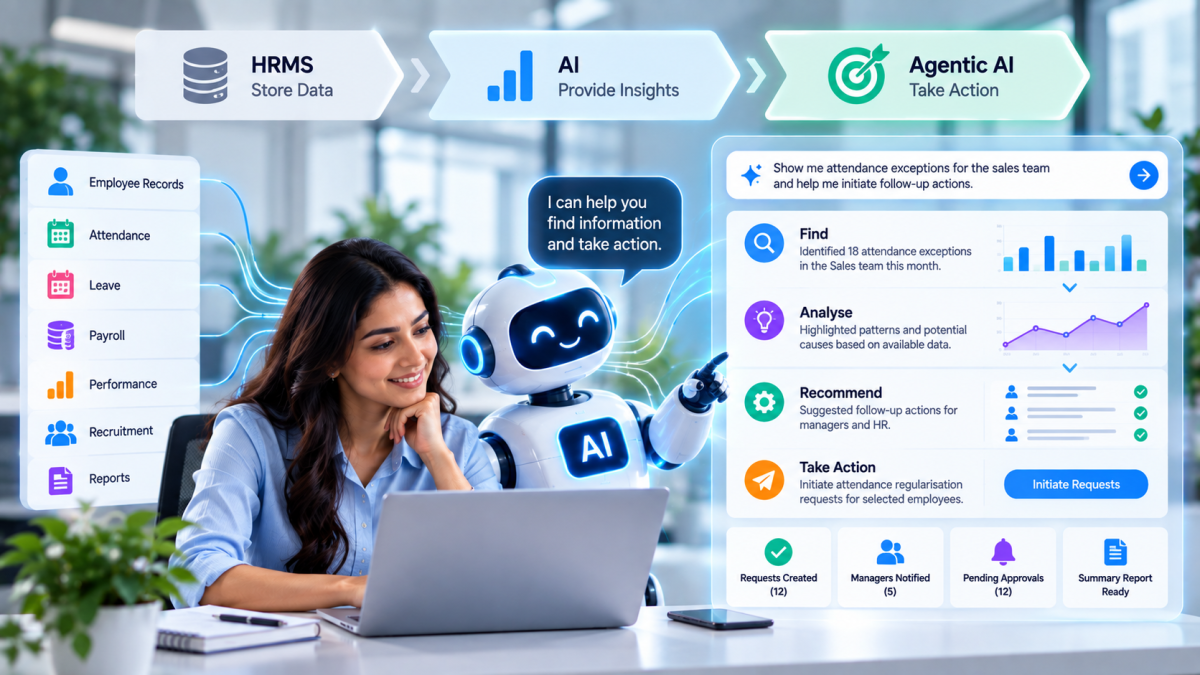
For decades, HR technology has evolved around one central goal: making workforce management more efficient. Paper employee files became digital records, spreadsheets gave way to HRMS platforms, and manual attendance and payroll processes became increasingly automated. Today, HR technology is entering another phase with the emergence of Agentic AI.
Businesses evaluating the best HRMS software in India are therefore beginning to look beyond features such as payroll, attendance, leave and employee self-service. The next question is whether HR technology can help users understand information and take the next appropriate action. This is where Agentic AI becomes particularly interesting. Instead of functioning only as a system of record or answering isolated questions, AI agents can potentially understand a user's objective, work with authorised HR data and assist with defined tasks.
The shift is from software that waits for instructions at every step to technology that can help users move work forward.
How HR Technology Has Evolved
Understanding Agentic AI becomes easier when we look at how HR technology has changed over time.
The earliest HR systems primarily focused on digitisation.
Employee information that had previously been maintained in physical files could be stored digitally. Payroll software automated calculations that had once required substantial manual effort.
HRMS platforms expanded this model by connecting multiple HR functions.
Attendance, leave, payroll, employee records, performance management and other processes could increasingly be managed through a common platform.
The next major development was automation.
Instead of simply storing information, HR systems could execute predefined workflows.
For example:
Employee submits leave → Manager receives request → Manager approves → Leave balance is updated.
The workflow moves automatically, but every step is predetermined.
Artificial intelligence introduced another layer. AI could help users analyse information, generate summaries and interact with systems through natural language.
Agentic AI takes the concept further by focusing not only on answering questions but also on helping accomplish tasks.
What Is Agentic AI in HR?
Agentic AI refers to AI systems designed to work toward a defined objective by understanding requests, identifying necessary steps and interacting with available tools or information within established boundaries.
Consider the difference between three generations of HR technology.
A traditional HRMS might require a user to open the attendance module, select a report, apply filters and analyse the results.
An AI-enabled HRMS might allow the user to ask:
"Show attendance exceptions for the sales team this month."
The AI retrieves and presents the information.
An agentic system could potentially go further. Depending on the permissions and workflow design, it might identify the relevant exceptions, organise them for review and assist the user with the next permitted action.
This transition from information retrieval to task assistance is what makes Agentic AI particularly significant.
From Systems of Record to Systems of Action
Traditional HRMS platforms are excellent systems of record.
They answer questions such as:
Who is the employee's manager?
How much leave does the employee have?
What was the employee's attendance last month?
What salary components are configured?
These are essential capabilities.
However, HR professionals often need to do something after finding the information.
If attendance is incomplete, someone needs to investigate.
If an approval is pending, someone needs to act.
If a payroll exception appears, someone needs to verify it.
If an employee asks a question, someone needs to respond.
Agentic AI can potentially help bridge the gap between finding information and taking an appropriate next step.
That is why the future of HR technology may increasingly revolve around systems of action rather than systems that only store records.
1. Attendance Management Can Become More Action-Oriented
Attendance is a useful example because it generates large amounts of routine data.
HR professionals may need to identify missed punches, absences, late arrivals, overtime and other exceptions.
A traditional attendance system provides reports containing this information.
An AI-enabled system can make the information easier to find through natural-language queries.
An AI agent could potentially take this further by helping users organise attendance exceptions and initiate permitted workflows.
For example, an HR professional could request attendance exceptions for a particular team.
The agent could retrieve relevant information and classify the exceptions according to available data.
The HR professional can then review the information and determine the appropriate action.
Instead of HR spending time finding the problem, more attention can be given to resolving it.
2. Payroll Can Move from Searching to Investigating
Payroll teams regularly investigate questions about salary calculations, deductions, attendance inputs and employee payroll information.
Traditional payroll systems require users to navigate reports and employee records to find the required details.
AI can simplify information retrieval.
Agentic AI could potentially make the investigation process more structured.
Suppose a payroll professional identifies an unusual variation in a salary component.
An AI agent could help retrieve relevant historical information, attendance inputs and other authorised payroll data required for investigation.
The payroll professional remains responsible for validating the information and determining whether corrective action is required.
This distinction is important.
Agentic AI should make investigation faster without replacing established payroll controls or professional verification.
3. Employee Self-Service Could Become More Intelligent
Employee Self-Service has already transformed HR administration.
Employees can access payslips, check leave balances, submit requests and view attendance information without contacting HR.
However, traditional self-ser
vice still requires employees to understand where different features are located.
Agentic AI can potentially create a more conversational experience.
An employee might simply say:
"I need to correct yesterday's attendance."
Instead of explaining which menu to open, an AI agent could potentially identify the relevant workflow and guide or assist the employee through the permitted process.
Similarly, an employee could ask about available leave and then proceed to initiate a leave request within the same interaction.
The experience moves from searching for functionality to expressing an objective.
4. Managers Can Spend Less Time Navigating HR Software
Managers are important users of HR systems, but HR software is rarely their primary working tool.
They may log in only when they need to approve leave, check attendance, review performance or access team information.
This makes complex navigation particularly frustrating.
Agentic AI can reduce this friction.
A manager could ask:
"What HR actions are pending for my team?"
The system could potentially identify relevant authorised tasks such as pending approvals or other actions requiring attention.
Instead of navigating different modules individually, the manager receives a consolidated view of what needs action.
This can improve adoption of HR technology because the system becomes easier to interact with.
5. HR Reporting Can Become Goal-Oriented
Traditional HR reporting starts with a report.
Users decide which report they need, configure it and then analyse the information.
AI changes the starting point.
Users can begin with a question.
Agentic AI could change it further by allowing users to begin with an objective.
For example:
"Help me understand why overtime increased this month."
To support the investigation, an agent might retrieve authorised overtime information, compare it with previous periods and organise relevant patterns for review.
The system is no longer simply returning a predefined report.
It is helping the user work toward an answer.
Human judgement remains necessary because workforce data does not always explain the reasons behind a trend.
6. Multiple AI Agents Could Support Different HR Functions
HR is not one process.
Attendance, payroll, recruitment, performance and employee service involve different information and rules.
This creates the possibility of specialised AI agents.
An organisation might eventually use different agents for areas such as:
Attendance Agent: Helps users retrieve attendance information, identify exceptions and analyse trends.
Payroll Agent: Helps authorised users locate payroll information and investigate payroll-related queries.
Employee Service Agent: Helps employees access information and navigate routine HR requests.
Performance Agent: Helps users retrieve relevant goal or review information within configured permissions.
Specialisation can be valuable because each agent can operate within clearly defined data and permission boundaries.
7. Agentic AI Could Reduce Context Switching
One hidden source of HR inefficiency is context switching.
An HR professional may begin in an HRMS, open a spreadsheet, check an email, return to the HRMS, download a report and then prepare a summary.
Each individual activity may be simple, but constantly moving between tools adds friction.
Agentic systems have the potential to reduce some of this switching by bringing information and actions closer together.
Instead of requiring users to manually gather information from several screens, an AI agent can potentially coordinate permitted interactions across connected HR functions.
The result is not necessarily fewer HR systems.
It is a more unified way of interacting with them.
8. Automation and Agentic AI Are Not the Same
It is important to distinguish traditional automation from Agentic AI.
Automation works particularly well when the process is predictable.
For example:
If a leave request is approved, update the leave balance.
Agentic AI becomes useful when the user has an objective that may require interpretation.
For example:
"Help me understand the unusual attendance patterns in my team this month."
The first task follows a predefined rule.
The second requires understanding the request, retrieving relevant information and organising it in a useful way.
Organisations will likely continue using both.
Rule-based automation remains highly effective for predictable processes, while AI agents can assist with more flexible information and task-oriented interactions.
9. Human Approval Will Remain Important
Becoming action-oriented does not mean HR technology should autonomously make every decision.
HR processes frequently affect people's pay, careers and employment.
Decisions involving compensation, performance, disciplinary matters, recruitment or separation may have significant consequences.
AI agents should therefore operate within clearly defined boundaries.
Certain low-risk administrative activities may be suitable for automation.
Other actions should require human confirmation.
For example, an AI agent may identify an attendance exception and prepare relevant information. A human should determine whether the situation requires further action when context or employee impact is involved.
The goal should be human oversight with intelligent assistance, not uncontrolled automation.
10. Permissions Become More Important as AI Becomes More Capable
Traditional HR systems use role-based permissions to control access.
Employees can access certain information.
Managers can access relevant team information.
HR and payroll teams may have broader permissions depending on their responsibilities.
Agentic AI must respect these same boundaries.
An AI agent should not be able to access information simply because a user asks for it.
If a manager does not have permission to access another department's salary information, the AI agent should not provide it.
Permissions should also apply to actions.
Being authorised to view information does not automatically mean a user should be authorised to modify it.
As AI becomes more capable, access control, auditability and governance become even more important.
11. Data Quality Determines How Useful AI Agents Can Be
Agentic AI depends on reliable underlying information.
If employee records are outdated, reporting structures are incorrect or attendance information is incomplete, the AI agent will be working with poor-quality inputs.
Organisations should therefore avoid viewing Agentic AI as a shortcut around basic HR data management.
The opposite is true.
More intelligent HR systems make accurate employee information, structured processes and appropriate system configurations even more important.
Before introducing advanced AI capabilities, organisations should ensure that their HR data foundation is reliable.
12. The HR Professional's Role Is Changing Too
As HR technology becomes more action-oriented, the role of HR professionals may gradually change.
Less time may be required for activities such as:
-
Finding routine information
-
Navigating multiple reports
-
Answering repetitive employee questions
-
Consolidating basic workforce data
-
Manually identifying straightforward exceptions
This can create more capacity for work that requires human expertise.
HR professionals can spend more time understanding workforce challenges, supporting managers, improving employee experiences, developing talent and planning future workforce requirements.
Agentic AI is therefore not simply about making HR software smarter.
Its greater potential lies in changing how HR professionals spend their time.
What Should Organisations Look for in Agentic HR Technology?
Organisations considering Agentic AI should look beyond impressive demonstrations.
The practical questions matter more.
Does the AI agent solve a genuine HR problem?
Can users verify where its information comes from?
Does it respect role-based access?
Which actions can it perform?
Which actions require human confirmation?
Are agent activities logged?
How is sensitive employee information protected?
Can administrators define appropriate boundaries?
Does it work with existing HR data and workflows?
An AI agent should not create another layer of complexity.
It should reduce the effort required to complete real HR work.
Conclusion
HR technology has progressed through several important stages.
First, organisations digitised employee records.
Then HRMS platforms connected processes such as attendance, leave, payroll and performance management.
Automation allowed predefined workflows to move without constant manual intervention.
AI made workforce information easier to search, analyse and understand.
Agentic AI represents the next step: helping users move from information to action.
Instead of simply showing HR professionals what has happened, AI agents can potentially help them understand what requires attention and assist with the next permitted step.
The transition will need careful governance. Employee data must remain protected, consequential decisions need human oversight and organisations need clear boundaries around what AI agents can access and do.
Used appropriately, however, Agentic AI could fundamentally change the HRMS experience.
The HR system of the future may not require users to spend their day navigating modules, downloading reports and searching for information. Instead, users may increasingly describe what they need to accomplish and work with intelligent agents to get there.
That is the transition from HRMS as a system of record to HR technology as a system of action.








Comments (0)