

How to Choose the Right Loan Tenure Using an EMI Calculator
Learn how to choose loan tenure using an EMI calculator. Compare EMI, interest, repayment costs and find the best loan tenure for your budget.
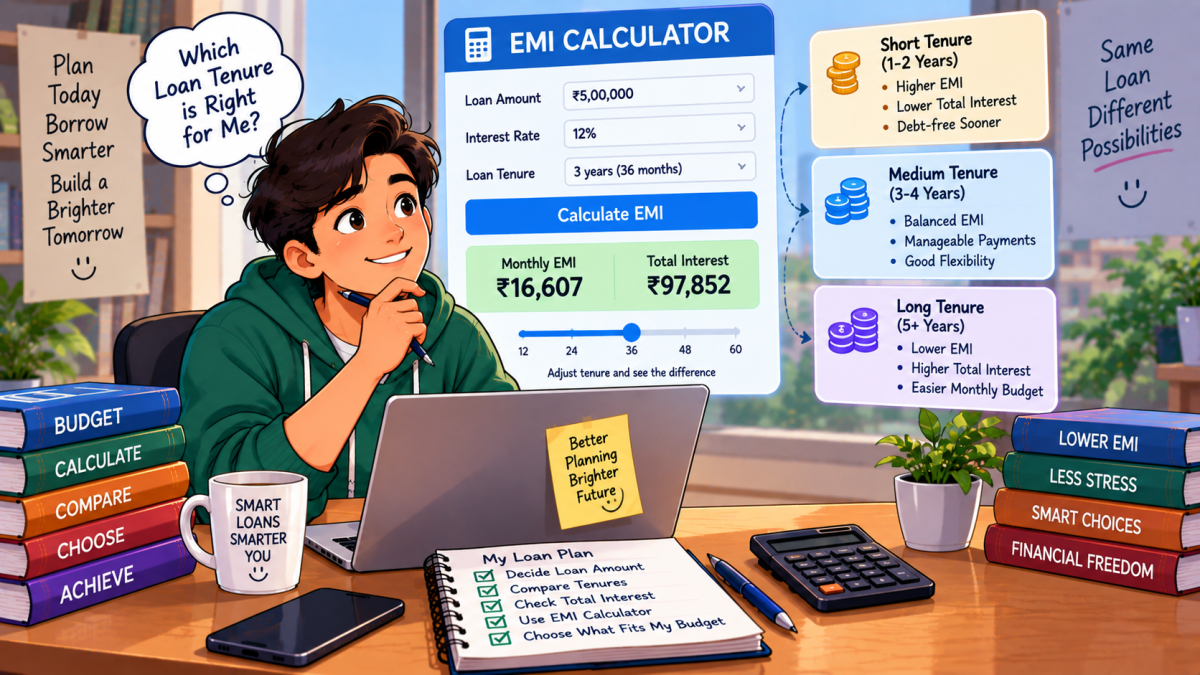
Choosing the right loan tenure is just as important as finding a suitable interest rate. A longer tenure can make your monthly EMI easier to manage, but it may increase the total interest you pay. A shorter tenure can reduce the overall interest cost, but the higher EMI may put more pressure on your monthly budget.
This is where an EMI calculator can help. By comparing different loan tenures before applying, you can understand how your EMI, total interest, and overall repayment change.
If you are wondering how to choose loan tenure, the best approach is to balance monthly affordability with the total cost of borrowing.
What Is Loan Tenure?
Loan tenure is the period over which you repay a loan. Depending on the lender and loan type, tenure can range from a few months to several years.
For example, if you borrow ₹2 lakh and choose a tenure of 12 months, you will repay the loan over one year. If you choose 36 months, the same loan is spread across three years.
The basic rule is simple:
Shorter tenure = higher EMI but lower total interest
Longer tenure = lower EMI but higher total interest
Your goal should be to select a tenure that keeps your EMI comfortable without unnecessarily increasing the total repayment cost.
Why Loan Tenure Matters
Loan tenure directly affects your monthly EMI and total interest.
Consider a personal loan of ₹2 lakh at an annual interest rate of 12%.
| Tenure | Approx. EMI | Approx. Total Interest |
|---|---|---|
| 12 months | ₹17,768 | ₹13,216 |
| 24 months | ₹9,415 | ₹25,960 |
| 36 months | ₹6,643 | ₹39,148 |
| 48 months | ₹5,267 | ₹52,816 |
| 60 months | ₹4,449 | ₹66,940 |
The longer tenure reduces the monthly EMI, but the total interest increases significantly.
This is why choosing a tenure only because it offers the lowest EMI can make a loan more expensive in the long run.
How to Choose Loan Tenure Using an EMI Calculator
An EMI calculator makes it easier to compare different repayment periods. You generally need three inputs:
-
Loan amount
-
Interest rate
-
Loan tenure
Enter the same loan amount and interest rate, then change the tenure one option at a time.
For example, compare 12, 24, 36, 48, and 60 months. Look at three numbers:
-
Monthly EMI
-
Total interest payable
-
Total repayment amount
This gives you a clearer picture of the cost of each option.
Step 1: Calculate Your Affordable EMI
Start with your monthly income and essential expenses.
Your EMI should leave enough money for:
-
Rent or home loan payments
-
Food and household expenses
-
Utilities
-
Insurance
-
Existing EMIs
-
Emergency savings
-
Investments and other financial goals
Do not select a short tenure simply to reduce interest if the EMI leaves your monthly budget too tight.
Step 2: Compare Multiple Tenures
Use the EMI calculator to compare several options.
For example:
₹2 lakh loan at 12% interest
-
12 months: Higher EMI, lower interest
-
24 months: Moderate EMI and interest
-
36 months: Lower EMI, higher interest
-
48 months: Lower monthly burden, significantly higher interest
-
60 months: Lowest EMI among these options, but highest interest
This comparison helps you identify the best loan tenure for your financial situation.
Step 3: Consider Your Monthly Cash Flow
Your salary alone should not determine your tenure.
Consider how much money you have left after regular expenses.
For example, suppose your monthly income is ₹60,000 and your essential expenses are ₹35,000. You have ₹25,000 remaining before considering savings and other commitments.
A ₹20,000 EMI may technically be affordable, but it could leave little room for emergencies or unexpected expenses.
A slightly longer tenure with a ₹12,000 to ₹15,000 EMI may provide more financial flexibility.
Step 4: Check the Total Interest
Never compare loans using EMI alone.
A lower EMI does not necessarily mean a cheaper loan.
For example, extending a loan from 24 months to 60 months can significantly reduce the monthly payment, but the additional interest paid over the longer period may be substantial.
Always check the total repayment amount before making a decision.
What Is the Best Loan Tenure?
There is no single best loan tenure for everyone.
The right tenure depends on:
-
Your monthly income
-
Existing debt
-
Loan amount
-
Interest rate
-
Monthly expenses
-
Financial goals
-
Emergency savings
-
Job or income stability
As a general principle, choose the shortest tenure that allows you to comfortably manage the EMI without compromising essential expenses and savings.
Short Tenure vs Long Tenure
Short Loan Tenure
A short tenure may be suitable when you have sufficient monthly cash flow.
Advantages:
-
Higher EMI
-
Lower total interest
-
Faster debt repayment
-
Lower overall borrowing cost
Disadvantages:
-
Greater monthly financial commitment
-
Less flexibility if income changes
-
Higher risk of budget pressure
Long Loan Tenure
A longer tenure can be useful when keeping the monthly EMI manageable is your priority.
Advantages:
-
Lower monthly EMI
-
Easier monthly budgeting
-
More cash-flow flexibility
Disadvantages:
-
Higher total interest
-
Debt remains for longer
-
Overall loan cost can increase
Don't Forget Loan Fees
An EMI calculator usually focuses on the principal, interest rate, and tenure. It may not include every fee charged by the lender.
Before accepting a loan, check additional costs such as:
-
Processing fee
-
GST on applicable charges
-
Documentation charges
-
Insurance, if applicable
-
Late payment charges
-
Foreclosure or prepayment charges
These costs can affect the true cost of the loan.
Consider Your Existing EMIs
If you already have loans or credit card balances, include those payments when planning your new loan.
For example, if you already pay ₹10,000 in EMIs each month, adding another ₹15,000 EMI creates a ₹25,000 monthly debt obligation.
Instead of asking only, "Can I pay this EMI?", ask:
"Can I comfortably pay this EMI every month while continuing my other financial commitments?"
This is an important part of personal loan repayment planning.
Should You Choose the Shortest Possible Tenure?
Not always.
The shortest tenure generally reduces interest, but it may not be the best choice if the EMI becomes difficult to manage.
Suppose you can comfortably afford a ₹10,000 EMI but choose a loan tenure that requires ₹17,000 every month just to save interest.
That could reduce your ability to handle:
-
Medical expenses
-
Job changes
-
Emergency repairs
-
Family expenses
-
Other financial goals
A slightly longer tenure can sometimes provide useful financial flexibility.
Should You Choose the Longest Tenure?
Again, not necessarily.
Choosing the longest available tenure simply because the EMI looks attractive can result in much higher interest costs.
For example, a ₹2 lakh loan may look easier to repay over five years because the EMI is lower. However, the additional years of interest can make the loan considerably more expensive.
The EMI calculator should therefore be used as a comparison tool, not simply as a way to find the lowest EMI.
A Simple EMI Calculator Guide
Use this process before selecting your tenure:
Enter loan amount → Enter interest rate → Compare tenures → Check EMI → Check total interest → Check total repayment → Select affordable tenure
You can create a simple comparison for 12, 24, 36, 48, and 60 months.
Then ask yourself:
-
Is the EMI affordable?
-
How much total interest will I pay?
-
How much money will I have left each month?
-
Does the tenure fit my income stability?
-
Are there additional loan charges?
-
Can I continue saving while repaying the loan?
This makes your personal loan repayment planning more practical.
A Useful Rule for Choosing Tenure
A good starting point is:
Choose the shortest tenure where the EMI remains comfortably affordable after accounting for your existing expenses, debt payments, savings, and emergency needs.
Avoid stretching a loan for several extra years just to save a few thousand rupees every month.
At the same time, avoid selecting an aggressive short tenure that leaves your monthly finances vulnerable.
Final Takeaway
Knowing how to choose loan tenure can help you control both your monthly EMI and the total cost of borrowing.
Use an EMI calculator to compare different repayment periods rather than selecting the first tenure offered by a lender. Look beyond the EMI and consider total interest, fees, existing financial commitments, savings, and monthly cash flow.
The best loan tenure is not necessarily the shortest or longest option. It is the tenure that gives you a manageable EMI while keeping the overall borrowing cost under control.
Before taking a personal loan, compare multiple tenure options and review the lender's complete cost information so you know exactly what you are committing to.
FAQs
1. How to choose loan tenure for a personal loan?
Compare different tenures using an EMI calculator. Choose a repayment period where the EMI is comfortably affordable while keeping the total interest as low as practical.
2. Is a shorter loan tenure always better?
Not always. A shorter tenure generally reduces total interest but increases the monthly EMI. It is suitable only when the higher EMI fits comfortably within your budget.
3. Does a longer tenure reduce EMI?
Yes. Spreading the principal over a longer period generally reduces the monthly EMI, but it usually increases the total interest paid.
4. How can an EMI calculator help?
An EMI calculator allows you to compare monthly payments, total interest, and repayment amounts across different loan tenures before making a borrowing decision.
5. What is the best loan tenure?
The best loan tenure depends on your income, expenses, existing debt, savings, interest rate, and loan amount. Ideally, choose a tenure that balances affordability and total borrowing cost.

BankCreds helps consumers explore and compare loan options from different lenders. The platform provides loan eligibility guidance, EMI planning tools, credit insights, lender information, and educational resources to simplify financial decision-making. BankCreds does not directly provide loans; it helps users understand their options before applying. For More Details Please Visit https://bankcreds.com/






Comments (0)