

Cloud Security Posture Management Market Size 2026–2035
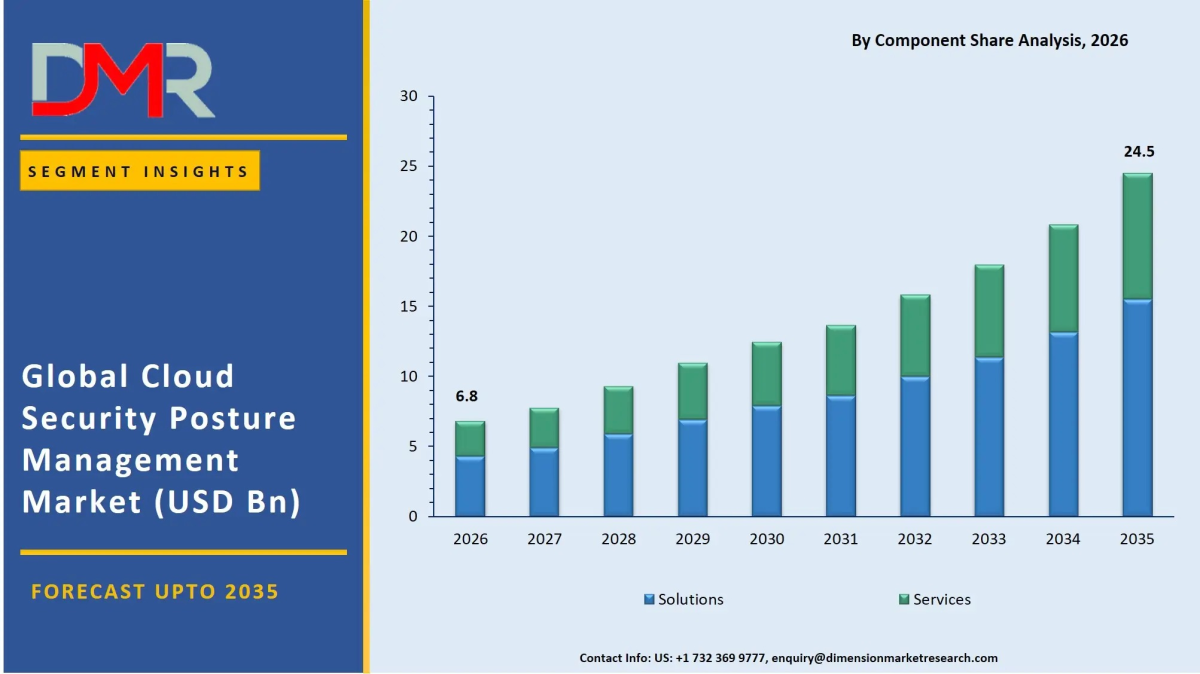
The Cloud Security Posture Management Market is projected to grow from USD 6.8 Bn in 2026 to USD 24.5 Bn by 2035 at a CAGR of 15.2%. Rising cloud adoption, misconfiguration risks, and compliance requirements are driving market expansion. North America leads with 38.7% share.

Market Overview
According to Dimension Market Research, the Global Cloud Security Posture Management Market size is estimated at USD 6.8 billion in 2026 and is projected to reach USD 24.5 billion by 2035, exhibiting a CAGR of 15.2% during the forecast period, driven by the rising use of automated security tools in cloud misconfiguration detection, continuous compliance monitoring across multi-cloud environments, and connected risk management systems.
Cloud Security Posture Management (CSPM) refers to a category of automated security tools designed to identify misconfigurations, compliance violations, and security risks across cloud infrastructure. These solutions continuously monitor cloud environments—including Infrastructure-as-a-Service (IaaS), Platform-as-a-Service (PaaS), and Software-as-a-Service (SaaS)—to detect deviations from security best practices and regulatory requirements, enabling organizations to remediate issues before they can be exploited by attackers.
The market is witnessing rapid growth as organizations accelerate their cloud adoption journeys and face increasing complexity in managing security across multi-cloud and hybrid environments. CSPM platforms provide visibility into cloud assets, enforce security policies, automate compliance checks, and integrate with DevOps workflows to embed security throughout the application lifecycle.
Growing concerns over data breaches, regulatory penalties, and the shared responsibility model of cloud security are driving demand for CSPM solutions across industries including BFSI, healthcare, government, retail, and technology. The integration of AI and machine learning into CSPM platforms is further enhancing threat detection, prioritization, and automated remediation capabilities.
Definition and Market Significance
Cloud Security Posture Management (CSPM) is an automated security solution that continuously monitors cloud infrastructure for misconfigurations, compliance violations, and security risks. CSPM tools assess cloud environments against security benchmarks, regulatory frameworks, and organizational policies, providing visibility into cloud assets and enabling rapid remediation of identified issues.
The importance of CSPM lies in its ability to address the unique security challenges of cloud environments, where traditional perimeter-based security models are insufficient. Misconfigurations remain one of the leading causes of cloud data breaches, and CSPM solutions help organizations detect and remediate these issues before they can be exploited.
CSPM also supports broader compliance and governance objectives by automating compliance monitoring, generating audit-ready reports, and enabling organizations to meet regulatory requirements across multiple jurisdictions. By integrating with DevOps and CI/CD pipelines, CSPM embeds security into cloud operations, supporting DevSecOps practices and reducing risk throughout the cloud lifecycle.
Request a Complimentary PDF Sample
https://dimensionmarketresearch.com/request-sample/cloud-security-posture-management-market/
Market Drivers
A major factor driving the Cloud Security Posture Management Market is the rising use of automated security tools in cloud misconfiguration detection. As organizations migrate workloads to the cloud, misconfigurations remain a leading cause of data breaches. CSPM solutions automate the detection and remediation of misconfigurations, reducing the burden on security teams and enabling faster response to potential threats.
The need for continuous compliance monitoring across multi-cloud environments is another key driver supporting market expansion. Organizations increasingly operate across multiple cloud providers, each with its own security controls, configurations, and compliance requirements. CSPM platforms provide centralized visibility and automated compliance checks, helping organizations maintain consistent security posture across diverse cloud environments.
The growing adoption of connected risk management systems and the integration of AI-driven cloud security monitoring are also contributing to market growth, enabling organizations to prioritize risks, automate remediation, and improve overall cloud security resilience.
Market Trends
The integration of AI and machine learning into CSPM platforms is emerging as an important trend in the market. AI-powered CSPM tools can analyze vast amounts of cloud telemetry, identify patterns, prioritize risks, and automate remediation, significantly enhancing the efficiency and effectiveness of cloud security operations.
Another significant trend is the convergence of CSPM with other cloud security categories, including Cloud Workload Protection Platforms (CWPP) and Cloud Infrastructure Entitlement Management (CIEM). This convergence is creating unified cloud-native application protection platforms (CNAPP) that provide comprehensive visibility and control across cloud environments.
The growing adoption of infrastructure-as-code (IaC) scanning and shift-left security practices is also transforming the market, enabling organizations to detect and remediate misconfigurations before cloud resources are deployed.
Market Restraints
Despite its strong growth potential, the Cloud Security Posture Management Market faces certain limitations. High implementation and operational costs pose significant challenges, particularly for small and medium-sized enterprises with limited security budgets. CSPM platforms require investment in software licensing, integration, training, and ongoing maintenance.
The shortage of skilled cloud security professionals is another significant restraint. Effective CSPM deployment and management require expertise in cloud architecture, security controls, and compliance frameworks, and organizations often struggle to recruit and retain qualified personnel.
In addition, the complexity of managing security across multi-cloud and hybrid environments, along with alert fatigue from high volumes of findings, can limit the effectiveness of CSPM solutions and slow adoption in some organizations.
Market Opportunities
The expansion of CSPM into emerging markets and new industry verticals presents significant growth opportunities. As cloud adoption accelerates in regions such as Asia Pacific, Latin America, and the Middle East, demand for CSPM solutions is expected to rise, creating new opportunities for vendors.
The development of AI-driven, automated remediation capabilities is another promising opportunity. Organizations increasingly seek CSPM platforms that can not only detect misconfigurations but also automatically remediate them, reducing response times and operational burden.
Furthermore, the integration of CSPM with DevSecOps workflows and the growing adoption of cloud-native application protection platforms are expected to open new opportunities for the CSPM industry, enabling comprehensive cloud security from code to runtime.
Segmentation
The Cloud Security Posture Management Market is categorized based on component, deployment mode, organization size, and industry vertical.
By component, solutions are expected to dominate, driven by demand for automated misconfiguration detection, compliance monitoring, and risk assessment platforms. Services, including consulting, integration, and managed services, are projected to grow rapidly as organizations seek expert support for CSPM deployment and optimization.
By deployment mode, cloud-based CSPM solutions are expected to lead, offering scalability, flexibility, and continuous updates that align with the dynamic nature of cloud environments.
By organization size, large enterprises are expected to dominate due to their extensive cloud footprints, complex compliance requirements, and higher security budgets. SMEs are projected to be the fastest-growing segment, driven by the growing availability of affordable, cloud-native CSPM solutions.
By industry vertical, BFSI is expected to hold the largest share, driven by stringent regulatory requirements and high-value data assets. Healthcare, government, retail, and technology sectors are also significant adopters.
Regional Analysis
North America is projected to take the lead in the global CSPM market, covering a market share of about 38.7% in the year 2026. The region's dominance is driven by the early and widespread adoption of cloud infrastructure across enterprises, the presence of major CSPM vendors and cloud service providers, stringent regulatory frameworks such as HIPAA, SOX, and CCPA, and significant government mandates like FedRAMP and the national zero-trust strategy. The widespread adoption of advanced cloud security processing and automation for multi-cloud environments, workload protection, and long-term compliance management further strengthens North America's leading position. Additionally, ongoing investments in AI-driven cloud security monitoring and cross-platform system interoperability further reinforce the region's technology leadership.
Europe holds a substantial share of the CSPM market, driven by strict data protection regulations including GDPR, growing cloud adoption across enterprises, and increasing focus on compliance and data sovereignty. The United Kingdom, Germany, France, and the Nordic countries are key markets.
Asia Pacific is emerging as the fastest-growing region in the CSPM market, driven by rapid cloud adoption, digital transformation initiatives, and expanding regulatory frameworks across countries such as China, India, Japan, Australia, and Southeast Asia.
Latin America and the Middle East & Africa are gradually adopting CSPM solutions as cloud adoption accelerates and regulatory requirements evolve, with Brazil, Mexico, the UAE, and Saudi Arabia emerging as key markets.
Competitive Landscape
The Cloud Security Posture Management Market is highly competitive, with a mix of specialized cloud security vendors, major cloud service providers, and diversified cybersecurity firms competing across solutions and services. Companies are investing in AI-driven automation, multi-cloud support, and integration with DevSecOps workflows to differentiate their offerings.
Prominent players include Palo Alto Networks (Prisma Cloud), CrowdStrike, Microsoft (Defender for Cloud), AWS (Security Hub), Google Cloud (Security Command Center), Check Point Software Technologies, Trend Micro, Qualys, Rapid7, Tenable, Orca Security, Wiz, Lacework, and Aqua Security. Recent developments include strategic acquisitions, product enhancements featuring AI-powered risk prioritization, and expanded partnerships with cloud service providers to strengthen multi-cloud security capabilities.
Technological Advancements
Rapid advancements in AI, machine learning, and automation are transforming the CSPM market. AI-powered platforms enable real-time risk assessment, intelligent prioritization, and automated remediation, reducing the burden on security teams and improving response times.
The integration of CSPM with infrastructure-as-code scanning, CI/CD pipelines, and cloud-native application protection platforms is also playing a significant role, enabling shift-left security practices and comprehensive protection across the cloud lifecycle.
Consumer Adoption Patterns
Organizations across BFSI, healthcare, government, retail, technology, and manufacturing sectors are increasingly adopting CSPM solutions to protect cloud assets, ensure compliance, and reduce risk. The growing availability of cloud-native, automated CSPM platforms is making these solutions more accessible to organizations of all sizes.
Regulatory Environment
Regulatory frameworks across different regions, including GDPR, HIPAA, SOX, CCPA, and government mandates such as FedRAMP, significantly influence the CSPM market. Compliance with these regulations drives investment in continuous monitoring, automated compliance reporting, and secure cloud configuration management.
Market Challenges
The CSPM market faces challenges related to high implementation costs, the shortage of skilled cloud security professionals, alert fatigue, and the complexity of managing security across multi-cloud and hybrid environments. Additionally, rapidly evolving cloud services and threat landscapes require continuous innovation and adaptation.
Future Outlook
The future of the Cloud Security Posture Management Market remains highly promising as cloud adoption continues to accelerate and organizations prioritize cloud security and compliance. Increasing adoption of AI-powered automation, convergence with CWPP and CIEM into unified platforms, expansion into emerging markets, and growing regulatory requirements are expected to drive strong market growth during the forecast period, with the market projected to reach USD 24.5 billion by 2035 at a CAGR of 15.2%.
Summary of Key Insights
The global Cloud Security Posture Management Market is expected to grow from USD 6.8 billion in 2026 to USD 24.5 billion by 2035, recording a CAGR of 15.2% during the forecast period. Solutions lead the component segment, while cloud-based deployment dominates. Large enterprises lead by organization size, and BFSI leads industry verticals. North America holds the largest regional share with 38.7% of global revenue in 2026, while Asia Pacific is projected as the fastest-growing region.
Purchase the Full Report
https://dimensionmarketresearch.com/checkout/cloud-security-posture-management-market/








Comments (0)