

Ammonia Market Outlook Signals Strong Revenue Growth Through 2034
The global ammonia market size was valued at USD 172.31 billion in 2025

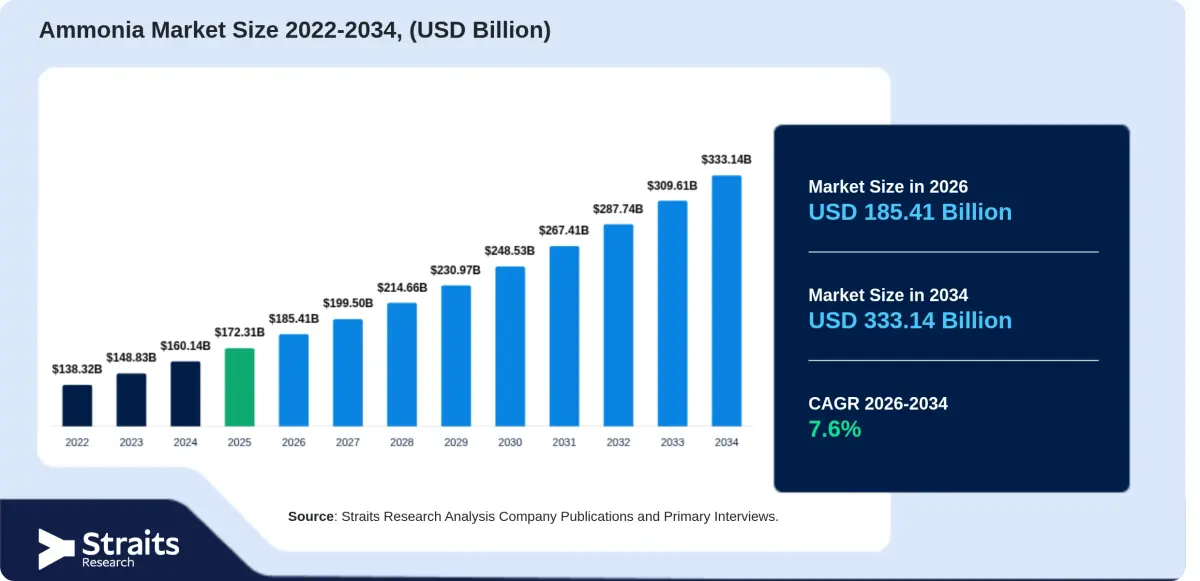
Ammonia Market Size, Forecast to 2034
The global ammonia market size was valued at USD 172.31 billion in 2025 and is projected to grow from USD 185.41 billion in 2026 to USD 333.14 billion by 2034, registering a CAGR of 7.6% during the forecast period from 2026 to 2034. Asia Pacific dominated the ammonia market in 2025, accounting for 47.2% of the global market.
Market Drivers
Expansion of Ammonia-Based Fertilizer Production
The demand for nitrogen-based fertilizers remains a major driver of the ammonia market, as ammonia serves as a primary feedstock for urea, ammonium nitrate, and other agricultural nutrients. The need to maintain crop productivity and meet food requirements encourages fertilizer manufacturers to secure reliable ammonia supplies and expand production capacity. Agricultural demand across major economies therefore continues to underpin ammonia consumption.
Increasing Demand from Chemical Manufacturing
Ammonia is an essential raw material in the production of nitric acid, ammonium salts, and several industrial chemicals. Its use across mining, textiles, pharmaceuticals, and other chemical processing applications broadens demand beyond agriculture. Industrial expansion and the need for ammonia-derived intermediates encourage manufacturers to maintain consistent supply and invest in production and distribution infrastructure.
Growing Interest in Low-Carbon Ammonia Production
Decarbonization targets are encouraging ammonia producers to explore production routes based on renewable hydrogen and other lower-emission technologies. Green and low-carbon ammonia can help reduce the emissions associated with conventional production and create new applications in clean energy and industrial feedstocks. Investments in hydrogen production, electrolyzers, and carbon management technologies are opening additional avenues for market development.
Market Challenges
Volatility in Natural Gas Prices
Natural gas is a key feedstock and energy source for conventional ammonia production, making operating costs sensitive to fluctuations in gas prices. Price volatility can reduce producer margins, affect plant utilization, and influence ammonia prices across regional markets. Producers in regions with expensive or constrained gas supplies may face difficulties competing with lower-cost manufacturing hubs.
High Capital Requirements for Low-Carbon Production
Green ammonia projects require substantial investment in renewable electricity, electrolyzers, hydrogen infrastructure, and ammonia synthesis facilities. These costs can make low-carbon ammonia more expensive than conventionally produced alternatives, particularly where renewable power and supporting infrastructure are limited. Financing uncertainty and the need for long-term offtake agreements can also delay project development.
Transportation, Storage, and Safety Requirements
Ammonia is a hazardous chemical that requires specialized storage systems, trained personnel, and carefully managed transportation infrastructure. Leakage risks and exposure concerns create strict handling requirements throughout the supply chain. These operational demands can raise logistics costs and complicate the expansion of ammonia distribution networks, particularly in regions with limited infrastructure.
Market Segmentation
The ammonia market is segmented by:
-
By Type: Liquid, gas
-
By End Use: Agriculture, textile, mining, pharmaceutical, refrigeration, others
-
By Sales Channel: Direct, distribution
-
By Region: North America, Europe, Asia Pacific, Middle East and Africa, Latin America
Regional Insights
North America Ammonia Market Analysis
North America is expected to register the fastest regional growth during the forecast period, supported by established fertilizer manufacturing, agricultural demand, and investments in domestic ammonia production. The region also presents opportunities for low-carbon ammonia projects, particularly where natural gas resources, carbon management infrastructure, and industrial demand provide favorable conditions. Demand from chemical manufacturing and industrial refrigeration further contributes to regional market development.
Europe Ammonia Market Analysis
Europe's ammonia market is shaped by fertilizer demand, chemical manufacturing, and efforts to reduce emissions from energy-intensive industrial processes. Natural gas prices and energy security considerations influence production economics, encouraging producers to improve efficiency and explore low-carbon alternatives. Investments in renewable hydrogen and industrial decarbonization are creating opportunities for ammonia production technologies with lower emissions.
Asia Pacific Ammonia Market Analysis
Asia Pacific accounted for the largest share of the ammonia market in 2025, reflecting its extensive agricultural sector, large fertilizer manufacturing base, and established chemical industries. China and India contribute substantially to regional consumption through fertilizer production and agricultural nutrient requirements. Industrial activity across Japan, South Korea, and Southeast Asia also supports demand for ammonia in chemical processing, refrigeration, and emerging energy applications.
Middle East and Africa Ammonia Market Analysis
The Middle East and Africa market benefits from established fertilizer production, natural gas resources, and export-oriented chemical industries. Producers in the Middle East are exploring low-carbon ammonia projects to diversify product portfolios and serve international markets pursuing emissions reductions. Across Africa, agricultural development and expanding fertilizer access offer additional demand potential, although infrastructure limitations and affordability remain important considerations.
Latin America Ammonia Market Analysis
Latin America's ammonia market is closely linked to agricultural production and the region's demand for nitrogen-based fertilizers. Major agricultural economies require reliable fertilizer supplies to support crops such as soybeans, corn, and sugarcane. Import dependence in several markets creates opportunities for supply-chain investment, while improvements in fertilizer distribution and domestic production capacity could strengthen regional availability.
Key Players Analysis
The ammonia market includes large fertilizer producers, integrated chemical companies, and specialized manufacturers serving agricultural and industrial customers. Established players compete through production scale, feedstock access, energy efficiency, logistics networks, and long-term customer contracts. Emerging and expanding producers increasingly focus on low-carbon production technologies, renewable hydrogen integration, and strategic partnerships that can strengthen supply security and address decarbonization requirements.
Key industry participants include CF Industries Holdings, Inc., Yara International ASA, QAFCO, SABIC, and Nutrien Ltd.
For Detailed Insights, Visit: https://straitsresearch.com/report/ammonia-market
About Us
Straits Research is a research and intelligence organization specializing in research, analytics, and advisory services, providing business insights and market research reports across diverse industries.
Contact Us
Email: [email protected]
Tel: +1 646 905 0080 (U.S.), +44 203 695 0070 (U.K.)












Comments (0)