How Salesforce Helps Different Departments Work as One Team
Discover how Salesforce connects sales, marketing, customer service, and operations to improve collaboration, productivity, and customer experiences across your business.
 techforceservices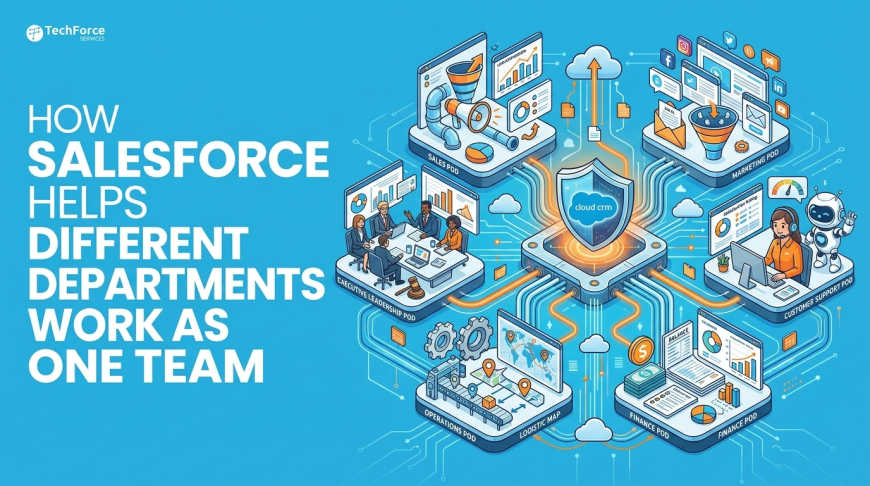
As businesses grow, collaboration becomes both more important and more challenging. Sales teams focus on closing opportunities, marketing generates leads, customer service resolves issues, finance manages invoices, and operations ensure projects are delivered successfully. While every department has its own responsibilities, they all rely on one thing: accurate and timely information.
Unfortunately, many organizations still operate with disconnected systems that make collaboration difficult. Customer information is stored in different applications, reports are generated from separate databases, and employees spend valuable time searching for updates instead of acting on them. These information gaps create delays, duplicate work, and inconsistent customer experiences that can affect both productivity and business growth.
Salesforce addresses these challenges by creating a connected environment where departments work with the same customer information, making collaboration simpler and decision-making more reliable.
Why Do Departments Often Work in Silos?
Business silos usually develop over time rather than by design. As organizations adopt new software to meet specific departmental needs, each team begins managing its own data independently. Marketing may use one platform for campaigns, sales another for opportunities, and customer support a completely different application for service requests.
Although these tools may perform well individually, they often fail to communicate effectively with one another. As a result, employees frequently enter the same information multiple times, rely on manual updates, or request data from colleagues through email and meetings.
These disconnected processes reduce efficiency and make it difficult for leadership to obtain a complete picture of customer interactions or overall business performance.
How Does Salesforce Improve Collaboration?
Salesforce acts as a centralized platform where customer information is shared securely across departments. Instead of maintaining multiple versions of the same record, everyone works with consistent and up-to-date information.
When a sales representative closes an opportunity, the information becomes immediately available to other authorized teams. Marketing can better understand customer preferences, customer service gains visibility into previous interactions, and management receives accurate reporting without waiting for manual updates.
This shared visibility encourages departments to work together rather than independently. Employees spend less time searching for information and more time focusing on activities that create value for customers.
What Benefits Does Each Department Receive?
Although Salesforce is often associated with sales teams, its benefits extend across the entire organization.
Sales teams gain better visibility into customer interactions, helping them manage opportunities more effectively and prioritize high-value prospects.
Marketing teams can create more personalized campaigns using reliable customer information while measuring campaign performance through integrated reporting.
Customer service teams access complete customer histories, allowing them to resolve issues faster and provide more consistent support.
Finance and operations benefit from improved visibility into customer activities, reducing manual communication and supporting more accurate business planning.
When every department works from the same trusted information, collaboration becomes a natural part of everyday operations rather than an additional effort.
Why Are Integrations Important for Team Collaboration?
Even the most capable CRM cannot operate in isolation. Most organizations already rely on accounting software, ERP platforms, HR applications, project management tools, and marketing automation systems.
Connecting these applications allows information to flow automatically between departments without requiring employees to perform repetitive manual updates.
Professional Salesforce Integration Services help organizations connect Salesforce with existing business systems, creating a unified technology environment that supports seamless collaboration across the enterprise.
Integrated systems reduce administrative work, improve reporting accuracy, and eliminate many of the delays caused by disconnected applications.
How Can Automation Help Employees Work More Efficiently?
Collaboration is about more than sharing information. It also depends on removing unnecessary manual tasks that interrupt productivity.
Salesforce automation allows businesses to streamline activities such as assigning leads, routing service requests, generating approval workflows, sending notifications, and updating records automatically.
When routine tasks happen in the background, employees have more time to focus on strategic initiatives, customer relationships, and problem-solving.
Organizations implementing Salesforce Implementation Services often identify automation opportunities early in the project to ensure teams benefit from improved efficiency immediately after deployment.
Automation also reduces the likelihood of human error, helping organizations maintain consistent processes across departments.
Why Is Collaboration a Competitive Advantage?
Customers expect organizations to respond quickly, provide accurate information, and deliver consistent experiences regardless of which department they contact.
If internal teams cannot collaborate effectively, customers are often the first to notice. They may receive conflicting information, repeat the same details multiple times, or experience delays while employees search for updates.
Businesses that remove these barriers create stronger customer relationships because every interaction feels connected and informed.
TechForce Services helps organizations build Salesforce environments that encourage collaboration across every department. By combining implementation expertise, enterprise integrations, and workflow automation, TechForce enables businesses to create connected processes that support both employees and customers.
Rather than viewing Salesforce as simply another business application, organizations can use it as the foundation for enterprise-wide collaboration and long-term digital transformation.
Conclusion
Successful businesses are built on collaboration, not isolated departments. As organizations grow, maintaining consistent communication and reliable information becomes increasingly important for delivering exceptional customer experiences and making confident business decisions.
Salesforce provides the tools needed to connect departments, automate routine work, and create a shared view of every customer interaction. When supported by thoughtful implementation and well-planned integrations, the platform becomes much more than a CRM. It becomes a central hub where people, processes, and technology work together toward common business goals.
Organizations that invest in connected systems today position themselves for greater productivity, stronger teamwork, and sustainable growth in the years ahead.