Internal Control on Financial Reporting: Strengthening Financial Integrity in Modern Businesses
Learn how internal control on financial reporting improves financial accuracy, strengthens governance, manages risks, and supports reliable decision-making for businesses.
 jpchawala
Financial information is one of the most valuable assets of any organisation. Business leaders, investors, lenders, and regulators depend on accurate financial data to assess performance, manage risks, and make informed decisions. As organisations grow, financial processes become increasingly complex, making it essential to establish systems that promote accuracy, consistency, and accountability.
This is where internal control on financial reporting plays a significant role. Effective internal controls help organisations maintain reliable financial records, safeguard assets, and support sound corporate governance. More importantly, they create a framework that enables businesses to identify potential risks and address them before they impact financial reporting.
What Does Internal Control on Financial Reporting Mean?
Internal Control on Financial Reporting (ICFR) refers to the processes, policies, and procedures designed to provide reasonable assurance that financial statements are prepared accurately and in accordance with applicable accounting principles and regulatory requirements.
These controls are embedded within an organisation's daily operations and financial activities. Their purpose is to ensure that financial transactions are authorised, recorded correctly, and reported in a timely manner.
A strong control framework is not only about preventing mistakes. It also helps organisations establish a culture of accountability and transparency across all levels of management.
The Growing Importance of Financial Reporting Controls
Businesses today operate in an environment shaped by technological advancements, regulatory expectations, and increasing stakeholder scrutiny. As a result, organisations are expected to demonstrate greater financial discipline and governance.
Weak financial controls can lead to:
- Errors in financial statements
- Delays in reporting
- Increased exposure to fraud risks
- Compliance-related concerns
- Reduced stakeholder confidence
Conversely, organisations with robust financial reporting controls are often better equipped to manage operational challenges and maintain trust among stakeholders.
Building a Strong Internal Control Framework
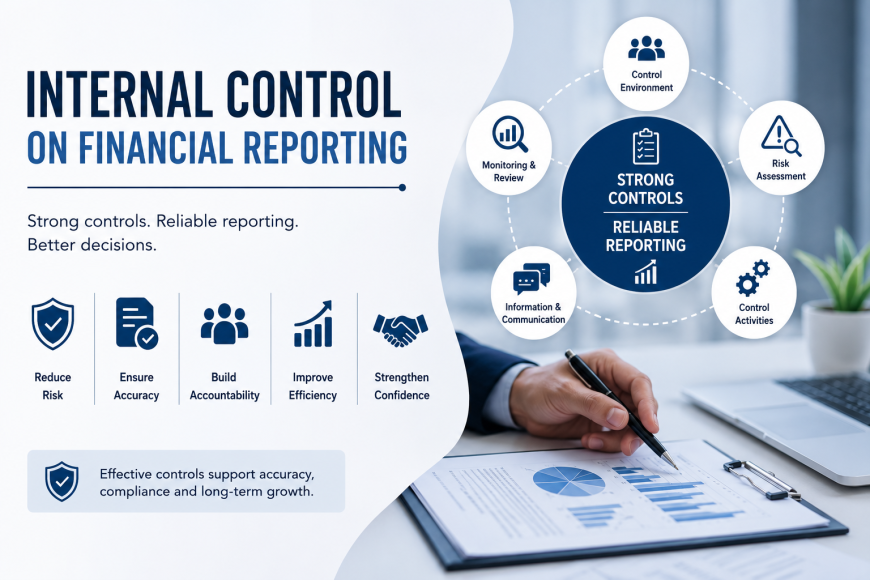
An effective ICFR framework is built on several interconnected elements that work together to support reliable financial reporting.
Establishing a Strong Governance Culture
Every successful control system begins with leadership. Senior management and those charged with governance play an important role in setting the tone for ethical conduct and accountability.
When management demonstrates a commitment to integrity and compliance, employees are more likely to follow established policies and procedures. A positive control culture creates an environment where financial responsibilities are clearly understood and consistently applied.
Identifying Financial Reporting Risks
Risk identification is a critical step in developing effective controls. Organisations should regularly assess areas where errors, omissions, or irregularities may occur.
Common financial reporting risks include:
- Complex accounting transactions
- System implementation changes
- Manual data processing
- Business expansion activities
- Regulatory changes
Understanding these risks allows management to design controls that address potential weaknesses before they affect financial reporting.
Implementing Appropriate Control Activities
Control activities are the practical measures used to reduce identified risks. These activities may vary depending on the size and nature of the organisation.
Examples include:
- Segregation of duties
- Approval and review processes
- Account reconciliations
- Budget monitoring procedures
- Access restrictions within financial systems
- Documentation and record retention practices
When properly implemented, these controls help ensure that financial information remains accurate and complete.
Enhancing Information Flow
Reliable reporting depends on timely and accurate information. Organisations should establish clear communication channels that allow relevant financial information to flow efficiently between departments and management levels.
Employees should understand their responsibilities within the reporting process and know how to escalate concerns when issues arise.
Continuous Monitoring
Internal controls should evolve alongside the business. Regular monitoring helps organisations determine whether controls continue to operate effectively and whether modifications are required due to changing business conditions.
Periodic reviews can help identify gaps, inefficiencies, or emerging risks that may require management attention.
Common Indicators of Control Weaknesses
Many organisations unknowingly operate with weaknesses in their financial reporting systems. Some warning signs may include:
- Frequent accounting adjustments
- Incomplete documentation
- Delayed financial reporting
- Lack of review procedures
- Excessive reliance on manual spreadsheets
- Limited segregation of responsibilities
Recognising these indicators early allows organisations to take corrective action before significant issues arise.
How Effective Controls Benefit Businesses
The advantages of strong internal controls extend well beyond compliance requirements.
Improved Accuracy
Reliable controls help reduce the likelihood of errors in financial records and reporting.
Greater Transparency
Clear processes and documented procedures promote accountability throughout the organisation.
Better Risk Management
Organisations can identify and address financial reporting risks more effectively when robust controls are in place.
Increased Stakeholder Confidence
Investors, lenders, and business partners often place greater trust in organisations that demonstrate strong governance and financial discipline.
Support for Long-Term Growth
Businesses with effective control frameworks are generally better positioned to manage expansion, operational complexity, and regulatory changes.
The Need for Periodic Evaluation
Even well-established control systems require regular assessment. Business processes, technology platforms, and regulatory expectations continue to evolve, making periodic evaluations an important aspect of financial governance.
A structured review of internal control on financial reporting may help organisations:
- Understand the effectiveness of existing controls
- Identify control gaps and inefficiencies
- Evaluate financial reporting risks
- Improve governance practices
- Enhance overall control maturity
Such assessments provide management with valuable insights that support continuous improvement and stronger financial oversight.
Conclusion
An effective internal control on financial reporting framework serves as the foundation for reliable financial management and sound corporate governance. It helps organisations maintain accurate financial records, manage reporting risks, and build confidence among stakeholders.
In today's complex business environment, organisations cannot afford to treat financial controls as a mere compliance exercise. Instead, they should view them as an essential component of sustainable growth and responsible business management. By regularly evaluating and strengthening financial reporting controls, businesses can create a more resilient and transparent operating environment that supports long-term success.