

Fresh Embryo Transfer vs Frozen Embryo Transfer: How Are They Different?
Fresh embryo transfer happens in the same IVF cycle as egg retrieval. Frozen embryo transfer uses cryopreserved embryos in a separate prepared cycle. Dr. Aravind's IVF Fertility & Pregnancy Centre — best IVF hospital in Coimbatore — explains when each approach delivers the best outcomes.

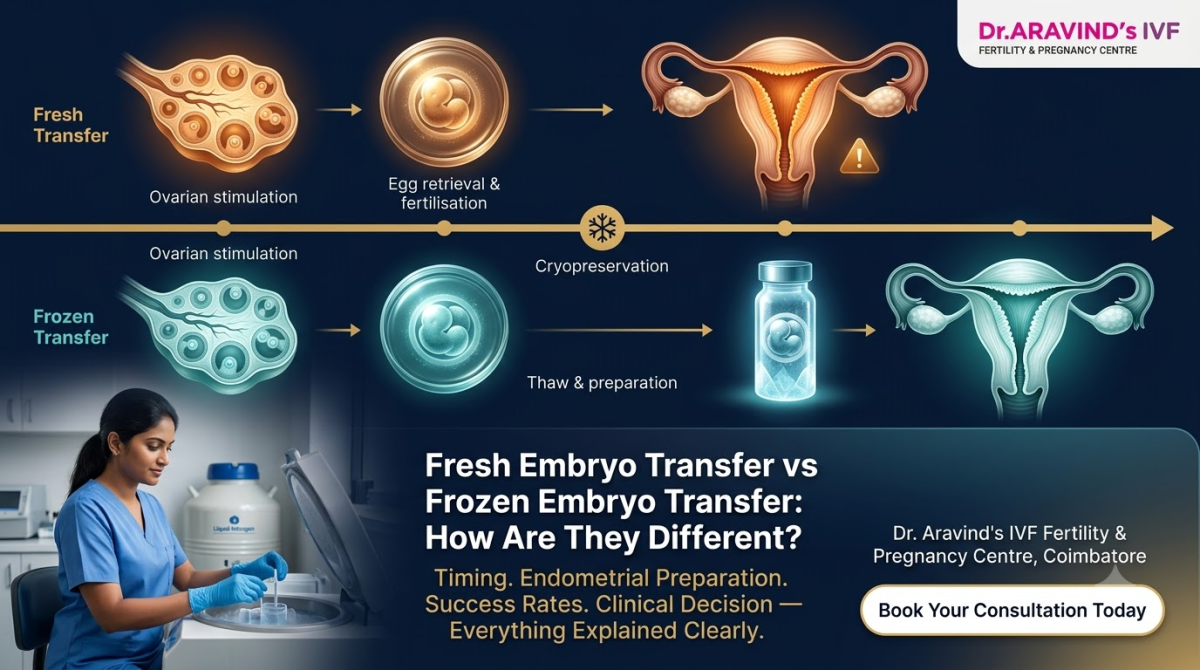
When a couple reaches the embryo transfer stage of an IVF cycle, one of the most important decisions they face is whether to proceed with a fresh transfer immediately after egg retrieval, or to freeze the embryos and transfer them in a subsequent cycle. This decision affects timing, physical preparation, and in many cases, the probability of success.
Understanding the differences between fresh embryo transfer and frozen embryo transfer — what each involves, why each is recommended in different clinical scenarios, and what the evidence says about outcomes — gives couples the clarity they need to approach this stage of treatment confidently.
At Dr. Aravind's IVF Fertility & Pregnancy Centre, the best IVF hospital in Coimbatore, this decision is made based on the individual patient's hormonal response, endometrial condition, and embryo quality — never on a default protocol applied regardless of clinical context.
What Is a Fresh Embryo Transfer?
A fresh embryo transfer takes place in the same stimulation cycle in which eggs were retrieved. After retrieval and fertilisation, embryos are cultured in the laboratory for three to five days. The best-quality embryo — or embryos, in agreed cases — is then transferred directly into the uterus without any freezing step.
The appeal of a fresh embryo transfer is its immediacy. The couple moves from retrieval to transfer within the same cycle, and the first opportunity to achieve pregnancy does not require waiting for an additional cycle. In the early years of IVF, fresh transfer was the standard pathway for almost all patients.
The clinical limitation of a fresh embryo transfer is the hormonal environment in which it occurs. Ovarian stimulation — the process of growing multiple follicles using hormone injections — produces supraphysiological estrogen levels that can alter the uterine environment in ways that reduce endometrial receptivity compared to a natural or prepared cycle. The uterus is processing the elevated estrogen and progesterone from stimulation at the same time it is expected to be receptive to an embryo — and these two demands do not always align optimally.
What Is a Frozen Embryo Transfer?
A frozen embryo transfer — commonly referred to as FET — involves cryopreserving embryos after the retrieval cycle and transferring them in a separate, subsequent cycle. The embryos are vitrified — flash-frozen using a technique that preserves cellular integrity — and stored until the transfer cycle is planned.
In the FET cycle, the uterus has recovered from the stimulation process entirely. The endometrium is prepared in a more controlled hormonal environment — either through a natural cycle where the woman's own ovulatory cycle is monitored, or through a hormone replacement protocol using estrogen and progesterone to build an optimal lining. This preparation produces a uterine environment that more closely resembles natural conception conditions.
Key Clinical Differences
Hormonal Environment
This is the most clinically significant difference between the two approaches. In a fresh embryo transfer, the uterus has been exposed to high estrogen levels from ovarian stimulation. This can affect endometrial gene expression and reduce the synchronisation between the embryo's developmental stage and the uterine receptivity window.
In a frozen embryo transfer, the uterus is prepared independently from ovarian stimulation. Estrogen and progesterone are given in measured doses that replicate the natural hormonal pattern. This allows more precise control over the endometrial environment at the time of transfer.
Research consistently shows that in normal and hyper-responders — women who produce large numbers of follicles during stimulation — frozen embryo transfer produces equivalent or superior pregnancy and live birth rates compared to fresh embryo transfer. The hormone-free recovery window gives the uterus time to reset before receiving the embryo.
Timing
Fresh embryo transfer happens within the same stimulation cycle — typically five to seven days after egg retrieval if a blastocyst transfer is planned. The couple does not need to wait for a subsequent cycle to begin working toward pregnancy.
Frozen embryo transfer requires at least one additional cycle — typically four to six weeks after the retrieval cycle — before the transfer can occur. For couples who want to minimise time between retrieval and their first transfer opportunity, this waiting period can be emotionally difficult. However, this period is also when the embryos undergo genetic testing — PGT-A — if that has been recommended, adding meaningful clinical value to the wait.
Risk of Ovarian Hyperstimulation Syndrome
Ovarian hyperstimulation syndrome — a potentially serious complication of ovarian stimulation involving swelling, fluid accumulation, and in severe cases hospitalisation — is a risk factor specifically in fresh embryo transfer cycles. When a woman shows signs of hyper-response during stimulation, proceeding with a fresh embryo transfer while OHSS is developing significantly worsens the condition.
Freezing all embryos and planning a frozen embryo transfer in a subsequent cycle completely eliminates OHSS escalation risk — the ovaries are allowed to recover fully before any uterine preparation begins. At the IVF hospital in Coimbatore specialist level of care, the decision to freeze all embryos is made proactively when hyper-response indicators appear during stimulation monitoring — before OHSS has a chance to develop fully.
Embryo Quality After Freezing
A common concern couples raise is whether freezing damages embryos. Modern vitrification technology has resolved this concern to a significant degree. Survival rates for vitrified blastocysts after thawing exceed ninety-five percent in well-equipped laboratories. The cellular integrity of a properly vitrified embryo is preserved with remarkable consistency.
This means the quality of the embryo transferred in an FET cycle is essentially equivalent to that of the fresh embryo — provided the laboratory infrastructure meets modern vitrification standards. As one of the best IVF centres in India, Dr. Aravind's IVF Fertility & Pregnancy Centre applies vitrification with the consistency and quality control that these survival rates require.
When Fresh Transfer Is Appropriate
Fresh embryo transfer remains appropriate in specific clinical scenarios. Women with a normal response to stimulation — producing an appropriate number of follicles without signs of hyper-response — who have a well-prepared endometrium at the time of retrieval and who do not require embryo genetic testing are reasonable candidates for fresh transfer.
In these patients, the endometrial environment is adequate, OHSS risk is low, and the efficiency of completing the process within a single cycle is a meaningful benefit. The clinical team assesses endometrial thickness, the estrogen level on the day of trigger, and the number of follicles retrieved to determine whether the uterine environment is suitable for immediate transfer.
When Frozen Embryo Transfer Is Recommended
Frozen embryo transfer is recommended — and in many cases strongly preferred — in the following scenarios. High responders where OHSS risk is present or developing. Patients who require PGT-A genetic testing of embryos before transfer. Patients where endometrial thickness or pattern is not optimal at the time of retrieval. Patients with elevated progesterone on the day of trigger, which can advance the endometrial receptivity window ahead of the embryo's developmental stage. Patients with uterine findings such as polyps or submucosal fibroids that should be addressed before transfer. And increasingly, patients in all categories where clinical evidence favours the endometrial environment of a prepared FET cycle over the stimulated environment of a fresh transfer.
Couples in Coimbatore exploring their options at a best IVF centre in Coimbatore will find complete information on embryo transfer protocols and what personalised care looks like at Dr. Aravind's IVF Fertility & Pregnancy Centre.
Cumulative Success Rates — The Complete Picture
One of the most important concepts in modern IVF is cumulative success rate — the probability of achieving a live birth across all transfers from a single egg retrieval cycle, including both fresh and subsequent frozen transfers. This metric gives a more complete picture of IVF outcomes than per-transfer rates alone.
When a stimulation cycle produces multiple good-quality embryos, the IVF centre in Coimbatore approach is to freeze additional embryos after the first transfer — whether fresh or frozen — for use in subsequent cycles if needed. This embryo banking strategy maximises the reproductive potential of each retrieval without requiring additional stimulation cycles.
Conclusion
Fresh embryo transfer and frozen embryo transfer are not competing approaches — they are complementary strategies, each most appropriate in different clinical circumstances. The decision between them should always be based on the individual patient's hormonal response, endometrial condition, embryo quality, and clinical risk profile — not on a blanket preference for one over the other.
As the best IVF hospital in Coimbatore and a trusted name among the best IVF centres in India, Dr. Aravind's IVF Fertility & Pregnancy Centre applies this clinical precision to every transfer decision — ensuring that the timing, preparation, and protocol for each transfer are optimised for each couple's specific situation rather than defaulted to a standard pathway.








Comments (0)