

C_ABAPD Questions: What to Expect and How to Prepare
C_ABAPD exam questions focus on applying ABAP concepts through code snippets and scenarios rather than testing memorized definitions. Internal tables, Open SQL, and Object-Oriented ABAP dominate the question pool, so hands-on practice matters more than reading theory.

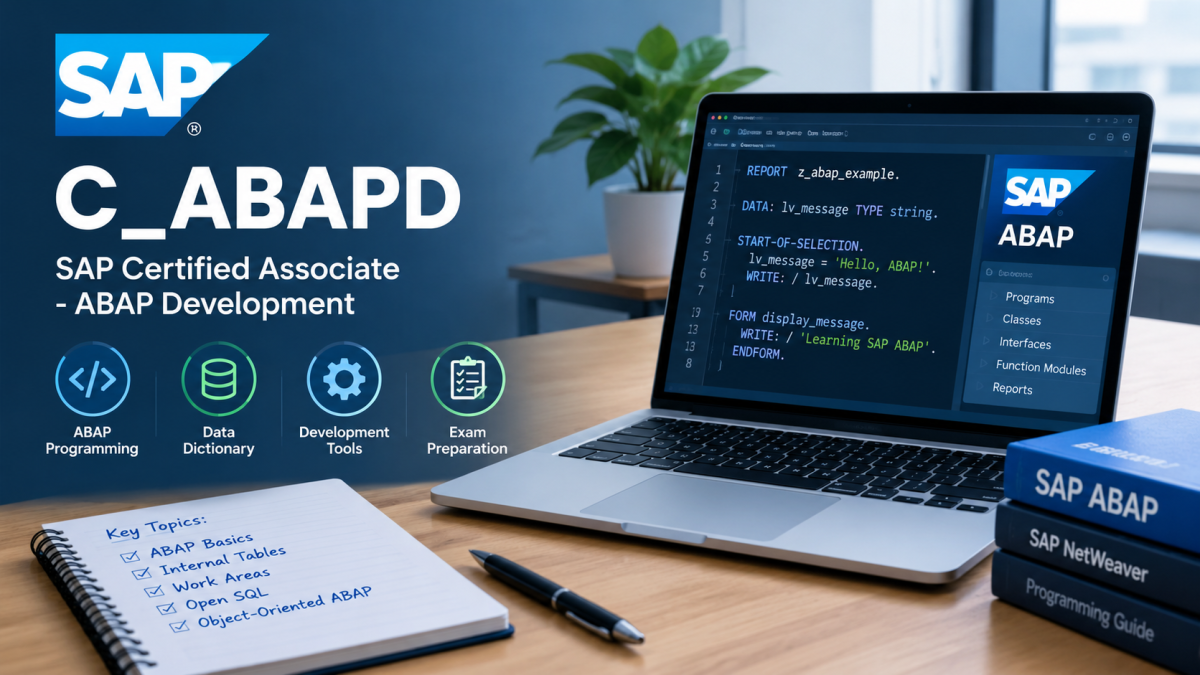
C_ABAPD questions on SAP's certification exam center on the ABAP RESTful Application Programming Model, the framework SAP now treats as standard for building business applications on S/4HANA and the SAP BTP ABAP Environment. Unlike older ABAP certifications that leaned heavily on syntax recall, this exam asks candidates to reason through scenarios — what happens when a particular determination fires, how a draft behaves during a save sequence, or what code satisfies a given business requirement. Understanding the shape of these questions in advance makes a real difference in how prepared someone feels walking into the exam.
The two categories of questions
Broadly, C_ABAPD questions fall into two groups. The first tests classic ABAP fundamentals: internal tables, structures, data types, Open SQL, and exception handling. These questions can look deceptively simple, but SAP expects genuine fluency here, since RAP applications still run on this foundation underneath their higher-level abstractions.
The second and larger group covers RAP-specific material:
- CDS view definitions, associations, and annotations
- Behavior definitions and implementations for managed and unmanaged business objects
- Draft handling in transactional applications
- Determinations, validations, and custom actions
- OData service exposure and Fiori Elements preview testing
- Debugging inside ABAP Development Tools (ADT)
A smaller subset touches on authorization concepts and enhancement techniques, usually just a few questions rather than a dedicated block.
Why scenario format matters for preparation
Most C_ABAPD questions describe a situation rather than ask for a bare definition. A question might describe a business object's behavior definition and ask what happens when a user saves a draft, or present a snippet of CDS annotation and ask what the resulting service looks like. This format rewards candidates who've actually built something with RAP over those who've only read about it, since the reasoning required mirrors real development work rather than fact recall.
Building genuine comfort with this style of question benefits from a structured approach:
- Start with SAP's official Learning Journey for C_ABAPD, which outlines the syllabus and points toward the right training material.
- Set up a free SAP BTP trial account and construct a basic managed RAP scenario — one entity, standard CRUD operations, a simple UI.
- Extend it deliberately: add a draft, attach a validation, wire in a custom action. Each addition creates the kind of situational knowledge that scenario-based questions test.
- Revisit classic ABAP fundamentals that might have gone stale, particularly Open SQL syntax and structured exception handling.
- Supplement study with SAP Community discussions and openSAP courses, which often explain the reasoning behind RAP behavior more directly than reference documentation does.
This kind of applied grasping of the material consistently outperforms passive review when it comes to handling the scenario format C_ABAPD questions favor.
Common patterns candidates should recognize
A few question patterns show up repeatedly. Questions about save sequences test whether candidates understand the order in which determinations, validations, and persistence happen — getting this sequence wrong is a frequent source of missed points. Questions about draft handling test whether candidates understand how draft and active instances differ, which trips up developers who've only worked with standard managed scenarios.
Questions on classic ABAP topics, while less frequent, shouldn't be dismissed. Gaps in areas like internal table operations or Open SQL syntax cost points independent of RAP knowledge, and candidates sometimes underestimate how much weight these carry cumulatively.
Exam format and logistics
SAP Learning Hub delivers C_ABAPD questions through a proctored testing platform, either at a test center or remotely, using multiple-choice and multiple-response formats. SAP doesn't publish one fixed pass mark across every exam version, so it's worth checking the current exam guide on SAP's certification portal before scheduling, since specifics shift between syllabus updates.
Because scenario-based questions require more reading and reasoning than straightforward recall questions, pacing matters more here than on some other exams. Practicing under time pressure during self-study — even informally, using a stopwatch while working through sample scenarios — helps prevent losing time on sections a candidate otherwise knows well.
Conclusion
Getting comfortable with C_ABAPD questions comes down to building real familiarity with RAP through hands-on development, not just reviewing lists of concepts. Candidates who work through even one complete application before the exam tend to handle scenario-based questions with far more confidence than those relying on theory alone. For structured, realistic practice, TheExamQuestions offers a way to work through exam-style scenarios and measure readiness ahead of test day.
FAQs
Are C_ABAPD questions mostly theoretical or scenario-based?
Mostly scenario-based. Expect questions that describe a situation — a save sequence, a draft interaction, a CDS annotation — and ask what the correct outcome or code would be, rather than simple definition recall.
Do C_ABAPD questions cover classic ABAP as heavily as RAP?
No, RAP dominates the syllabus, but classic ABAP topics like internal tables and Open SQL still appear and can cost points if neglected.
How can I get comfortable with the question style before the real exam?
Building a small RAP application and extending it with drafts, validations, and actions creates the kind of practical understanding that scenario-based questions test, more effectively than reading alone.
Is timing a real factor with C_ABAPD questions?
Yes. Scenario-based questions take longer to read and reason through than factual recall questions, so practicing under time constraints during preparation helps with pacing on exam day.
Do the questions change with each exam update?
Yes. SAP periodically revises certification content as RAP and related tools evolve, so it's worth checking the current exam guide before finalizing a study plan.







Comments (0)