How Much Does Native Mobile App Development Cost?
Discover how much native mobile app development costs, key pricing factors, features, and benefits. Explore expert native app development services from Dignite Studios.
 dignitestudios

If you're planning to build a high-quality mobile application, one of the first questions you will probably ask is: How much does native mobile app development cost?
There is no single price that applies to every project. The final native mobile app development cost depends on the platform, features, design, backend requirements, integrations, security, testing, and development team involved.
Current 2026 market estimates show that professional mobile applications can range from tens of thousands o
f dollars for focused products to well over $100,000 for complex enterprise applications. More advanced applications with AI, real-time functionality, extensive integrations, or complex backend systems can cost significantly more.
The important point is that the cheapest quote is not necessarily the lowest-cost solution. Poor architecture, weak testing, limited scalability, and inadequate maintenance can create additional expenses after launch.
What Is Native Mobile App Development?
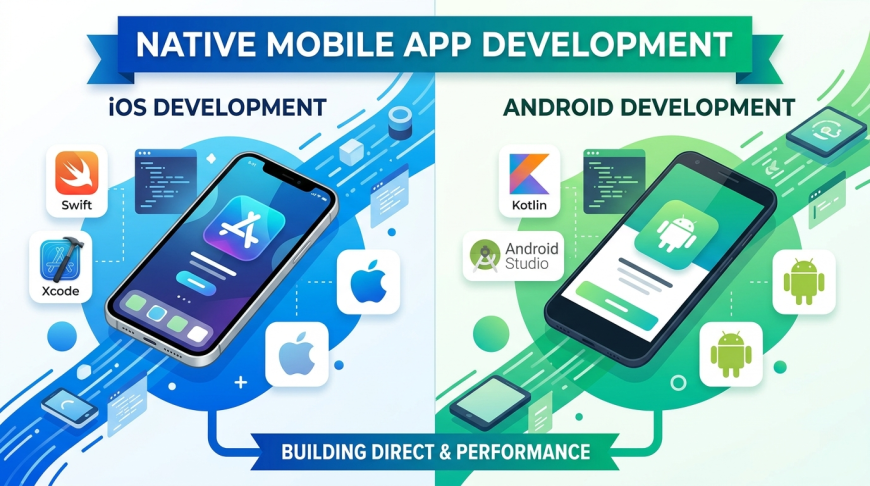
Native mobile app development means building an application specifically for a particular operating system using its preferred programming language and development tools.
For Android app development, developers commonly use Kotlin alongside Android Studio and Google's Android development ecosystem.
For iOS app development, Swift and Apple's native development tools are commonly used.
Because native applications are designed specifically for their target platforms, developers can take advantage of platform-specific capabilities, APIs, hardware features, security frameworks, and performance optimizations.
This makes native development particularly valuable for applications where performance, responsiveness, device functionality, or deep operating-system integration are important.
How Much Does Native Mobile App Development Cost?
A realistic budget cannot be determined from the app name alone.
A simple native Android or iOS application with a limited number of screens and basic functionality will require considerably less development work than a fintech platform, healthcare application, marketplace, or enterprise product.
For context, current market guides place professional mobile app development across broad ranges, with simple projects occupying the lower end and complex native applications reaching substantially higher budgets.
A practical way to think about your budget is:
| App Complexity | Typical Scope | Relative Cost |
|---|---|---|
| Basic | Core screens, authentication, simple APIs | Lower |
| Medium | Custom backend, payments, notifications, integrations | Moderate |
| Complex | Real-time features, advanced security, multiple user roles | High |
| Enterprise | Complex architecture, advanced integrations, AI, analytics, scalability | Very High |
These are planning categories rather than fixed quotations because every application has a different technical scope.
What Factors Affect Native Mobile App Development Cost?
1. Platform Selection
Building a native Android application and building a native iOS application involve separate development environments and codebases.
If you require both platforms natively, development effort generally increases because the application must be engineered and tested separately for Android and iOS.
This is one reason cross-platform frameworks can reduce development costs when a business does not require extensive platform-specific functionality. Some current industry estimates put cross-platform development roughly 20–50% below separate native builds, although the actual difference depends heavily on the project.
2. App Complexity
The number and complexity of features are among the biggest cost drivers.
Basic authentication is relatively straightforward. Features such as real-time messaging, GPS tracking, subscriptions, complex payment systems, offline synchronization, AI functionality, advanced analytics, and multiple user roles require substantially more engineering.
The more workflows and edge cases your application has, the more development and testing time it needs.
3. UI/UX Design
A professional application needs more than attractive screens.
Mobile UI/UX design involves user research, information architecture, wireframes, prototypes, visual design, interaction patterns, accessibility, and usability testing.
Custom animations, complex interfaces, personalized experiences, and highly interactive components can also increase development effort.
4. Backend Development
Many mobile applications depend on a backend that manages users, databases, authentication, APIs, business logic, transactions, notifications, and application data.
A simple backend may be relatively straightforward, while a scalable backend supporting thousands or millions of users requires considerably more architecture and engineering.
Current industry cost guides consistently identify backend infrastructure and API complexity as major contributors to overall app development budgets.
5. Third-Party API Integrations
Your application may need integrations with payment gateways, maps, social platforms, analytics tools, CRM systems, cloud services, SMS providers, authentication services, or other external platforms.
Each integration introduces development, testing, security, and maintenance requirements.
6. Security Requirements
Security becomes particularly important for applications handling payments, financial information, healthcare data, personal information, or business-critical operations.
Secure authentication, encryption, access controls, data protection, secure APIs, vulnerability testing, and compliance requirements can increase the development budget, but they are often essential investments rather than optional expenses.
7. Testing and Quality Assurance
Native app development requires testing across supported devices, screen sizes, operating-system versions, network conditions, and real-world usage scenarios.
Professional app testing and quality assurance can identify crashes, performance issues, usability problems, security weaknesses, and compatibility issues before users encounter them.
Skipping QA may reduce the initial quotation, but it can increase the cost of fixing problems after launch.
Native vs. Cross-Platform Development: Which Costs More?
Native development generally requires separate platform-specific codebases when you want both Android and iOS.
Cross-platform technologies such as Flutter and React Native can allow businesses to share a substantial portion of the code between platforms.
That can make cross-platform development attractive when speed and budget efficiency are primary considerations. Current market comparisons commonly report meaningful savings compared with two separate native builds.
However, cost should not be the only consideration.
Native development may be the better choice when your application requires:
- Maximum platform performance
- Advanced graphics
- Deep hardware integration
- Bluetooth or specialized device functionality
- Complex background processing
- Platform-specific features
- Highly optimized user experiences
The right approach depends on what your application needs to accomplish.
What Is Included in Professional Native Mobile App Development Services?
A professional native development engagement should cover more than writing code.
At Dignite Studios, our approach can include:
- Product discovery and technical planning
- Mobile UI/UX design
- Native Android development
- Native iOS development
- Kotlin development
- Swift development
- Backend development
- API integration
- Database architecture
- Authentication
- Payment integration
- Push notifications
- Quality assurance
- Performance optimization
- Security testing
- App Store and Google Play preparation
- Deployment
- Post-launch support and maintenance
The exact scope depends on your application requirements.
This structured approach helps ensure that design, engineering, testing, and deployment work together rather than being treated as separate activities.
How Can You Reduce Native App Development Costs?
Reducing costs does not necessarily mean choosing the cheapest developer.
A better strategy is to control unnecessary complexity while protecting the features that create genuine business value.
Start by defining your target users and core objectives.
Then identify the features required for your minimum viable product.
Avoid building every possible feature before validating the core product.
A well-defined MVP can help control the initial investment while giving you real user feedback before expanding the application.
Clear requirements also reduce scope changes, rework, and development delays.
Choosing an experienced development team can further reduce avoidable costs by establishing the architecture correctly from the beginning.
Don't Forget Post-Launch Costs
The initial development budget is only part of the total cost of owning a mobile application.
After launch, applications may require:
- Bug fixes
- OS compatibility updates
- Security patches
- Performance optimization
- Server and cloud costs
- Third-party service fees
- New features
- Analytics and monitoring
- App Store updates
- Google Play updates
- Technical support
Industry estimates commonly suggest budgeting around 15–25% of the original development cost annually for maintenance, although the actual amount varies according to application complexity and support requirements.
Planning for maintenance from the beginning makes your technology budget more realistic.
Why Choose Dignite Studios for Native Mobile App Development?
Dignite Studios approaches native mobile application development as a product engineering process rather than simply a coding task.
Our team works across mobile app development, UI/UX design, backend engineering, API integration, testing, deployment, and ongoing support to create solutions around specific business requirements.
Whether you need an Android application, iOS application, enterprise mobile solution, startup MVP, or a complex application requiring specialized functionality, our goal is to match the technology and architecture to the actual needs of the product.
We focus on creating applications that are scalable, secure, intuitive, reliable, and prepared for future growth.
The result is not simply an application that works at launch. It is a digital product designed to remain useful and maintainable as your users, features, and business requirements grow.
Final Thoughts
So, how much does native mobile app development cost?
The honest answer is that the cost depends on what you are building and how extensively it needs to perform.
Platform selection, app complexity, UI/UX design, backend architecture, integrations, security, testing, development expertise, and ongoing maintenance all influence the final investment.
Native development can cost more than a shared-code approach, but for applications that depend on high performance, deep device integration, or platform-specific capabilities, the additional investment can provide significant technical advantages.
The best way to establish an accurate budget is to define your requirements first and then obtain a technical assessment based on your actual product scope.
Dignite Studios can help you turn those requirements into a clear native mobile development roadmap, selecting the right architecture, features, and development strategy for your product.