Why Schools are Rethinking Technology Infrastructure in 2026
Discover why schools are upgrading their technology infrastructure in 2026. Learn how cloud-based systems, AI, cybersecurity, and integrated Student Information Systems improve efficiency, security, and student outcomes.
 openSIS
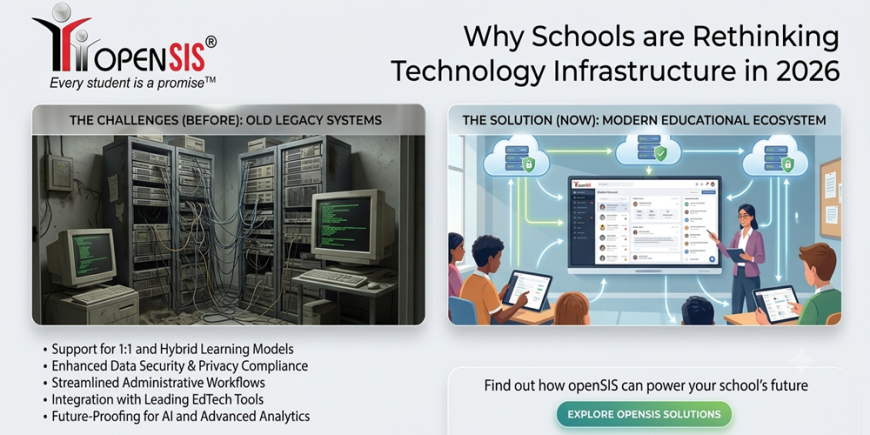
A normal school day does begin with dramatic conflicts. The conflict builds itself with time, in slow and progressive motion. The story usually opens with school buses rolling in, teachers logging attendance marks, administrators working on reports, and the IT department trying their best to get one of the software systems started. Usually, these are times when the entire school operation comes to a sudden halt. Because if one system stops working, the others automatically delay report generation. The constant work interruptions due to fragmentation have forced schools to rethink their technical infrastructure. Now, they are considering unified school analytics software systems that not only collect data, but also analyze it for detailed report generation.
The modern K-12 leaders are not looking for a plethora of apps anymore. The question is not – which system comes with a longer list of features anymore. The question is – which system can make everything work together. The modern looks for simplification of administrative processes and data management. And the new-age academic reporting software systems like openSIS are doing just that. Instead of adding more complex features, these systems offer one simple dashboard that houses everything you need to run your school operation with ease.
The Myth of More Software
More software systems don’t mean you have a better operation running behind the scenes. And schools are realizing this over time. If you think that schools are turning less digital, you are mistaken. In this era, technology runs the industry and academic industry is not immune to this. However, modern schools are becoming more strategic about the expenditure. They look for smart systems rather than more systems.
The realization that smooth operations need a single platform, has engineered the rise of centralization. If you don’t find everything at one place, eventually you will suffer from indecision and strategic paralysis. During the time, when you face the parents or media, you need all the pieces at your fingertips. One button tap should be able to present the required information before you.
The myth of more software systems means better operations is slowly waning because schools are waking up to the limitations fragmentation brings with itself.
Data Is Your Asset
In modern academic world, data is one of the pillars for any school. If you want to grow, and offer an excellent learning experience to your students, you will have to use data. However, data in itself will not be of any use for you. It will be like locking your magic wand in a cabinet and expecting your world to feel magical.
Data reveals a lot more than just attendance and grades. It shows progress and patterns that can become handy for the school counselors. They can log in to the school academic reporting software system and access data analytics reports on each student to understand their current situation and predict whether they are heading for success or a low period. Without these reports, counseling might not be as effective as it should be.
And the truth is, you cannot predict anything just by looking at a single report. For accurate pattern reading and prediction, you need to look at
-
Attendance
-
Grades
-
Communication
-
Homework
-
Health
-
Engagement
-
Participation
All of these assemble together to create a complete picture. Now, consider this – you have 50,000 students. And you will have to generate all of their data reports for the counselors. If you have to check all the aspects of a student’s academic journey manually, you will naturally lag in report submission. It will not only be a challenging situation, but it will expose you to the risk of making errors as well. Digitization makes data analysis effortless and removes human error from the process.
This is one of the reasons why schools are turning toward school analytics software systems for data collection and management.
Reporting Is Not A Puzzle To Solve
Every administrator shriek at the thought of reporting season, and rightfully so. Reporting requires more than just typing words on paper and taking printouts. Report generating means –
-
Looking at every aspect of school operation
-
Analyzing each piece of information
-
Verifying everything
You cannot make any mistake when you generate reports. One error can stall the whole administrative operation. Modern school analytics software systems eliminate human errors. These tools give you an accurate view of your data. It makes time for educators to focus on other tasks, rather than toiling over data verification. AI-powered school software systems pull data from different departments and take an analytical look before generating any report.
School Information System Has Evolved
If you think that the school information systems (SIS) are only data collection tools, you are probably thinking about the outdated SIS platforms. The modern school analytics software systems come with a multitude of features to simplify your operations. AI-powered insight is one of the features that will sharpen your eye for data processing. In addition, you will find real-time visibility and the flexible reporting system to be perfectly aligned with your operational needs. However, it is essential to understand that features are for task simplification and not adding to technical complications. Therefore, choose carefully.
FAQ
1. What is a Student Information System (SIS)?
A Student Information System (SIS) is a centralized platform that manages student data, attendance, grades, enrollment, and administrative processes.
2. Why are K-12 schools modernizing their technology infrastructure?
Schools are upgrading to improve efficiency, strengthen cybersecurity, and better support teaching and learning.
3. How does school analytics software benefit educators?
School analytics software provides real-time insights that help educators make faster, data-driven decisions.
4. What is academic reporting software used for?
Academic reporting software automates report generation, reducing manual work and improving data accuracy.
5. How does an SIS improve communication?
An SIS connects administrators, teachers, parents, and students through a single source of reliable information.
6. Why is system integration important in schools?
Integrated systems eliminate data silos, reduce duplicate work, and create a smoother user experience.
7. How does modern school technology improve data security?
Centralized platforms offer stronger access controls, encryption, and regular security updates to protect sensitive information.