AI is not one single thing. It comes in different shapes. Some tools do many jobs. Others do one job really well.
This split has a name. People call it vertical AI and horizontal AI. Knowing the difference can save your business real money.
Picking the wrong type wastes time and budget. Picking the right type solves your problem fast. This guide breaks it down in plain words.
What Is Horizontal AI?
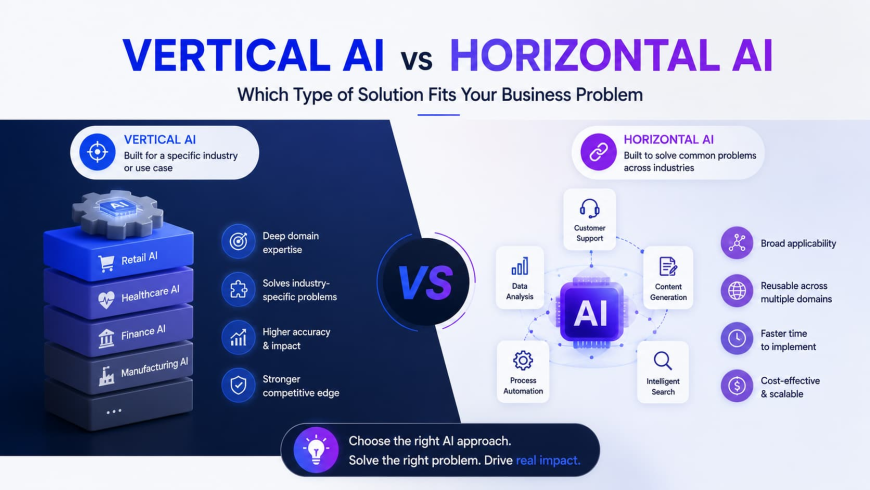
Horizontal AI works across many industries. It handles broad tasks like writing, chat, and search. Think of it as a general helper.
ChatGPT is a classic example. It can write an email, plan a trip, or explain math. It was not built for one single job.
Horizontal tools are flexible. You can point them at almost any task. But they lack deep knowledge of your specific field.
A hospital and a bakery could both use the same horizontal tool. It would help both, but not deeply understand either one.
What Is Vertical AI?
Vertical AI is built for one industry. It learns the rules, data, and language of that field. It goes deep, not wide.
A tool built only for reading medical scans is vertical AI. A tool built only for detecting bank fraud is vertical AI too.
These tools know industry jargon already. They understand compliance rules. They fit into existing workflows without much extra training.
Vertical AI trades flexibility for depth. It cannot switch tasks easily. But within its lane, it performs with real precision.
Quick Comparison Table
Factor
Horizontal AI
Vertical AI
Scope
Many industries
One industry
Setup time
Faster to start
Needs more setup
Accuracy in niche tasks
Moderate
High
Flexibility
Very high
Low
Cost to build
Lower upfront
Higher upfront
Best for
General tasks
Specialized problems
Why This Choice Actually Matters?
Your business problem decides the right fit. This is not about which AI is "better" overall. Better depends on your use case.
A small store answering FAQs needs less precision. A horizontal tool handles that fine. No need for deep customization here.
A hospital reading X-rays needs high accuracy. Mistakes here can hurt patients. This calls for vertical AI, not a general chatbot.
Vertical AI often shows strong returns because it fits industry workflows instantly. One industry report notes it targets specific sector needs like healthcare and finance directly.
Real Business Signals to Watch
Ask yourself these questions before choosing:
Does my task involve strict rules or regulations?
Do I need one tool for many departments?
Is speed to launch more important than deep accuracy?
Does my industry have unique language or data?
If you answered yes to regulation and unique language, lean vertical. If speed and range matter more, lean horizontal.
Cost Is Not Always What You Expect
People assume vertical AI always costs more. That is only partly true. Horizontal tools may need heavy customization later.
You might buy a horizontal tool cheap today. Then spend months tuning it for your industry. That adds hidden cost.
Vertical AI costs more upfront. But it needs less tuning. It already speaks your industry's language from day one.
When Businesses Pick Horizontal AI?
Startups often start here. They need one tool for content, support, and internal notes. Budget is tight in early stages.
Marketing teams also lean horizontal. They write posts, emails, and ad copy across many topics. Flexibility beats deep specialization here.
Customer support desks use horizontal tools too. Questions vary widely. A general assistant handles this variety better.
When Businesses Pick Vertical AI?
Banks use vertical AI for fraud checks. The stakes are high. Errors cost real money and trust.
Law firms use vertical tools for contract review. Legal language is tricky. A general model often misses key clauses.
Manufacturers use vertical AI for defect detection. This needs training on factory-specific images. A generic tool cannot do this well.
Many companies now explore custom AI development services to build tools that match their exact workflow, instead of forcing a generic model to fit.
The Hybrid Path Many Companies Choose
Some businesses do not pick just one. They mix both types together. This is common in mid-size and large companies.
They use a horizontal tool for general chat and writing. Then they add a vertical tool for one critical task, like fraud detection.
This hybrid setup balances cost and precision. You save money on general tasks. You spend where accuracy truly matters.
A comparison guide on AI agents notes that adaptability often decides long-term success more than raw specialization alone.
Building the Right Tool for Your Business
Sometimes, no ready-made tool fits well. Off-the-shelf horizontal tools feel too generic. Off-the-shelf vertical tools feel built for someone else.