Turning Orlando Trade Show Traffic Into Better Business Conversations
 castleexhibits
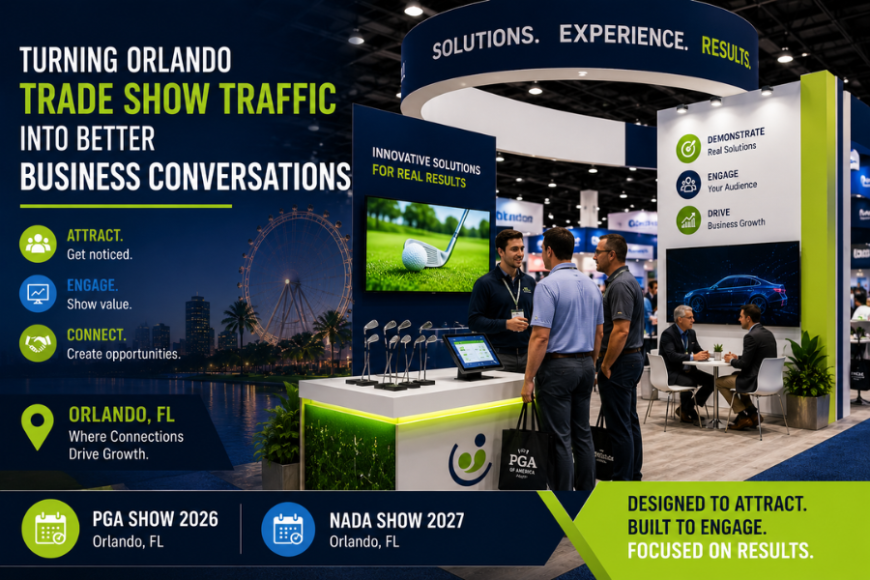
A busy trade show floor can create thousands of visitor opportunities, but traffic alone doesn't guarantee meaningful business results. Exhibitors need a booth that helps the right people stop, understand the offering, and move naturally into a conversation.
This is particularly important for companies preparing for major Orlando events such as PGA Show and NADA Show. While the industries are different, both attract professional audiences who are often looking for new products, technologies, services, and business opportunities.
For exhibitors, the challenge is not simply getting attention. It is creating an environment where attention can turn into engagement.
A Trade Show Booth Builder in Orlando can help companies design that experience around visitor behavior, product presentation, staff interaction, and lead generation.
Design for the Visitor, Not Just the Brand
Many exhibitors begin booth planning by asking how they want their brand to look.
Branding is important, but visitor behavior should come first.
Ask yourself:
- What will visitors notice first?
- What will make them stop?
- What should they understand within a few seconds?
- Where should they interact with the product?
- Where should serious conversations take place?
Answering these questions can create a more useful booth layout.
Instead of filling every available surface with graphics and products, create a clear journey from the aisle to the conversation area.
PGA Show: Create a Reason to Explore
The PGA Show brings together professionals from across the golf industry, creating an environment where product discovery and networking are central to the visitor experience.
Companies preparing a trade show booth builder for PGA Show 2026 strategy should consider how their exhibit can encourage visitors to explore rather than simply walk past.
Product demonstrations can be particularly effective.
If a company offers golf technology, equipment, training solutions, accessories, or digital services, the booth can allow visitors to experience the product rather than only view it.
For example, a product demonstration might show how a technology works in a real-world situation. A digital display could allow visitors to compare features. A hands-on area could encourage visitors to test or interact with a product.
The objective is simple:
Make the product easier to understand by making the visitor part of the experience.
NADA Show: Make Complex Solutions Easier to Understand
Automotive businesses often have products and services that require explanation.
Technology platforms, dealership solutions, equipment, software, financing tools, and operational services may involve multiple features.
A trade show booth builder for NADA Show 2027 can help organize these solutions into clear areas so visitors aren't overwhelmed by information.
Instead of displaying every feature at once, focus on the problems your solution solves.
For example:
Problem → Solution → Demonstration → Business Benefit
This structure allows visitors to quickly understand why the product matters.
It also gives booth staff a natural starting point for conversation.
Build Around Three Types of Visitors
Not every visitor has the same intention.
A good booth should accommodate at least three groups.
The Quick Visitor
They may only have a few minutes.
Your main message should be visible immediately, with an easy way to access additional information.
The Interested Visitor
They want to understand your product.
Give them demonstrations, product displays, videos, or interactive content that lets them explore.
The Qualified Prospect
They are interested in a serious business discussion.
Provide a comfortable meeting area where staff can discuss requirements without competing with the noise and movement of the main aisle.
Designing for these different visitor types makes the booth more effective throughout the event.
Use Product Demonstrations Strategically
A demonstration doesn't have to be complicated.
The most effective demonstrations usually focus on one important benefit.
Instead of explaining ten features, demonstrate the feature that solves the biggest customer problem.
For example, a technology company might show how its platform saves time.
A manufacturer might demonstrate a product's performance.
A service provider might show a before-and-after process.
The visitor should leave the demonstration understanding something useful.
That creates a stronger impression than a booth filled with specifications.
Don't Let Graphics Do All the Work
Graphics are essential for communicating your brand, but too much text can make a booth difficult to understand.
Use graphics to create a hierarchy.
Your main wall might communicate one strong message.
Secondary graphics can explain benefits.
Product displays can provide additional detail.
Digital screens can deliver deeper information for visitors who want it.
This approach allows the booth to communicate at different levels without overwhelming people walking through the aisle.
Create a Comfortable Conversation Area
Once a visitor becomes interested, the next step is conversation.
This is where booth layout becomes especially important.
A meeting area should feel connected to the main booth but separate enough to support discussion.
Depending on available space, consider:
- Small consultation tables
- Semi-private seating
- Product discussion counters
- Meeting rooms
- Charging areas
- Storage-integrated furniture
The objective isn't to create an elaborate lounge.
It is to provide a practical space where sales representatives can understand a prospect's needs.
Train Staff Around the Booth Experience
Even a well-designed booth can underperform if staff members don't know how to use it.
Before the event, identify what each booth element is supposed to accomplish.
Staff should know:
- Which product to demonstrate
- Which questions to ask
- How to identify qualified visitors
- Where meetings should take place
- How leads should be recorded
- What information should be sent after the show
Rather than approaching every visitor with the same sales pitch, staff can respond to visitor behavior.
Someone looking at a product demonstration may need a different opening question than someone reviewing a brochure.
The booth should make those conversations easier.
Give Visitors Something Worth Taking Away
A successful trade show interaction doesn't always end at the booth.
Visitors may want product information, specifications, pricing, case studies, videos, or follow-up materials after leaving.
QR codes and digital resources can make this easier.
Instead of handing everyone a large collection of printed materials, provide access to information based on their interests.
For example:
Product demonstration → QR code → Product information → Follow-up
This keeps the interaction useful while giving your team another opportunity to continue the relationship.
Make Lead Capture Part of the Experience
Lead collection should not feel like an interruption.
When a visitor has demonstrated genuine interest, staff can ask a few relevant questions.
Useful information may include:
- Company
- Role
- Product interest
- Current challenge
- Buying timeframe
- Follow-up preference
This information allows sales teams to prioritize leads after the event.
A booth that attracts hundreds of visitors but produces little usable information may not deliver the same value as a smaller booth generating highly qualified conversations.
Consider Flexibility for Multiple Events
Companies exhibiting at several events throughout the year may not want to create a completely different exhibit from scratch each time.
A Custom Booth Builder can help create a flexible exhibit system that adapts to different booth spaces and audiences.
Graphics, product displays, furniture, lighting, meeting areas, and interactive elements can be planned around a modular strategy where appropriate.
This can be useful for companies participating in both industry-specific and broader business events.
The objective is to maintain brand consistency while adapting the visitor experience to each audience.
Think About the Entire Exhibition Process
Booth design is only one part of trade show preparation.
A successful exhibit also depends on:
- Floor-plan planning
- Graphics production
- Lighting
- Electrical requirements
- Product transportation
- Technology setup
- Furniture
- Storage
- Installation
- Dismantling
- On-site coordination
- Lead management
Planning these details early can reduce last-minute problems.
For Orlando exhibitors, working with a Trade Show Booth Builder in Orlando can bring many of these elements together under one coordinated exhibition plan.
Final Thoughts
PGA Show and NADA Show serve different industries, but they highlight the same exhibition challenge: visitors need a reason to stop and engage.
A strong booth doesn't simply display products.
It creates a path from attention to discovery, discovery to interaction, and interaction to conversation.
For PGA Show, hands-on experiences and product demonstrations can make the booth more engaging. For NADA Show, clear explanations and technology demonstrations can help simplify complex solutions.
The strongest strategy is to build the exhibit around what visitors need rather than simply what the company wants to display.
With the right planning, an Orlando booth can become more than a branded space on the show floor. It can become a practical environment for demonstrating products, starting conversations, qualifying prospects, and creating relationships that continue long after the event ends.