Why Risk Registers Fail When Business Conditions Change
Learn why risk registers become outdated as businesses change and how continuous risk reviews can improve decisions, controls, and resilience.
 AssurePlusGRC
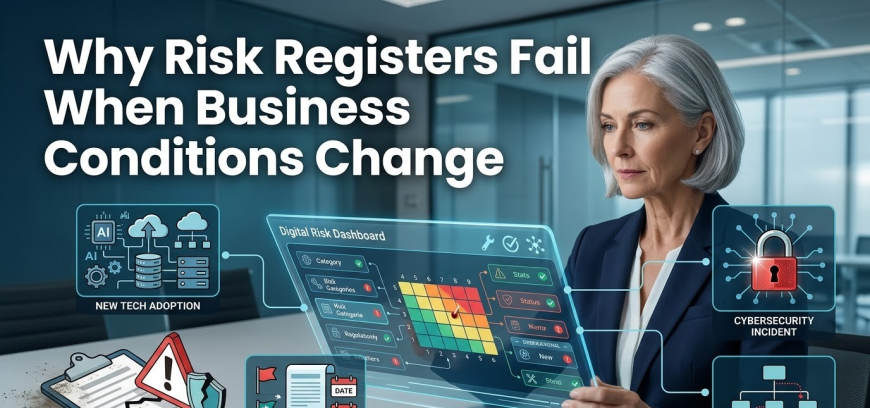
Risk registers are supposed to give decision-makers a clear view of uncertainty. Yet even a carefully prepared risk management process can become less useful when the organization around it changes.
A company may have completed a detailed risk assessment earlier this year, but since then it may have introduced new software, changed suppliers, expanded into another market, experienced an incident, or faced new regulatory expectations. The register may still look complete, while some of the assumptions behind it are no longer accurate.
That is why effective risk management needs to account for change rather than treating the risk register as a document that is reviewed only on a fixed schedule.
What Causes a Risk Register to Become Outdated?
A risk assessment reflects the organization's circumstances at the time it was performed.
Consider a business that introduces a new cloud-based system. The change might improve productivity, but it can also create new dependencies involving data access, third-party providers, system availability, and employee permissions.
The same principle applies to operational changes. A new supplier can create concentration risk. A restructuring can alter accountability. A new product can introduce unfamiliar regulatory or customer risks.
These changes do not necessarily mean that an organization needs to rebuild its entire risk register. They do mean that the affected risks deserve another look.
ISO 31000:2018 describes risk management as a process that includes identifying, analysing, evaluating, treating, monitoring, and communicating risk. ISO confirms that the 2018 edition remains current, although a third edition is now under development.
The monitoring element is particularly relevant. Risk information needs to evolve when the circumstances surrounding it change.
Should an Incident Trigger a New Risk Assessment?
An incident can be one of the strongest reasons to revisit an existing risk.
Imagine an organization has assessed a particular control as adequate. A few months later, an incident demonstrates that the control did not operate as expected.
The event raises several questions. Was the control poorly designed? Was it not followed? Did the underlying process change? Or was the original risk assessment based on assumptions that were too optimistic?
Simply closing the incident does not answer those questions.
A structured approach to managing incidents and corrective actions can help organizations capture events, investigate what happened, track responses, and preserve evidence for later review.
This becomes particularly valuable when incidents are analyzed for patterns. Several seemingly minor events may point toward a larger operational risk that was not obvious from the original assessment.
How Can Businesses Review Risk Without Creating More Administrative Work?
Continuous risk management does not mean reviewing every risk every time something changes.
A better approach is to establish meaningful review triggers.
A major technology implementation might trigger a technology and data risk review. A significant supplier change might prompt a third-party risk assessment. A serious incident might require an examination of the controls associated with it.
Organizations can also use risk assessment techniques appropriate to the situation. IEC 31010:2019 provides guidance on selecting and applying risk assessment techniques across different situations and explains that these techniques support decisions where uncertainty exists.
The goal is to direct attention where new information could materially change the organization's understanding of risk.
Can Technology Help Keep Risk Information Connected?
Risk management becomes harder when relevant information is scattered across spreadsheets, emails, shared drives, and separate departmental systems.
A connected GRC environment can help organizations relate risks to controls, incidents, compliance obligations, actions, and supporting evidence.
AssurePlus, for example, provides a centralized environment for connecting governance, risk, and compliance activities, with capabilities covering areas such as incidents, audits, assessments, and third-party risk.
The value of this approach is not simply having another software platform. It is having a clearer relationship between information that decision-makers already need.
When an incident affects a control, the relevant risk can be reviewed. When a control changes, the associated risk can be reconsidered. When new evidence appears, previous assumptions can be challenged.
That makes the risk register more useful as a management tool rather than a static record.
What Does More Responsive Risk Management Look Like?
A strong risk process combines scheduled reviews with event-driven reassessment.
Leadership should know which risks are most important, risk owners should understand when reassessment is necessary, and incidents should be capable of feeding new information back into risk decisions.
This is particularly relevant as organizations deal with faster technology changes, more complex supply chains, and emerging risks. ISO/TS 31050:2023 specifically provides guidance on managing emerging risks to enhance organizational resilience.
The purpose is not to predict every possible problem. It is to make sure the organization can recognize when its existing understanding of risk no longer reflects reality.
A risk register should therefore be treated as a living management resource. Its usefulness depends less on how often it is updated and more on whether meaningful changes are recognized and reflected in the organization's decisions.