The Procurement Perspective: Selecting Consistent Organic Peppermint Leaf Powder
 greenjeeva
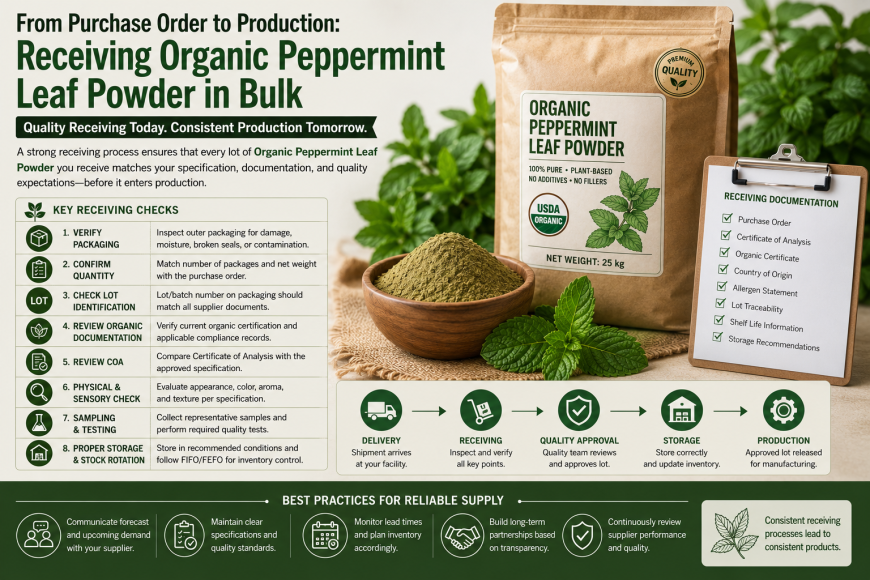
One of the more common problems in botanical procurement appears after the supplier has already passed the initial evaluation. A sample of Organic Peppermint Leaf Powder may show the right color, aroma, and particle size, yet a subsequent lot can behave differently during blending, filling, or storage. The difference is often not a failure of the ingredient itself. It comes from agricultural variation and the processing controls applied between harvest and final packaging.
For sourcing teams, this makes bulk purchasing less about finding a compliant powder and more about understanding which variables need to remain controlled over time.
Trace the Material Back to the Leaf
Organic peppermint leaf powder is produced by drying and milling peppermint leaves, commonly from Mentha × piperita. Commercial material can originate from different agricultural regions, and growing conditions can influence the resulting leaf.
Climate, soil, cultivar, harvest timing, drying conditions, and post-harvest handling can all contribute to variation in color, aroma, moisture, and naturally occurring plant constituents.
In most sourcing projects, asking only for the country of origin is not enough. Buyers should establish the botanical identity, cultivation region where available, harvest period, drying method, processing location, and storage conditions.
Organic certification should be reviewed alongside traceability records. The certification needs to apply to the relevant ingredient and supply chain, while lot documentation should allow the buyer to connect the finished powder with its stated source.
Processing Determines More Than Particle Size
Peppermint leaves contain volatile oils such as menthol and menthone, along with polyphenols, chlorophyll, fiber, and other naturally occurring compounds. Processing and storage can influence the final sensory and physical profile.
Drying is particularly important. If temperature or exposure time is poorly controlled, the resulting powder may show differences in aroma and color. On the other hand, inadequate drying can leave excessive moisture, creating storage and handling concerns.
Milling introduces another variable. Particle-size distribution affects flow, bulk density, blending, and filling. A powder that performs smoothly in a small laboratory blend may behave differently when introduced into industrial mixing equipment.
For this reason, formulation teams should consider moisture, water activity, particle size, bulk density, and flowability alongside identity and compositional testing.
Let the End Application Drive the Specification
Manufacturers use Organic Peppermint Leaf Powder across food, beverage, nutraceutical, and botanical product categories.
Food applications may include herbal blends, dry mixes, confectionery products, seasonings, and other formulations requiring powdered leaf material. Nutraceutical manufacturers may incorporate it into capsules, tablets, sachets, and botanical blends. Functional beverage manufacturers may use it in powdered drink systems where its aroma, dispersion, and particle characteristics fit the production process.
One important sourcing decision is whether the formulation requires leaf powder or peppermint extract. Whole-leaf powder represents the dried botanical material, while an extract is generally used when the formulation requires a more concentrated or controlled constituent profile.
These products should not be evaluated as direct substitutes simply because they originate from the same plant.
Bulk Procurement Requires More Than a COA
When purchasing Organic Peppermint Leaf Powder Bulk, buyers should review a quality package that may include the COA, organic certificate, botanical identity testing, microbiological results, pesticide-residue analysis, heavy-metal testing where applicable, allergen documentation, country-of-origin information, and relevant food-safety certifications.
But one practical sourcing lesson is that paperwork does not capture every characteristic that matters on the production floor.
Before approving a large recurring supply, compare samples from several lots. Check aroma, color, moisture, particle size, bulk density, flowability, and dispersion. For beverage or dry-blend applications, testing the powder within the actual formulation can reveal compatibility issues that are difficult to identify from the raw ingredient alone.
Packaging is another consideration. Peppermint's aromatic profile can be affected by unsuitable storage or prolonged exposure to environmental conditions. Moisture can also contribute to caking and reduced flow. Appropriate barrier packaging, storage temperature, humidity control, and defined shelf-life conditions should therefore be included in the procurement assessment.
Control the Variables That Matter
A useful specification for Organic Peppermint Leaf Powder Bulk should focus on measurable characteristics that influence manufacturing. Depending on the application, this may include moisture, particle-size range, bulk density, microbiological limits, and relevant compositional parameters.
Retaining a reference sample from an approved production lot can provide a practical benchmark for future shipments. It is also worth establishing how suppliers communicate changes in cultivation region, harvest season, drying process, milling equipment, or manufacturing location.
Such changes do not necessarily make a material unacceptable, but they can affect its performance.
In the end, dependable peppermint powder sourcing comes from understanding the entire chain behind the ingredient. Procurement teams that evaluate agricultural origin, processing, physical behavior, documentation, packaging, and lot consistency are better positioned to prevent small raw-material differences from becoming larger formulation or production problems.