When Testicular Changes Should Prompt a Fertility Check
Testicular changes can silently affect sperm health. Learn when to act and how the fertility centre in Madurai evaluates male fertility thoroughly.
 suryakumar
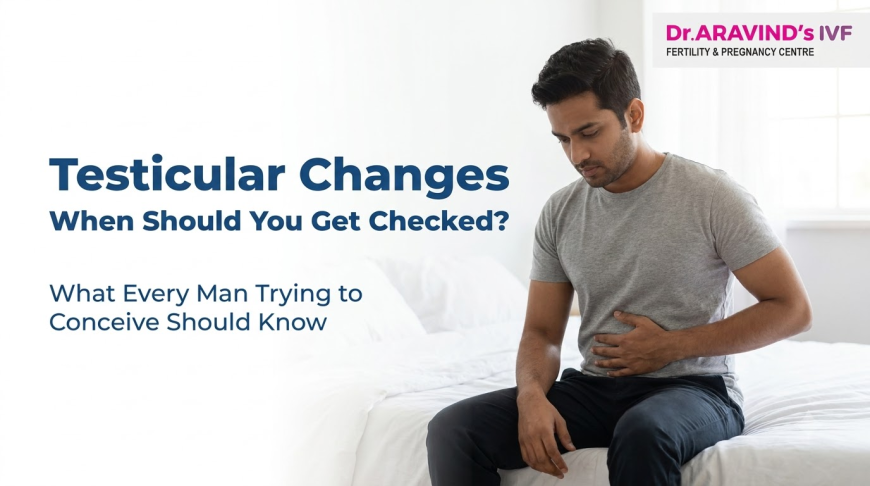
Most men notice changes in their body and wait to see if they resolve on their own.
Sometimes that is the right call. But when the change involves the testicles — the organs responsible for producing both testosterone and sperm — waiting without investigation carries a fertility risk that quietly accumulates over time.
Testicular changes are not always dramatic. They are often subtle. A slight heaviness. A small lump that was not there before. A dull ache that comes and goes. Easy to dismiss. Harder to ignore once a couple has been trying to conceive without success and a fertility evaluation finally reveals what was present months earlier.
For men in Madurai, the fertility centre in Madurai at Dr. Aravind's IVF Fertility and Pregnancy Centre takes testicular health seriously as part of every male fertility evaluation — because what happens inside the scrotum has direct and measurable consequences for sperm production, quality, and fertility outcomes.
Change 1: A Feeling of Heaviness or Dragging Discomfort
A persistent feeling of heaviness or a dull dragging sensation in one or both testicles — particularly on the left side — is one of the most consistent early signs of varicocele.
Varicocele is an enlargement of the veins within the scrotum. It affects approximately 15 percent of all men and up to 40 percent of men presenting to fertility clinics with a primary infertility concern. It raises scrotal temperature, impairs sperm production, increases sperm DNA fragmentation, and reduces testosterone — all in ways that accumulate quietly over months and years.
The heaviness or discomfort it produces is often mild enough to be attributed to physical exertion, prolonged sitting, or simply ignored. But when it is persistent and accompanied by difficulty conceiving, it is the first testicular change worth investigating properly.
Change 2: A New Lump or Swelling
A new lump, swelling, or firmness in the testicle that was not previously present deserves prompt medical evaluation — not monitoring at home.
Not every testicular lump is serious. Epididymal cysts are common, benign, and typically require no treatment. Hydroceles — fluid accumulations around the testicle — are equally common and mostly harmless. But testicular lump investigation matters because the list of possible causes includes conditions that do affect fertility — and in a small proportion of cases, conditions that require urgent treatment entirely separate from the fertility question.
A scrotal ultrasound takes minutes and provides the clinical information needed to distinguish between benign findings and those that warrant further investigation. Delaying this because the lump is not causing significant pain is the most common reason men present late with conditions that were detectable much earlier.
Change 3: Testicular Atrophy — One or Both Sides Appearing Smaller
A noticeable reduction in testicular size — compared to a previous baseline or compared to the other side — is a clinically significant finding that directly correlates with impaired sperm production.
Testicular atrophy can result from previous infection — including mumps orchitis in adolescence or adulthood — previous varicocele, hormonal imbalance, or prior trauma. In each case, the reduction in testicular tissue represents a reduction in the Sertoli cells responsible for nurturing sperm development.
Men who notice that one testicle appears smaller than it used to, or significantly smaller than the other, should raise this at a fertility consultation rather than assuming it is normal anatomical variation.
Change 4: Pain or Tenderness That Persists
Acute testicular pain from trauma resolves. Persistent or recurring testicular tenderness that appears without obvious cause suggests an ongoing process — epididymitis, orchitis, or in some cases a structural issue — that deserves clinical evaluation.
Epididymitis is inflammation of the epididymis — the coiled structure behind each testicle that stores and transports maturing sperm. When inflamed, it impairs sperm transport and can cause scarring that blocks sperm passage entirely if left untreated. It is most commonly caused by bacterial infection — including sexually transmitted infections that may have produced minimal symptoms at the time of transmission.
Persistent testicular tenderness in a man who is trying to conceive should never be managed with over-the-counter pain relief and ignored. It is a clinical signal that warrants investigation.
Change 5: Changes in Consistency or Texture
A testicle that feels harder, softer, or differently textured compared to its previous feel or to the other side is worth discussing with a specialist.
Changes in consistency often reflect changes in the internal structure of the testicle — which can follow infection, trauma, or progressive varicocele damage. These changes are not always accompanied by pain or visible swelling. They are detected through careful self-examination or during a clinical physical examination.
Fertility Centre in Madurai — Why Early Detection Changes Outcomes
The fertility impact of testicular changes depends heavily on when they are identified and addressed. Varicocele treated before significant sperm parameter deterioration has occurred produces substantially better outcomes than varicocele treated after years of undetected damage. Epididymal blockage identified early can sometimes be surgically corrected. Identified late, it often cannot.
This is the clinical argument for taking testicular changes seriously early — not because every change is serious, but because the ones that matter most present subtly, resolve nothing on their own, and produce consequences that are measurable in a semen analysis months or years later.
What a Fertility Evaluation After Testicular Changes Should Include
When a man presents to a fertility specialist with any of the changes described above, the evaluation should be structured and comprehensive — not limited to a single investigation.
A scrotal ultrasound identifies varicocele, structural changes, cysts, and any findings that require further investigation. A semen analysis with sperm DNA fragmentation testing gives the functional picture of how the testicular change has affected sperm production. Hormonal profiling covering testosterone, LH, FSH, and prolactin identifies whether the change is producing hormonal consequences alongside sperm parameter effects. And a complete reproductive history — including any past infections, surgeries, or trauma — contextualises the findings.
For a detailed guide to the signs of male infertility and what a complete evaluation should cover, this clinical resource on signs of infertility in men and male infertility treatment in Madurai provides comprehensive and patient-friendly guidance on what to expect from the investigation process.
Expert Guidance at Dr. Aravind's IVF Fertility and Pregnancy Centre
At Dr. Aravind's IVF Fertility and Pregnancy Centre — the fertility centre in Madurai for comprehensive male reproductive health evaluation — testicular changes are assessed as part of a complete fertility workup rather than in isolation.
Scrotal ultrasound, semen analysis, sperm DNA fragmentation testing, and hormonal profiling together give the complete clinical picture before any treatment recommendation is made. Both partners are evaluated from the first consultation. And findings are explained clearly — so couples understand not just what was found, but what it means for their specific fertility situation and what the right next step actually is.
Because a testicular change that is noticed early and investigated promptly is almost always more manageable than one that is discovered months later through an unexplained fertility investigation.
FAQ
Q1. When should a man see a doctor about a testicular change?
Any new lump, swelling, persistent heaviness, tenderness, or change in size or consistency that has been present for more than two weeks without resolving warrants clinical evaluation. In the context of fertility concerns, any of these changes alongside difficulty conceiving should prompt a fertility specialist consultation rather than a general practitioner visit alone.
Q2. Can varicocele cause infertility without any symptoms?
Yes. Varicocele frequently produces no symptoms beyond a mild dragging discomfort — or no symptoms at all. Yet it causes measurable impairment of sperm count, motility, morphology, and DNA integrity that directly affects fertility. A scrotal ultrasound is the only reliable way to identify it.
Q3. Does a testicular lump always mean something serious?
No. Most testicular lumps are benign — epididymal cysts and hydroceles are common and typically harmless. But distinguishing between benign findings and those that require treatment requires a scrotal ultrasound. Self-monitoring without clinical investigation is not an appropriate substitute for a proper evaluation.
Q4. How do testicular changes affect sperm quality?
Testicular changes that affect internal structure, blood flow, or temperature regulation directly impair sperm production and quality. Varicocele raises scrotal temperature and increases sperm DNA fragmentation. Epididymal damage affects sperm transport. Testicular atrophy reduces the number of cells producing sperm. Each has a measurable impact on semen analysis parameters.
Q5. Where can men in Madurai get a testicular health and fertility evaluation?
Dr. Aravind's IVF Fertility and Pregnancy Centre — the fertility centre in Madurai — offers complete male fertility evaluation including scrotal ultrasound, semen analysis with sperm DNA fragmentation testing, and hormonal profiling. Both partners are assessed from the first consultation with findings explained clearly and treatment recommended based on specific clinical results.